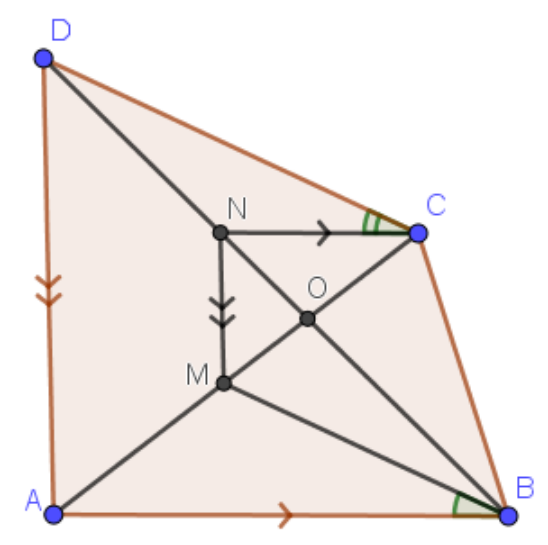
In a convex quadrilateral $ABCD$, the diagonals intersect at $O$, $M$ and $N$ are points on the segments $OA$ and $OD$ respectively. Suppose $MN$ is parallel to $AD$ and $NC$ is parallel to $AB$. Prove that $\angle ABM=\angle NCD$.
What is the maximum number of integers that can be chosen from $1,2,\ldots,99$ so that the chosen integers can be arranged in a circle with the property that the product of every pair of neighbouring integers is a 3-digit integer.
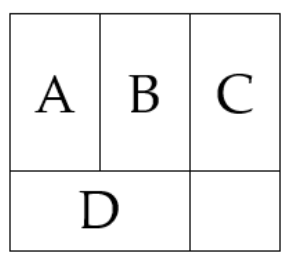
Define a domino to be a $1\times2$ rectangular block. A $2023\times2023$ square grid is filled with non-overlapping dominoes, leaving a single $1\times1$ gap. John then repeatedly slides dominoes into the gap; each domino is moved at most once. What is the maximum number of times that John could have moved a domino?
(Example: In the $3\times3$ grid shown below, John could move $2$ dominoes: $D$, followed by $A$.)
Two distinct 2-digit prime numbers $p,q$ can be written one after the other in 2 different ways to form two 4-digit numbers. For example, 11 and 13 yield 1113 and 1311. If the two 4-digit numbers formed are both divisible by the average value of $p$ and $q$, find all possible pairs $(p,q)$.
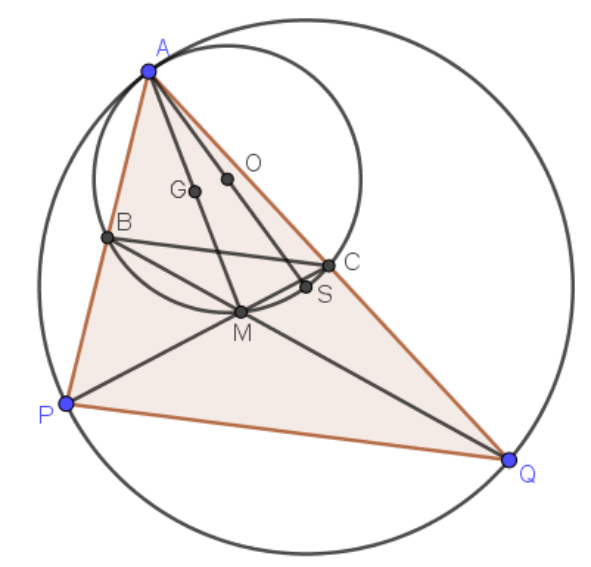
In a scalene triangle $ABC$ with centroid $G$ and circumcircle $\omega$ centred at $O$, the extension of $AG$ meets $\omega$ at $M$, lines $AB$ and $CM$ intersect at $P$, and lines $AC$ and $BM$ intersect at $Q$. Suppose the circumcentre $S$ of the triangle $APQ$ lies on $\omega$ and $A,O,S$ are collinear. Prove that $\angle AGO=90^\circ$.
A grid of cells is tiled with dominoes such that every cell is covered by exactly one domino. A subset $S$ of dominoes is chosen. Is it true that at least one of the following $2$ statements is false?
(1) There are $2022$ more horizontal dominoes than vertical dominoes in $S$.
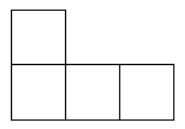
(2) The cells covered by the dominoes in $S$ can be tiled completely and exactly by the tetrominoes shown below (including rotations & reflections):
Let $n\ge2$ be a positive integer. For any integer $a$, let $Q_a(x)$ denote the polynomial $x^n+ax$. Let $p$ be a prime number and $S_a$ be the set
$$S_a=\{b\mid0\le b\le p-1,\ \exists c\in\mathbb Z,\ Q_a(c)\equiv b\pmod p\}.$$
Show that the expression $\dfrac1{p-1}\sum_{a=1}^{p-1}|S_a|$ is an integer.
Determine all real numbers $x$ between $0$ and $180$ such that it is possible to partition an equilateral triangle into finitely many triangles, each of which has an angle of $x^\circ$.
Let $ABCD$ be a square, $E$ be a point on the side $DC$, $F$ and $G$ be the feet of the altitudes from $B$ to $AE$ and from $A$ to $BE$, respectively. Suppose $DF$ and $CG$ intersect at $H$. Prove that $\angle AHB=90^\circ$.
Let $n$ be a positive integer. There are $n$ islands with $n-1$ bridges connecting them such that one can travel from any island to another. One afternoon, a fire breaks out in one of the islands. Every morning, it spreads to all neighbouring islands. (Two islands are neighbours if they are connected by a bridge.) To control the spread, one bridge is destroyed every night until the fire has nowhere to spread the next day. Let $X$ be the minimum possible number of bridges one has to destroy before the fire stops spreading. Find the maximum possible value of $X$ over all possible configurations of bridges and islands where the fire starts at.
Colour a $20000\times20000$ square grid using $2000$ different colours with $1$ colour in each square. Two squares are neighbours if they share a vertex. A path is a sequence of squares so that $2$ successive squares are neighbours. Mark $k$ of the squares. For each unmarked square $x$, there is exactly $1$ marked square $y$ of the same colour so that $x$ and $y$ are connected by a path of squares of the same colour. For any $2$ marked squares of the same colour, any path connecting them must pass through squares of all the colours. Find the maximum value of $k$.
In a certain company, one-third of the employees have a university degree. Half of the employees who have a university degree are men and 40% of the employees who do not have a university degree are women. If 102 of the employees are men, how many of the employees are women?
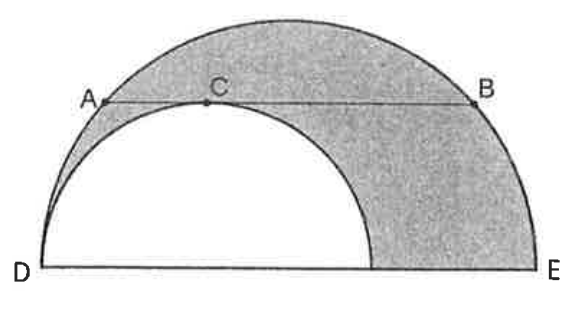
The following diagram shows two semicircles whose diameters lie on the same line. $AB$ is a chord of the larger semicircle that is tangent to the smaller semicircle at the point $C$ and is parallel to the diameter $DE$ of the larger semicircle. If $|AB|=16$ cm, what is the area of the shaded region in $\text{cm}^2$?