Find the largest positive integer $n$ such that for every prime $p$ with $2\lt p\lt n$, the number $n-p$ is prime. (4 points)
Neutral editorial illustration.
Practice scoring adds all whole-question scores (maximum 60). Official ITOT scoring adds only the three highest whole-question scores (maximum 32), after summing subparts within each question. The importer does not enforce best-three scoring. Duration: 300 minutes from historical organizer general rules, not an individually printed duration on this paper.
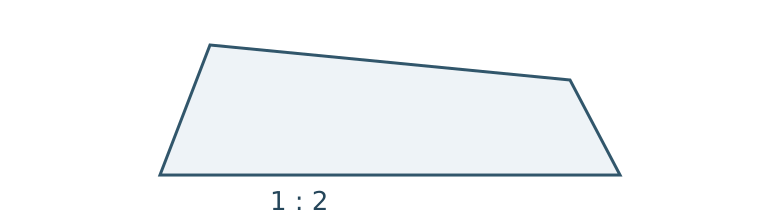
Prove that every convex quadrilateral can contain three non-overlapping copies of itself, each with all lengths reduced by a factor of 2. Copies may share boundary points but not interiors. (7 points)
Some cells of a $100\times100$ board are coloured black. Every row and column that contains black cells contains an odd number of them. The middle black cells of different rows lie in different columns; the middle black cells of different columns lie in different rows. (a) Prove that some cell is simultaneously the middle black cell of its row and of its column. (5 points) (b) Must every middle black cell of a row also be the middle black cell of its column? (5 points)
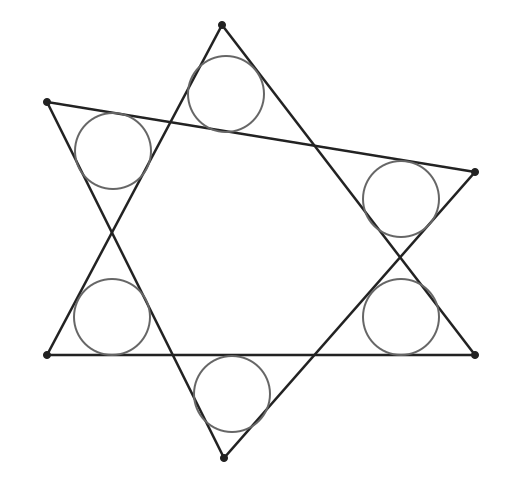
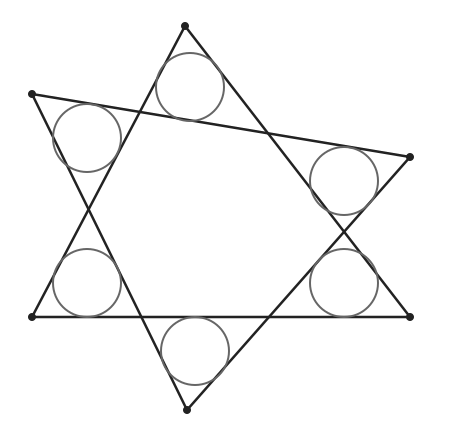
Two triangles overlap as shown, forming a six-pointed star. The incircles of the six outer small triangles all have equal radii. Prove that the incircles of the two original triangles have equal radii. (10 points)
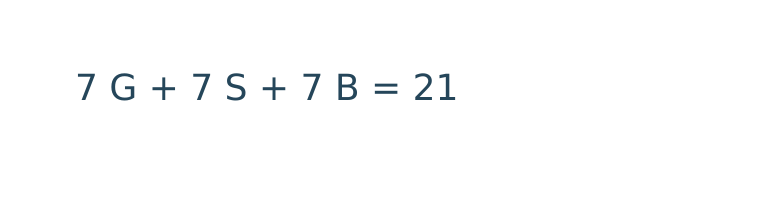
There are 21 medals:7 gold,7 silver and 7 bronze. Exactly one medal is defective. A defective gold medal is lighter than a genuine gold medal; a defective bronze medal is heavier than a genuine bronze medal; a defective silver medal may be lighter or heavier than a genuine silver medal. Genuine medals of the same metal have equal mass. Find the defective medal in three weighings on a balance scale without weights. (10 points)
A convex polygon can be tiled by unit squares and unit equilateral triangles in exactly $p$ different ways, where $p$ is prime. Prove that the polygon has a side of length $p-1$. (12 points)
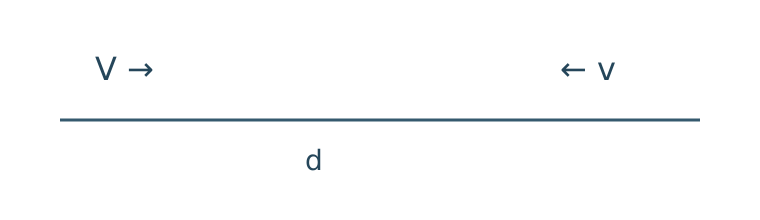
Two people walk towards one another along a straight line at different constant speeds. At the same instant each releases a dog to run forwards. The dogs have the same constant speed. Each dog runs to the other person, then returns to its own owner. Which dog returns first: the faster walker’s dog or the slower walker’s dog? (3 points)
Neutral editorial illustration.
Practice scoring adds all whole-question scores (maximum 23). Official ITOT scoring adds only the three highest whole-question scores (maximum 16), after summing subparts within each question. The importer does not enforce best-three scoring. Duration: 300 minutes from historical organizer general rules, not an individually printed duration on this paper.
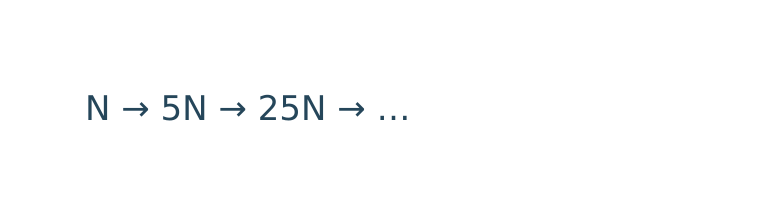
Petya chooses a positive integer and repeatedly multiplies by 5. Is it true that from some point onwards every resulting number contains the digit 5 in its decimal representation? (4 points)
There are 11 indistinguishable-looking coins:7 genuine and 4 counterfeit. All genuine coins have equal mass; all counterfeits have equal smaller mass. Fox gives Pinocchio 4 coins. Can he determine in only two balance-scale weighings whether all four are genuine? (5 points)
In square $ABCD$, point $P$ lies on diagonal $AC$. Let $H$ be the orthocentre of triangle $APD$, and let $M,N$ be the midpoints of $AD,CD$. Prove $PN\perp MH$. (5 points)
Alice and Bob independently tile a $20\times21$ board with $1\times3$ or $3\times1$ trominoes. They then compare their tilings, and Alice pays Bob one dollar for each tromino occupying exactly the same cells in both tilings. What is the largest amount Bob can guarantee? (6 points)
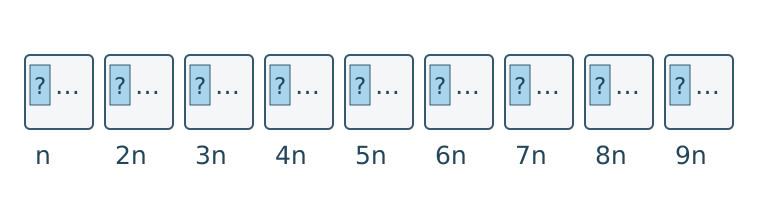
What is the smallest possible number of different leading decimal digits among $n,2n,3n,\ldots,9n$, where $n$ is a positive integer? (5 points)
Neutral editorial illustration.
Practice scoring adds all whole-question scores (maximum 57). Official ITOT scoring adds only the three highest whole-question scores (maximum 28), after summing subparts within each question. The importer does not enforce best-three scoring. Duration: 300 minutes from historical organizer general rules, not an individually printed duration on this paper.
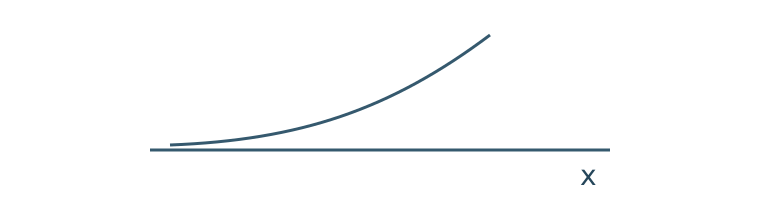
On a blank sheet of paper, perpendicular coordinate axes $x,y$ with equal scales were drawn and the graph $y=f(x)$ was plotted. The marks on the $x$-axis and the entire $y$-axis were then erased. Using only pencil, straightedge and compass, reconstruct the $y$-axis when (a) $f(x)=3^x$; (b) $f(x)=\log_a x$, where the unknown constant satisfies $a>1$. (4+4 points)
Two triangles overlap as shown, forming a six-pointed star. The incircles of the six outer small triangles all have equal radii. Prove that the incircles of the two original triangles have equal radii. (8 points)
A rook traverses an $n\times n$ board, each move to an edge-adjacent cell, visiting each cell exactly once. Bob writes the integers 1 through $n^2$ in the order of the visits. Let $M$ be the largest absolute difference between numbers in any two edge-adjacent cells. What is the smallest possible value of $M$? (8 points)
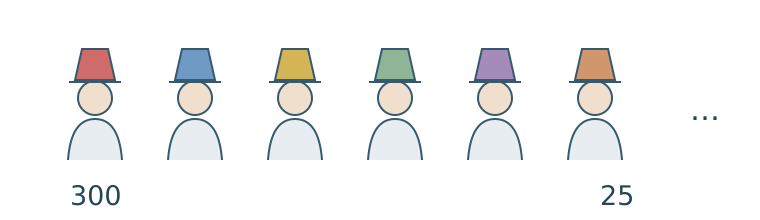
There are 300 sages and 25 possible hat colours. Each sage wears one hat and sees all the other hats but not their own. They know that the numbers of hats of the 25 colours are pairwise different. They must simultaneously guess their own colours. Can they agree in advance on a strategy guaranteeing at least 150 correct guesses? (8 points)
A spacecraft is at distance $a>0$ from an unknown plane separating two half-spaces. The crew knows $a$ but not the plane's direction. The craft may follow any path in space, records its travelled distance, and has a sensor signalling contact with the plane. Can the crew guarantee contact with total travel at most (a) $14a$; (b) $13a$? (6+6 points)
Peter starts with a positive integer and multiplies it by 5, then multiplies the result by 5, and continues for a total of $k$ multiplications. Neither the initial integer nor any result contains the decimal digit 7. Prove that there is a positive integer which can be multiplied successively by 2 a total of $k$ times with no initial or resulting number containing 7. (4 points)
Neutral editorial illustration.
Practice scoring adds all whole-question scores (maximum 24). Official ITOT scoring adds only the three highest whole-question scores (maximum 16), after summing subparts within each question. The importer does not enforce best-three scoring. Duration: 300 minutes from historical organizer general rules, not an individually printed duration on this paper.