(FRA 1) Find all solutions of the following system of $n$ equations in $n$ variables:
$$\begin{aligned}x_1|x_1|-(x_1-a)|x_1-a|&=x_2|x_2|,\\x_2|x_2|-(x_2-a)|x_2-a|&=x_3|x_3|,\\&\cdots\\x_n|x_n|-(x_n-a)|x_n-a|&=x_1|x_1|,\end{aligned}$$
where $a$ is a given number.
(CAN 2) Prove:
(a) There are infinitely many triples of positive integers $m,n,p$ such that $4mn-m-n=p^2-1$.
(b) There are no positive integers $m,n,p$ such that $4mn-m-n=p^2$.
(USS 3) Find all positive integers $n$ such that
$$n=d_6^2+d_7^2-1,$$
where $1=d_1\lt d_2\lt \cdots\lt d_k=n$ are all positive divisors of the number $n$.
(MON 1) IMO5 Let $d$ be the sum of the lengths of all diagonals of a convex polygon of $n$ $(n\gt 3)$ vertices and let $p$ be its perimeter. Prove that
$$\frac{n-3}{2}\lt \frac{d}{p}\lt \frac12\left(\left[\frac n2\right]\left[\frac{n+1}{2}\right]-2\right).$$
(CAN 3) Let $c$ be a positive integer. The sequence $\{f_n\}$ is defined as follows:
$$f_1=1,\quad f_2=c,\quad f_{n+1}=2f_n-f_{n-1}+2\qquad(n\ge2).$$
Show that for each $k\in\mathbb N$ there exists $r\in\mathbb N$ such that $f_kf_{k+1}=f_r$.
(FRG 5)
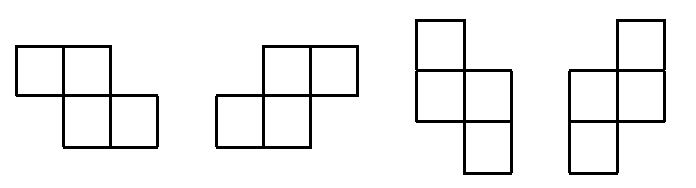
(a) Decide whether the fields of the $8\times8$ chessboard can be numbered by the numbers $1,2,\ldots,64$ in such a way that the sum of the four numbers in each of its parts of one of the forms
is divisible by four.
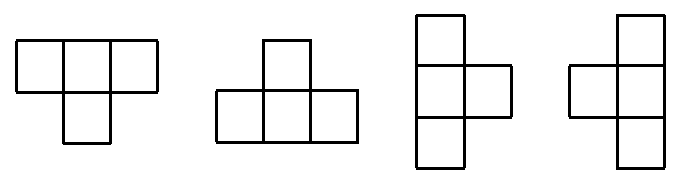
(b) Solve the analogous problem for
(ROM 2) IMO3 In a plane two different points $O$ and $A$ are given. For each point $X\ne O$ of the plane denote by $\alpha(X)$ the angle $AOX$ measured in radians $(0\le\alpha(X)\lt 2\pi)$ and by $C(X)$ the circle with center $O$ and radius $OX+\frac{\alpha(X)}{OX}$. Suppose each point of the plane is colored by one of a finite number of colors. Show that there exists a point $X$ with $\alpha(X)\gt 0$ such that its color appears somewhere on the circle $C(X)$.
(POL 2) Let $a,b,c$ be positive numbers with $\sqrt a+\sqrt b+\sqrt c=\frac{\sqrt3}{2}$. Prove that the system of equations
$$\begin{aligned}\sqrt{y-a}+\sqrt{z-a}&=1,\\\sqrt{z-b}+\sqrt{x-b}&=1,\\\sqrt{x-c}+\sqrt{y-c}&=1,\end{aligned}$$
has exactly one solution $(x,y,z)$ in real numbers.
(CAN 1) Let $n$ be a natural number and $a_1,a_2,\ldots,a_{2n}$ mutually distinct integers. Find all integers $x$ satisfying
$$(x-a_1)\cdot(x-a_2)\cdots(x-a_{2n})=(-1)^n(n!)^2.$$
(ROM 5) IMO4 Let $ABCD$ be a convex quadrilateral for which the circle with diameter $AB$ is tangent to the line $CD$. Show that the circle with diameter $CD$ is tangent to the line $AB$ if and only if the lines $BC$ and $AD$ are parallel.
(LUX 2) Angles of a given triangle $ABC$ are all smaller than $120^\circ$. Equilateral triangles $AFB$, $BDC$ and $CEA$ are constructed in the exterior of $\triangle ABC$.
(a) Prove that the lines $AD$, $BE$, and $CF$ pass through one point $S$.
(b) Prove that $SD+SE+SF=2(SA+SB+SC)$.
(POL 1) IMO6 Let $a,b,c,d$ be odd positive integers such that $a\lt b\lt c\lt d$, $ad=bc$, and $a+d=2^k$, $b+c=2^m$ for some integers $k$ and $m$. Prove that $a=1$.
(FRG 3) In a permutation $(x_1,x_2,\ldots,x_n)$ of the set $1,2,\ldots,n$ we call a pair $(x_i,x_j)$ discordant if $i\lt j$ and $x_i\gt x_j$. Let $d(n,k)$ be the number of such permutations with exactly $k$ discordant pairs. Find $d(n,2)$ and $d(n,3)$.
(USA 5) Inside triangle $ABC$ there are three circles $k_1,k_2,k_3$ each of which is tangent to two sides of the triangle and to its incircle $k$. The radii of $k_1,k_2,k_3$ are $1$, $4$, and $9$. Determine the radius of $k$.
(CAN 5) The triangular array $(a_{n,k})$ of numbers is given by $a_{n,1}=1/n$, for $n=1,2,\ldots$, $a_{n,k+1}=a_{n-1,k}-a_{n,k}$, for $1\le k\le n-1$. Find the harmonic mean of the 1985th row.