We call a positive integer *sunny* if it has four digits and if moreover each of the two digits on the outside is exactly 1 larger than the digit next to it. The numbers $8723$ and $1001$ for example are sunny, but $1234$ and $87245$ are not.
a) How many sunny numbers are there such that twice the number is again a sunny number?
b) Prove that every sunny number greater than $2000$ is divisible by a three-digit number with a $9$ in the middle.
Find all quadruples $(a, b, c, d)$ of non-negative integers such that $ab = 2(1 + cd)$ and there exists a non-degenerate triangle with sides of length $a - c$, $b - d$, and $c + d$.
Determine all positive integers $n \ge 2$ which have a positive divisor $m \mid n$ satisfying
$$n = d^3 + m^3,$$
where $d$ is the smallest divisor of $n$ which is greater than $1$.
Consider an acute triangle $ABC$ with $|AB| \gt |CA| \gt |BC|$. The vertices $D$, $E$, and $F$ are the base points of the altitudes from $A$, $B$, and $C$, respectively. The line through $F$ parallel to $DE$ intersects $BC$ in $M$. The angular bisector of $\angle MFE$ intersects $DE$ in $N$. Prove that $F$ is the circumcentre of $\triangle DMN$ if and only if $B$ is the circumcentre of $\triangle FMN$.
Let $n$ be a positive integer. For a real $x \ge 1$, assume that $\lfloor x^{n+1} \rfloor, \lfloor x^{n+2} \rfloor, \dots, \lfloor x^{4n} \rfloor$ are all squares of positive integers. Prove that $\lfloor x \rfloor$ is also the square of a positive integer.
Here $\lfloor z \rfloor$ is the greatest integer smaller than or equal to $z$.
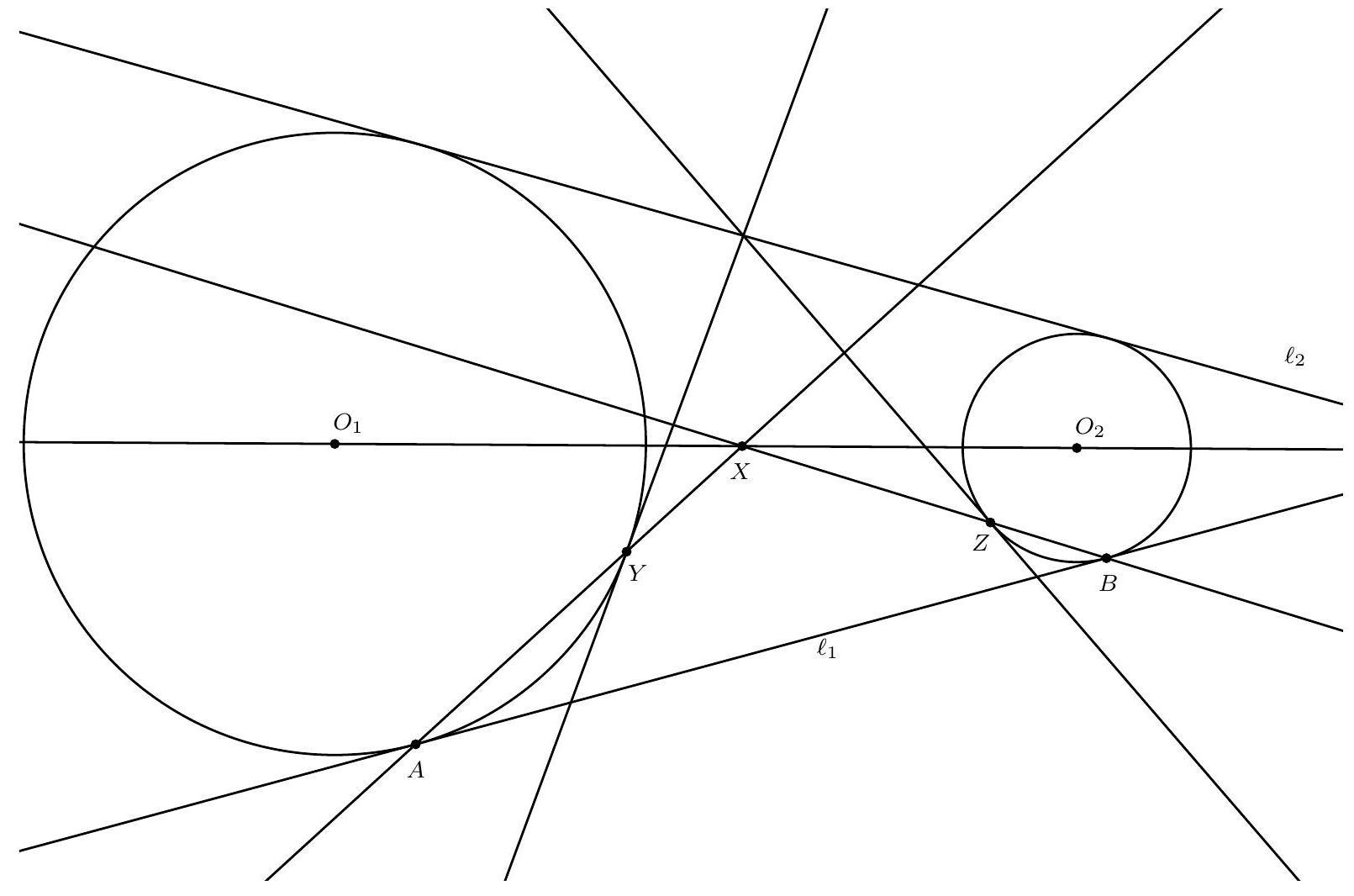
Two circles $\Gamma_1$ and $\Gamma_2$ are given with centres $O_1$ and $O_2$ and common exterior tangents $\ell_1$ and $\ell_2$. The line $\ell_1$ touches $\Gamma_1$ in $A$ and $\Gamma_2$ in $B$. Let $X$ be a point on segment $O_1O_2$, not lying on $\Gamma_1$ or $\Gamma_2$. The segment $AX$ intersects $\Gamma_1$ in $Y \neq A$ and the segment $BX$ intersects $\Gamma_2$ in $Z \neq B$. Prove that the line through $Y$ tangent to $\Gamma_1$ and the line through $Z$ tangent to $\Gamma_2$ intersect each other on $\ell_2$.
For real numbers $x$ and $y$ we define $M(x, y)$ to be the maximum of the three numbers $xy$, $(x-1)(y-1)$, and $x+y-2xy$. Determine the smallest possible value of $M(x, y)$ where $x$ and $y$ range over all real numbers satisfying $0 \le x, y \le 1$.
In a sequence $a_1, a_2, \dots, a_{1000}$ consisting of $1000$ distinct numbers, a pair $(a_i, a_j)$ with $i \lt j$ is called *ascending* if $a_i \lt a_j$ and *descending* if $a_i \gt a_j$. Determine the largest positive integer $k$ with the property that every sequence of $1000$ distinct numbers has at least $k$ non-overlapping ascending pairs or at least $k$ non-overlapping descending pairs.
Determine all positive integers $n \ge 2$ which have a positive divisor $m \mid n$ satisfying
$$n = d^3 + m^3,$$
where $d$ is the smallest divisor of $n$ which is greater than $1$.
Consider an acute triangle $ABC$ with $|AB| \gt |CA| \gt |BC|$. The vertices $D$, $E$, and $F$ are the base points of the altitudes from $A$, $B$, and $C$, respectively. The line through $F$ parallel to $DE$ intersects $BC$ in $M$. The angular bisector of $\angle MFE$ intersects $DE$ in $N$. Prove that $F$ is the circumcentre of $\triangle DMN$ if and only if $B$ is the circumcentre of $\triangle FMN$.
Find all quadruples $(a, b, c, d)$ of non-negative integers such that $ab = 2(1 + cd)$ and there exists a non-degenerate triangle with sides of length $a - c$, $b - d$, and $c + d$.
Find all functions $f: \mathbb{Z}_{\gt 0} \rightarrow \mathbb{Z}_{\gt 0}$ such that $f(n) \mid f(m)-n$ if and only if $n \mid m$, for all natural numbers $m$ and $n$.
Two circles $\Gamma_1$ and $\Gamma_2$ are given with centres $O_1$ and $O_2$ and common exterior tangents $\ell_1$ and $\ell_2$. The line $\ell_1$ touches $\Gamma_1$ in $A$ and $\Gamma_2$ in $B$. Let $X$ be a point on segment $O_1O_2$, not lying on $\Gamma_1$ or $\Gamma_2$. The segment $AX$ intersects $\Gamma_1$ in $Y \neq A$ and the segment $BX$ intersects $\Gamma_2$ in $Z \neq B$. Prove that the line through $Y$ tangent to $\Gamma_1$ and the line through $Z$ tangent to $\Gamma_2$ intersect each other on $\ell_2$.
Let $n\gt 1$ be an integer. There are $n$ boxes in a row, and we have $n+1$ identical stones. A distribution is a way of distributing the stones over the boxes, where each stone is in exactly one box. We say that two such distributions are at a stone's throw from each other if we can obtain one distribution from the other by moving exactly one stone to a different box. The sociability of a distribution $a$ is defined as the number of distributions that are at a stone's throw from $a$. Determine the average sociability over all possible distributions.
(Two distributions are the same if the $i$-th box of both rows contains the same number of stones, for all $i \in \{1,2, \ldots, n\}$.)
Let $n$ be a positive integer. For a real $x \ge 1$, assume that $\lfloor x^{n+1} \rfloor, \lfloor x^{n+2} \rfloor, \dots, \lfloor x^{4n} \rfloor$ are all squares of positive integers. Prove that $\lfloor x \rfloor$ is also the square of a positive integer.
Here $\lfloor z \rfloor$ is the greatest integer smaller than or equal to $z$.
Let $ABC$ be an acute triangle and let $D$ be the foot of the altitude from $A$. The circle with centre $A$ passing through $D$ intersects the circumcircle of triangle $ABC$ in $X$ and $Y$, where the order of the points on this circumcircle is $A, X, B, C, Y$. Prove that $\angle B X D = \angle C Y D$.
On the ceiling of a room hang 15 lamps, numbered from 1 to 15. Initially, all lamps are off. In another room there are 15 switches: a switch for lamps 1 and 2, a switch for lamps 2 and 3, a switch for lamps 3 and 4, and so on, up to a switch for lamps 15 and 1. When the switch for such a pair of lamps is flipped, each of those two lamps changes its state (from on to off or vice versa). The switches hang in a random order and all look identical. Raymond wants to find out which switch belongs to which pair of lamps. From the room with the switches he cannot see the lamps. He can, however, flip a number of switches and then walk to the other room to see which lamps are on. He can do this several times. What is the minimum number of times he must walk to the other room in order to know for certain, for each switch, which pair of lamps it belongs to?
Find all natural numbers $n$ for which there exists an integer $a\gt 2$ such that $a^{d}+2^{d} \mid a^{n}-2^{n}$ for all positive divisors $d \neq n$ of $n$.
For real numbers $x$ and $y$ we define $M(x, y)$ to be the maximum of the three numbers $xy$, $(x-1)(y-1)$, and $x+y-2xy$. Determine the smallest possible value of $M(x, y)$ where $x$ and $y$ range over all real numbers satisfying $0 \le x, y \le 1$.