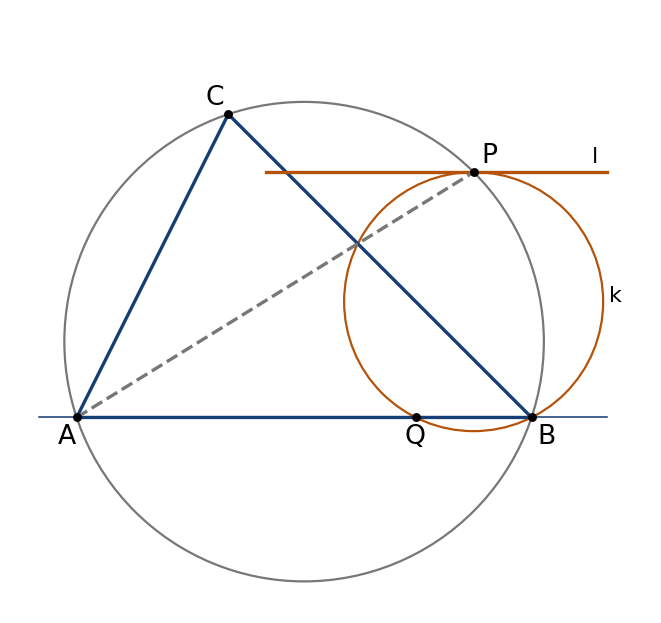
Given a triangle $ABC$, let $P$ lie on the circumcircle of the triangle and be the midpoint of the arc $BC$ which does not contain $A$. Draw a straight line $l$ through $P$ so that $l$ is parallel to $AB$. Denote by $k$ the circle which passes through $B$, and is tangent to $l$ at the point $P$. Let $Q$ be the second point of intersection of $k$ and the line $AB$ (if there is no second point of intersection, choose $Q = B$). Prove that $AQ = AC$.
The *Somanacci* sequence is generated by three initial terms, each a positive integer smaller than $2012$. Each term of the sequence, beginning from the fourth term, is the sum of all preceding numbers. How many distinct Somanacci sequences have $2012$ as one of their terms?
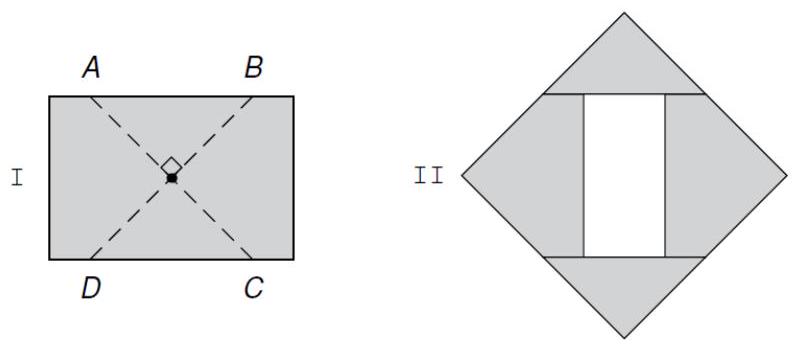
A rectangular sheet $20\,\mathrm{cm}$ by $30\,\mathrm{cm}$ is cut along dashed lines $AC,BD$ into four pieces: two congruent triangles and two congruent five-sided polygons, as in Figure I. Segments $AC,BD$ have equal lengths and meet at the rectangle's center at right angles.
a) What is the length of $AB$?
b) What is the area of a triangular piece? Of a five-sided piece?
c) Rearranging the four pieces forms a square with a rectangular hole, as in Figure II. What is the hole's area?
André, Bianca, Carlos, and Dalva want to draw lots for a book. They put 3 white balls and 1 black ball in a box and agree to draw one ball each, without replacement, in alphabetical order of their names. Whoever draws the black ball wins.
a) What is André's probability of winning?
b) What is Dalva's probability of winning?
To draw lots for another book, André suggests using 2 black balls and 6 white balls. As before, the first person to draw a black ball wins. If the first four balls are white, they keep drawing in the same order.
c) In this new drawing, what is André's probability of winning?
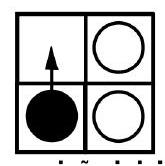
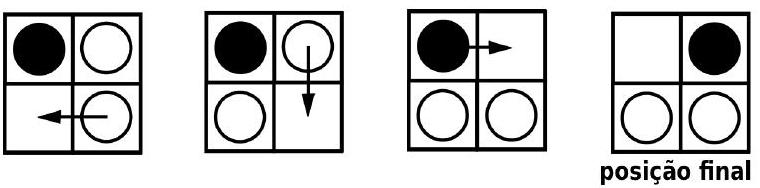
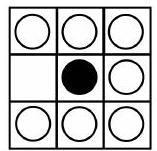
The game Arrasta Um uses a square grid and round pieces, one black and the rest white. Put one piece in each cell except one, which is left empty. A move slides a piece from an adjacent cell into the empty cell. The game ends when the black piece reaches the top right corner. Here is an example finishing a $2\times2$ board in four moves.
Initial position
This sequence is described by $(\uparrow,\leftarrow,\downarrow,\rightarrow)$.
a) Describe how to finish in six moves on the following $3\times3$ board.
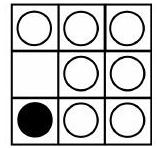
b) Describe how to finish in ten moves on the following $3\times3$ board.
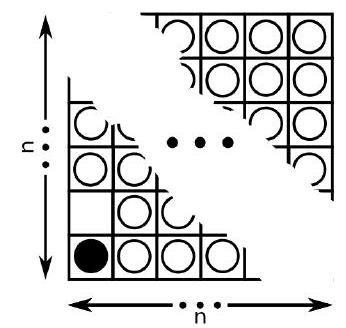
c) Show that on an $n\times n$ board as shown, it is possible to finish in $6n-8$ moves.
Find the smallest positive integer $n$, such that there exist $n$ integers $x_{1}, x_{2}, \ldots, x_{n}$ (not necessarily different), with $1 \leq x_{k} \leq n, 1 \leq k \leq n$, and such that
$$
x_{1}+x_{2}+\cdots+x_{n}=\frac{n(n+1)}{2}, \quad \text{ and } \quad x_{1} x_{2} \cdots x_{n}=n!
$$
but $\left\{x_{1}, x_{2}, \ldots, x_{n}\right\} \neq\{1,2, \ldots, n\}$.
A strange calculator has only digit keys $0$ to $9$ and two special keys $A,B$. Pressing $A$ squares the displayed number; pressing $B$ adds $3$. One can obtain $22$ from $1$ by pressing $BABB$:
$$1\xrightarrow B4\xrightarrow A16\xrightarrow B19\xrightarrow B22.$$
a) Starting with $3$, what number appears after pressing $BBAB$?
b) Show how to obtain $55$ from $1$ using $A,B$.
c) Explain why $54$ cannot be obtained from $2$ using $A,B$.
Let $\mathbb{R}^{\star}$ be the set of all real numbers, except $1$. Find all functions $f: \mathbb{R}^{\star} \rightarrow \mathbb{R}$ that satisfy the functional equation
$$
x + f(x) + 2 f\left(\frac{x+2009}{x-1}\right) = 2010
$$
English source version: 30 persons, each of whom is either a Knight or a Liar, sit around the table (the places around the table are numbered $1,2,\ldots,30$ in consecutive order). Knights always tell the truth, while Liars always lie. Each person has exactly one friend among the others. The friend of a Knight is a Liar, and the friend of a Liar is a Knight. Each person was asked “Is it true that your friend is a neighbor of you?” Fifteen persons sitting in odd-numbered places answered “Yes”. Find the number of persons in even-numbered places who also answered “Yes”. (S. Agakhanov)
Russian source version, translated: 30 people, Knights and Liars, sit around a round table (Knights always tell the truth and Liars always lie). Each has exactly one friend at the same table; a Knight's friend is a Liar and vice versa (friendship is always mutual). To the question “Is your friend sitting next to you?”, people in alternate seats answered “Yes”. How many of the others could also have answered “Yes”? List all possibilities and prove there are no others. (S. Agakhanov)
The real numbers $a$, $b$, $c$ are such that $a^{2} + b^{2} = 2c^{2}$, and also such that $a \neq b$, $c \neq -a$, $c \neq -b$. Show that
$$
\frac{(a+b+2c)\left(2a^{2}-b^{2}-c^{2}\right)}{(a-b)(a+c)(b+c)}
$$
is an integer.
Call a number square-paired when adding it to the number obtained by reversing its digits gives a perfect square. For example, $164$ and $461$ are square-paired, since $164+461=625=25^2$. How many square-paired numbers are there between $10$ and $100$?
Juliana wants to assign a nonzero numerical value to each of the 26 letters $A,B,C,D,\ldots,W,X,Y,Z$, so that $A\times C=B$, $B\times D=C$, $C\times E=D$, and so on, up to $X\times Z=Y$.
a) If she assigns $A=5$ and $B=7$, what are $C,D,E$?
b) Show that $G=A$, whatever values she assigns to $A,B$.
c) If she assigns values with $A\times B=2010$, what is the product $A\times B\times C\times D\times\cdots\times W\times X\times Y\times Z$?
When
$$
\left(x^{2}+2 x+2\right)^{2009}+\left(x^{2}-3 x-3\right)^{2009}
$$
is expanded, what is the sum of the coefficients of the terms with odd exponents of $x$?
Determine if there exist positive integers $n, a_1, a_2, \dots, a_{2012}$ all greater than 1, such that
$$
n^2 = a_1^2 + a_2^3 + a_3^5 + \dots + a_i^{p_i} + \dots + a_{2012}^{p_{2012}},
$$
where $p_i$ is the $i$-th prime.
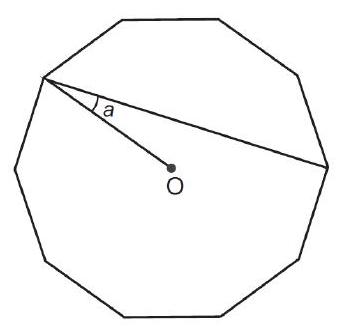
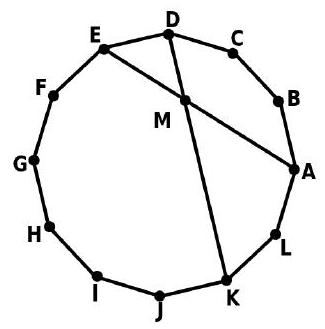
Polygon $ABCDEFGHIJKL$ is regular with twelve sides.
a) Find its interior angles.
b) Point $M$ is the intersection of $AE$ and $DK$. Find $\angle MDE$ and $\angle DME$.
c) Find $\angle CBM$.
d) Prove that $B,M,F$ are collinear.