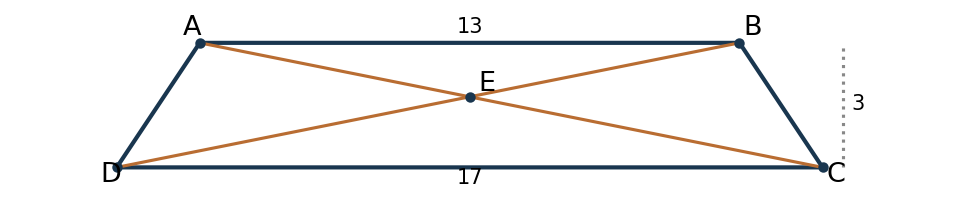
An isosceles trapezoid $ABCD$ with bases $AB$ and $CD$ has $AB = 13$, $CD = 17$, and height $3$. Let $E$ be the intersection of $AC$ and $BD$. Circles $\Omega$ and $\omega$ are circumscribed about triangles $ABE$ and $CDE$. Compute the sum of the radii of $\Omega$ and $\omega$.
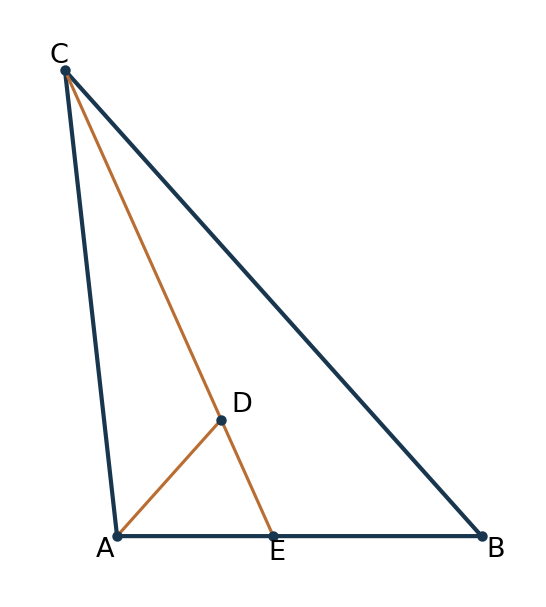
Consider triangle $ABC$ with $\angle A = 2 \angle B$. The angle bisectors from $A$ and $C$ intersect at $D$, and the angle bisector from $C$ intersects $\overline{AB}$ at $E$. If $\frac{DE}{DC} = \frac{1}{3}$, compute $\frac{AB}{AC}$.
Let $ABC$ be a triangle with $\angle ABC = 120^\circ$ and triangle bisectors $(AA_1)$, $(BB_1)$, $(CC_1)$, respectively. $B_1F \perp A_1C_1$, where $F \in (A_1C_1)$. Let $R$, $I$ and $S$ be the centers of circles which are inscribed in triangles $C_1B_1F$, $C_1B_1A_1$, $A_1B_1F$, and $B_1S \cap A_1C_1 = \{Q\}$. Show that $R$, $I$, $S$, $Q$ are on the same circle.
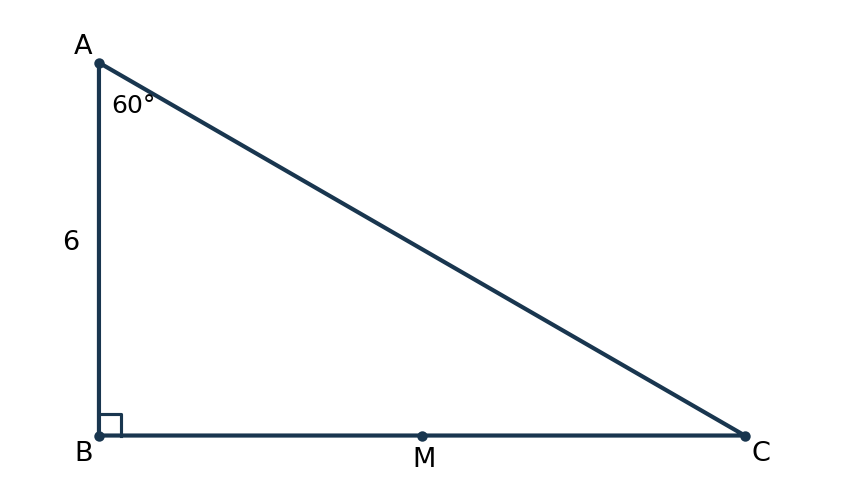
The walls of a room are in the shape of a triangle $ABC$ with $\angle ABC = 90^{\circ}$, $\angle BAC = 60^{\circ}$, and $AB = 6$. Chong stands at the midpoint of $BC$ and rolls a ball toward $AB$. Suppose that the ball bounces off $AB$, then $AC$, then returns exactly to Chong. Find the length of the path of the ball.
A natural number $n$ has the following property. For any real numbers $a_1,a_2,\ldots,a_d$ satisfying both $a_1+\cdots+a_d=2013$ and $0\le a_i\le1$ for $i=1,\ldots,d$, there is a partition of the collection of these real numbers into $n$ pairwise disjoint subsets (some may be empty), such that the sum of the numbers in each subset is at most $1$. Determine the smallest such $n$.
Find the number of ordered triples of integers $(a, b, c)$ with $1 \leq a, b, c \leq 100$ and $a^{2} b + b^{2} c + c^{2} a = a b^{2} + b c^{2} + c a^{2}$.
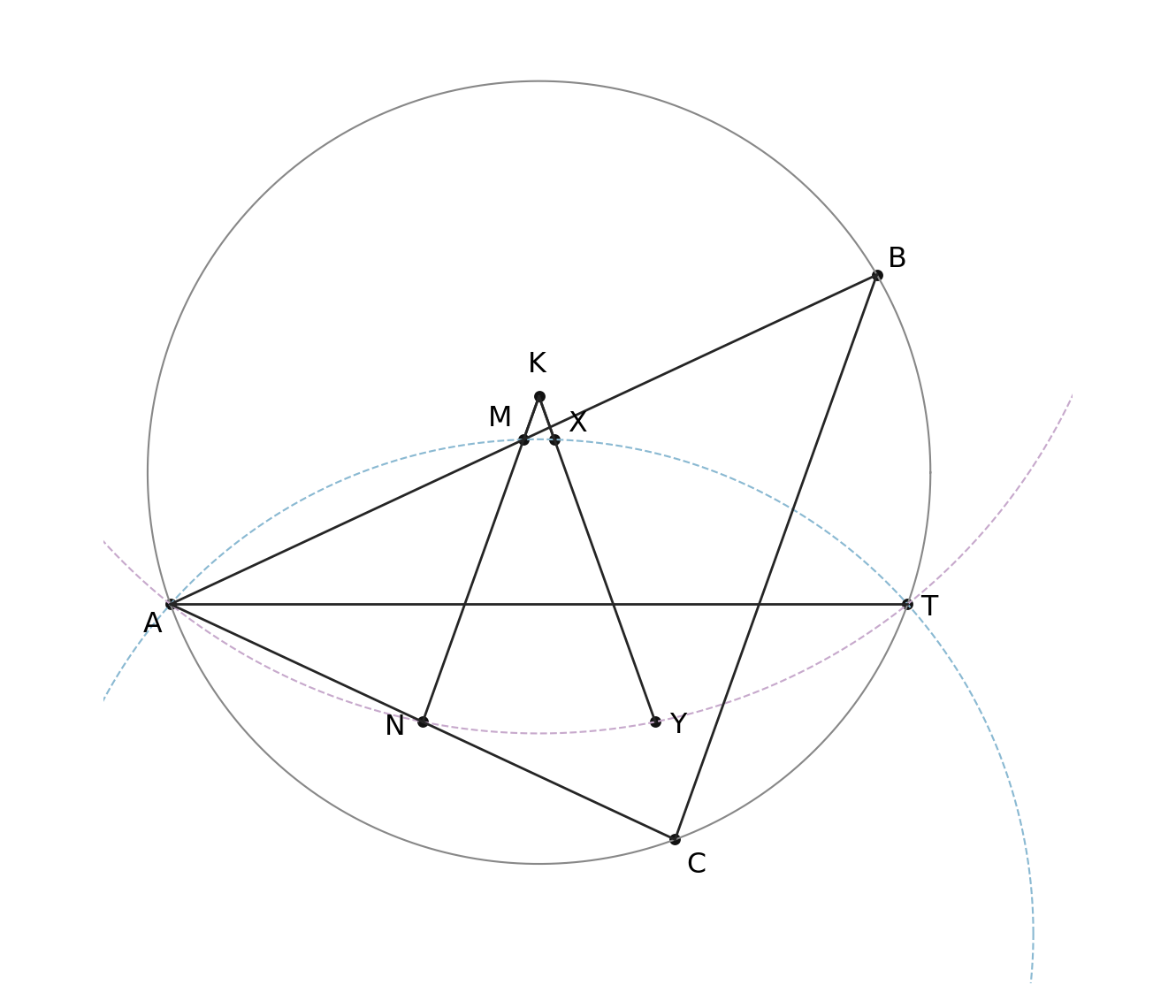
Let $\omega$ be the circumcircle of a triangle $A B C$. Denote by $M$ and $N$ the midpoints of the sides $A B$ and $A C$, respectively, and denote by $T$ the midpoint of the $\operatorname{arc} B C$ of $\omega$ not containing $A$. The circumcircles of the triangles $A M T$ and $A N T$ intersect the perpendicular bisectors of $A C$ and $A B$ at points $X$ and $Y$, respectively; assume that $X$ and $Y$ lie inside the triangle $A B C$. The lines $M N$ and $X Y$ intersect at $K$. Prove that $K A=K T$.
Find the number of subsets $S$ of $\{1,2, \ldots, 6\}$ satisfying the following conditions:
- $S$ is non-empty.
- No subset of $S$ has the property that the sum of its elements is $10$.
The central bank of Sikinien mints coins worth $11$ and $12$ Kulotnik. In a burglary, eleven Sikinien thieves broke into a safe and stole coins with total value $5940$ Kulotnik. They tried for a while to divide the loot fairly, so that everyone received the same value, but could not do so. After a while their leader claimed to have reasoned that this was indeed impossible. Prove that they did not steal any coin worth $12$ Kulotnik.
Let $z_{0} + z_{1} + z_{2} + \cdots$ be an infinite complex geometric series such that $z_{0} = 1$ and $z_{2013} = \frac{1}{2013^{2013}}$. Find the sum of all possible sums of this series.
Suppose that $x$ and $y$ are chosen randomly and uniformly from $(0,1)$. What is the probability that $\left\lfloor\sqrt{\frac{x}{y}}\right\rfloor$ is even? Hint: $\sum_{n=1}^{\infty} \frac{1}{n^{2}}=\frac{\pi^{2}}{6}$.
Suppose the excircle of triangle $ABC$ opposite $A$ touches side $BC$ at $A_1$. Define $B_1$ on $CA$ and $C_1$ on $AB$ similarly using the excircles opposite $B$ and $C$. Suppose the circumcenter of triangle $A_1B_1C_1$ lies on the circle through $A,B,C$. Prove that triangle $ABC$ is right-angled.
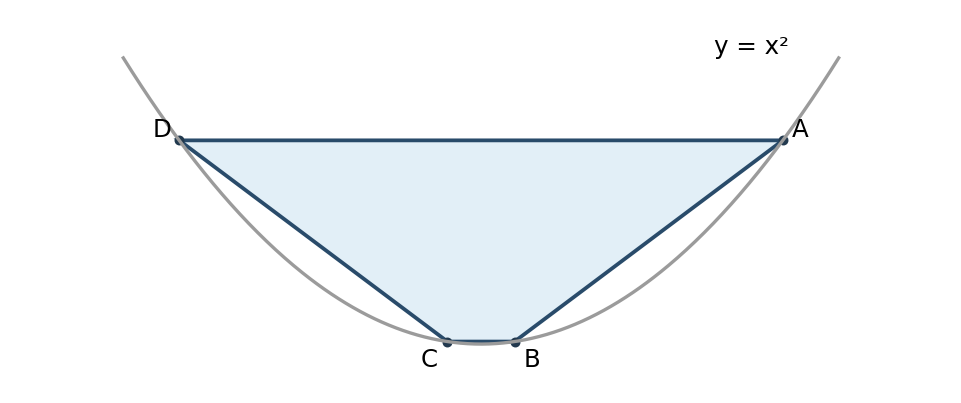
Trapezoid $ABCD$ is inscribed in the parabola $y = x^{2}$ such that $A = (a, a^{2})$, $B = (b, b^{2})$, $C = (-b, b^{2})$, and $D = (-a, a^{2})$ for some positive reals $a, b$ with $a \gt b$. If $AD + BC = AB + CD$, and $AB = \frac{3}{4}$, what is $a$?
Let $r$ be a positive integer, and let $a_{0}, a_{1}, \ldots$ be an infinite sequence of real numbers. Assume that for all nonnegative integers $m$ and $s$ there exists a positive integer $n \in [m+1, m+r]$ such that
$$
a_{m}+a_{m+1}+\cdots+a_{m+s}=a_{n}+a_{n+1}+\cdots+a_{n+s}
$$
Prove that the sequence is periodic, i.e. there exists some $p \geqslant 1$ such that $a_{n+p}=a_{n}$ for all $n \geqslant 0$.
Prove that in any set of $2000$ distinct real numbers there exist two pairs $a \gt b$ and $c \gt d$ with $a \neq c$ or $b \neq d$, such that
$$
\left|\frac{a-b}{c-d}-1\right|\lt \frac{1}{100000}
$$