Let $l(n)$ denote the greatest odd divisor of any natural number $n$. Find the sum
$$
l(1) + l(2) + l(3) + \cdots + l(2^{2013}). \qquad (\text{Michal Rol\'inek})
$$
Let $n$ be a positive integer. For any positive integer $j$ and positive real number $r$, define $f_j(r)$ and $g_j(r)$ by
$$
f_j(r) = \min(jr, n) + \min\left(\frac{j}{r}, n\right), \quad \text{and} \quad g_j(r) = \min(\lceil jr \rceil, n) + \min\left(\left\lfloor \frac{j}{r} \right\rfloor, n\right),
$$
where $\lceil x \rceil$ denotes the smallest integer greater than or equal to $x$. Prove that
$$
\sum_{j=1}^{n} f_j(r) \le n^2 + n \le \sum_{j=1}^{n} g_j(r)
$$
for all positive real numbers $r$.
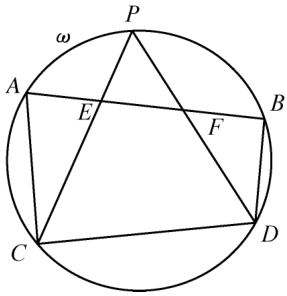
As seen in Fig. 1.1, $AB$ is a chord of circle $\omega$, $P$ is a point on arc $AB$, and $E, F$ are 2 points on $AB$ satisfying $AE = EF = FB$. Connect $PE, PF$ and extend them to intersect with $\omega$ at $C, D$, respectively. Prove
$$
EF \cdot CD = AC \cdot BD.
$$
Let $ABCD$ be a cyclic quadrilateral with $BC = CD$, let $\omega$ be the circle centered at $C$ tangent to $BD$, and let $I$ be the incenter of $ABD$. Show that the line through $I$ parallel to $AB$ is tangent to $\omega$.
Let $n$ be a positive integer. For any positive integer $j$ and positive real number $r$, define
$$
f_{j}(r)=\min (j r, n)+\min \left(\frac{j}{r}, n\right), \quad \text{and} \quad g_{j}(r)=\min (\lceil j r\rceil, n)+\min \left(\left\lceil\frac{j}{r}\right\rceil, n\right),
$$
where $\lceil x\rceil$ denotes the smallest integer greater than or equal to $x$. Prove that
$$
\sum_{j=1}^{n} f_{j}(r) \leq n^{2}+n \leq \sum_{j=1}^{n} g_{j}(r)
$$
Each of $n$ Robin Hoods ($n \ge 3$) robbed some coins. Together they have earned $100n$ coins. They have decided to cut the loot in a following way: in one step one Robin can take his two coins and give to some other two Hoods, one coin each. Find all positive integers $n \ge 3$ for which they can split the loot in equal parts ($100$ coins each). (Ján Mazák)
Ann and Bob play the following game. They, in turn (Ann starts), replace one of the asterisks in the expression $\overline{*****}$ by one of the digits from $0$ to $9$ (each digit can be used exactly one time). Ann wins if the obtained $5$-digit number is divisible by $11$, otherwise Bob wins.
Who of the players wins if both of them play to win?
Suppose there are $m$ questions in an examination attended by $n$ students, where $m, n \ge 2$ are given natural numbers. The marking rule for each question is as follows: if there are exactly $x$ students failing to answer the question correctly, then they will each get 0 marks, and those who answer it correctly will each get $x$ marks. The total marks of a student are the sum of marks he/she gets from the $m$ questions. Now rank the total marks of the $n$ students as $p_1 \ge p_2 \ge \cdots \ge p_n$. Find the maximum possible value of $p_1 + p_n$.
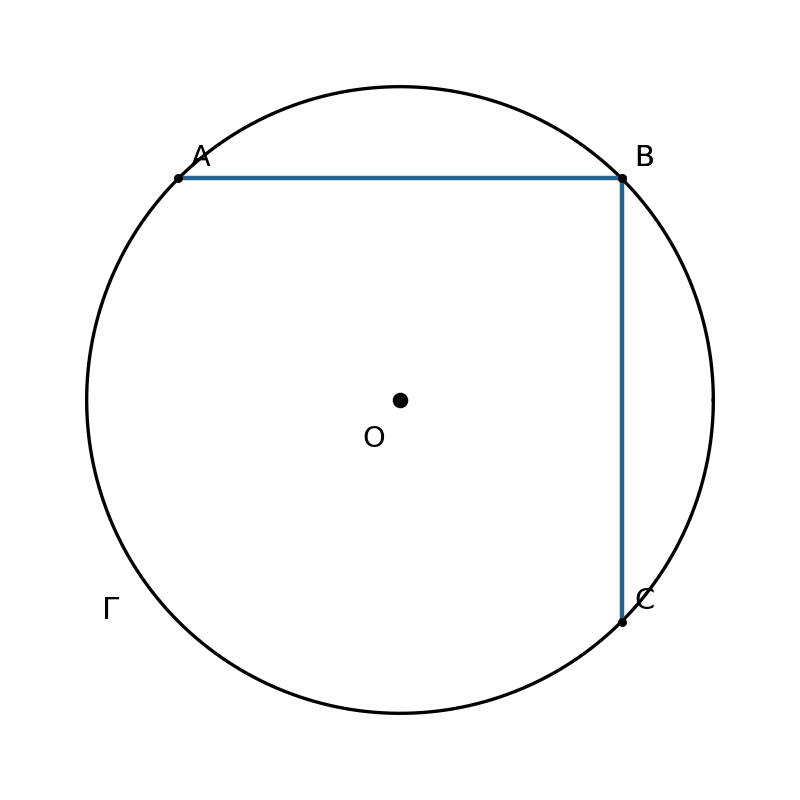
$N$ segments are arranged inside a unit circle $\Gamma$. The sum of the lengths of all these segments is equal to $2\sqrt{N}$.
Prove that there exists a concentric with $\Gamma$ circumference intersecting at least two of these segments.
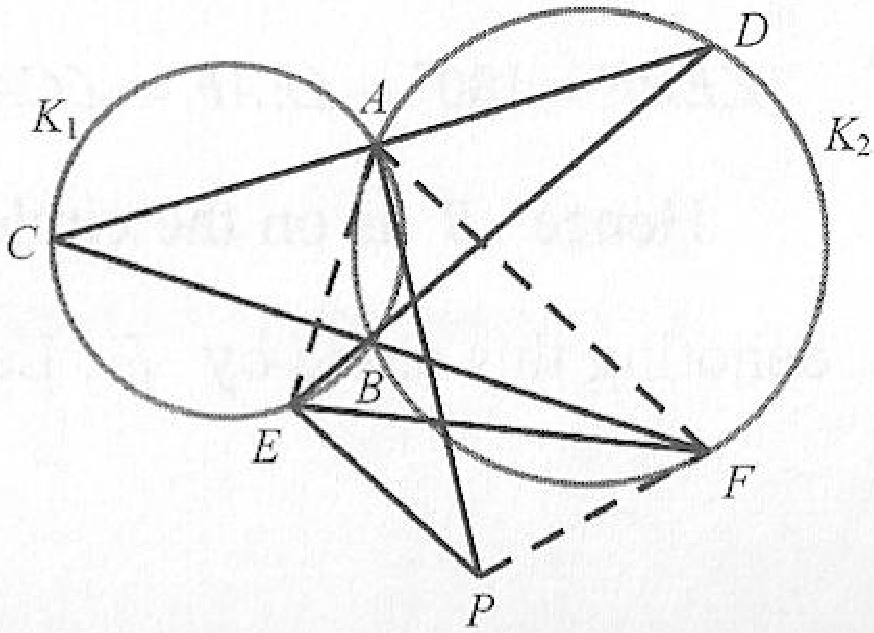
Two circles $K_1$ and $K_2$ of different radii intersect at two points $A$ and $B$, let $C$ and $D$ be two points on $K_1$ and $K_2$, respectively, such that $A$ is the midpoint of the segment $CD$. The extension of $DB$ meets $K_1$ at another point $E$, the extension of $CB$ meets $K_2$ at another point $F$. Let $l_1$ and $l_2$ be the perpendicular bisectors of $CD$ and $EF$, respectively.
(1) Show that $l_1$ and $l_2$ have a unique common point (denoted by $P$).
(2) Prove that the lengths of $CA$, $AP$ and $PE$ are the side lengths of a right triangle.
Let $N^*$ be the set of all positive integers. Prove that there exists a unique function $f: N^* \to N^*$ satisfying $f(1) = f(2) = 1$ and $f(n) = f(f(n-1)) + f(n-f(n-1))$, $n = 3, 4, \dots$. For such $f$, find the value of $f(2^m)$ for integer $m \ge 2$.
Let $S$ be a subset of $m$ elements of $\{0, 1, 2, \dots, 98\}$, $m \geq 3$, such that for any $x, y \in S$, there exists $z \in S$ with $x + y \equiv 2z \pmod{99}$. Find all possible values of $m$.
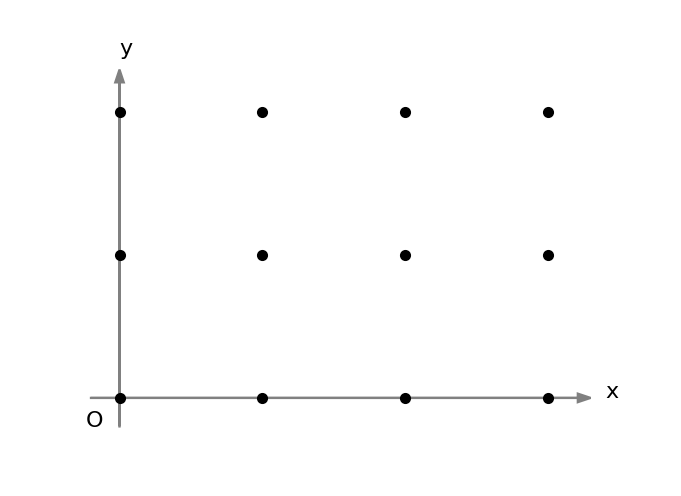
All points in the plane having integer coordinates are colored in three colors. Find the least positive integer $S$ having the following property: for arbitrary such covering there exists a triangle of area $S$ having all its vertices in one and the same color.
Find the smallest real number $x$ such that the inequality $x + c \le (x + a)(x + b)$ holds for any triangle, where $a \le b \le c$ are the sides of the triangle.
Let $O$ denote the circumcentre of an acute-angled triangle $ABC$. Let point $P$ on side $AB$ be such that $\angle BOP = \angle ABC$, and let point $Q$ on side $AC$ be such that $\angle COQ = \angle ACB$. Prove that the reflection of $BC$ in the line $PQ$ is tangent to the circumcircle of triangle $APQ$.