Let $B_n$ be a number of ways to partition a $n$-element set onto non-empty parts. For example, $B_3 = 5$ because we have the following partitions of the 3-element set $\{a, b, c\}$:
$$
\{a, b, c\}; \quad \{a\}, \{b, c\}; \quad \{a, c\}, \{b\}; \quad \{a, b\}, \{c\}; \quad \{a\}, \{b\}, \{c\}.
$$
Prove that for every positive integer $m$ and prime number $p$,
$$
B_{p^m} \equiv m + 1 \pmod{p}.
$$
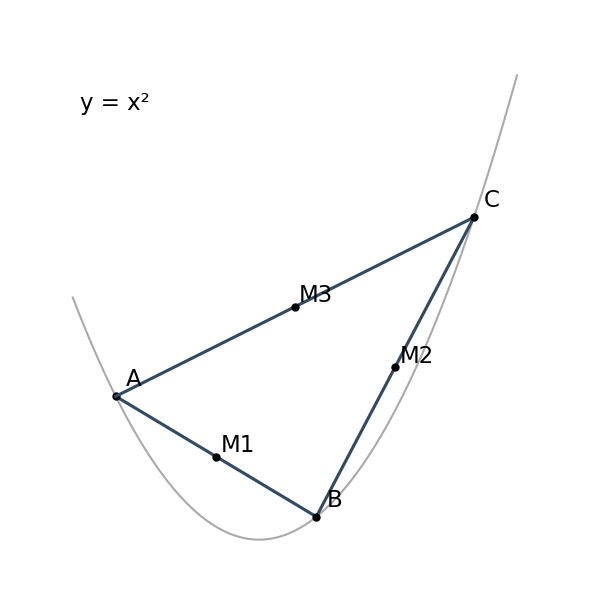
A triangle $ABC$ is inscribed in the parabola $y = x^2$. Let $a$, $b$, $c$ be the abscissae of the midpoints of its sides.
Find the radius of the circumcircle of $\triangle ABC$.
Given a right-angled triangle $ABC$ with $AC = BC$, and $\angle C = 90^\circ$. Let points $M$ and $N$ belong to the sides $AC$ and $BC$ respectively; $MN = BC$. For each pair of such points $M$ and $N$ a circle passing through $M$, $N$ and touching the hypotenuse $AB$ is constructed.
Find the locus of the centers of these circles.
Prove that there are at least 2013 different values of $m$, such that $m \times m$ square grid can be cut along grid lines into pieces $D_1, D_2, \dots, D_n$, such that $D_i$ consists of exactly $i$ cells.
For which positive integers $k$ can the integers $1, 2, 3, \dots, (2k)^2$ be arranged as a $2k \times 2k$ table in such a way that all row sums and column sums were of the same parity, opposite to that of $k$?
Points $X$ and $Y$ are marked on the sides $AB$ and $AD$ of the convex quadrilateral $ABCD$ respectively.
Find $AX : BX$ if $CX \parallel DA$, $DX \parallel CB$, $BY \parallel CD$, $CY \parallel BA$.
Let $f$ and $g$ be two polynomials with integral coefficients such that $\deg f \gt \deg g$ and $\deg f \ge 2$. If the polynomial $pf+g$ has a rational root for infinitely many primes $p$, prove that $f$ has a rational root.
$D$ is a point inside triangle $ABC$. The circle $S_1$ inscribed in the triangle $ABD$ touches the circle $S_2$ inscribed in the triangle $CBD$. Prove that the intersection point of outer common tangent lines of circles $S_1$ and $S_2$ lies on the line $AC$.
There are some lamps in a row. Initially, some of the lamps are on, and the rest are off. We may change the states of the lamps by the following operations:
(1) Change the state of the rightmost lamp;
(2) Change the states of two consecutive lamps that are either both on or both off.
Is it necessarily possible to use the operations (1) and (2) so that all the lights become off?
The odd number of the asterisks are written on the blackboard: $\underbrace{**\dots*}_{2n+1}$.
Ann and Bob play the following game. They, in turn (Ann starts), replace one of the asterisks in the expression $\underbrace{**\dots*}_{2n+1}$ by any of the digits from $0$ to $9$ (the first left asterisk cannot be replaced by $0$). Ann wins if the obtained number is divisible by $11$, otherwise Bob wins.
Who of the players wins if both of them play to win?
The set of vertices of the graph $G$ is a set of 2014 points in general position on the plane. The segment $AB$ is an edge of the graph iff each of the two (open) half-planes of line $AB$ contains 1006 points. Prove that $G$ does not contain a Hamiltonian path (i.e. a path that passes through every vertex exactly once).
For a positive integer $n$ assume that $n$ numbers have been chosen from the table
$$
\begin{array}{cccc}
0 & 1 & \cdots & n-1 \\
n & n+1 & \cdots & 2n-1 \\
\vdots & \vdots & \ddots & \vdots \\
(n-1)n & (n-1)n+1 & \cdots & n^2-1
\end{array}
$$
with no two of them from the same row or the same column. What is the maximal product of these $n$ numbers?