Suppose that $a_1,a_2,a_3,a_4,\ldots$ is an arithmetic progression with $a_1>0$ and $3a_8=5a_{13}$. Let $S_n=a_1+a_2+\cdots+a_n$ for all integers $n\ge1$. Find the integer $n$ such that $S_n$ has the maximum value.
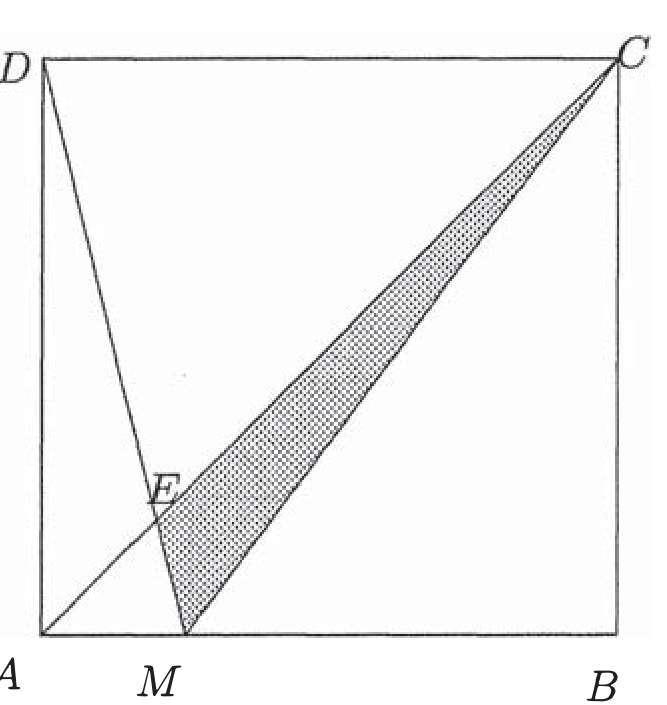
In the figure below, $ABCD$ is a square with $AB=20$ cm (not drawn to scale). Assume that $M$ is a point such that the area of the shaded region is $40$ cm$^2$. Find $AM$ in centimetres.
In the triangle $ABC$, a circle passes through the point $A$, the midpoint $E$ of $AC$, the midpoint $F$ of $AB$ and is tangent to the side $BC$ at $D$. Suppose
Let $a_1,a_2,a_3,\ldots$ be a sequence of real numbers in a geometric progression. Let $S_n=a_1+a_2+\cdots+a_n$ for all integers $n\ge1$. Assume that $S_{10}=10$ and $S_{30}=70$. Find the value of $S_{40}$.
All the positive integers which are co-prime to $2012$ are grouped in an increasing order in such a way that the $n$th group has $2n-1$ numbers. So, the first three groups in this grouping are $(1)$, $(3,5,7)$, $(9,11,13,15,17)$. It is known that $2013$ belongs to the $k$th group. Find the value of $k$.
(Note: Two integers are said to be co-prime if their greatest common divisor is $1$.)
The numbers $1,2,3,\ldots,7$ are randomly divided into two non-empty subsets. The probability that the sum of the numbers in the two subsets being equal is $p/q$ expressed in the lowest term. Find $p+q$.
In the triangle $ABC$, $AB=AC$, $\angle A=90^\circ$, $D$ is the midpoint of $BC$, $E$ is the midpoint of $AC$ and $F$ is a point on $AB$ such that $BE$ intersects $CF$ at $P$ and $B,D,P,F$ lie on a circle. Let $AD$ intersect $CP$ at $H$. Given $AP=\sqrt5+2$, find the length of $PH$.