Different letters stand for different digits, identical letters for identical digits. The three-digit number $\overline{ABB}$ is twenty-five less than $\overline{CDC}$. Find the positive integer square root of $\overline{ABBCDC}$.
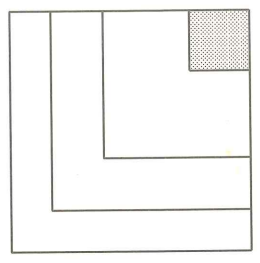
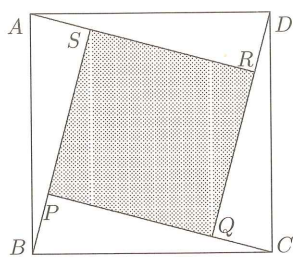
A square house thirty metres on each side occupies the northeast corner of a square farm one hundred twenty metres on each side. Two V-shaped fences divide the remaining land into three equal-area V-shaped plots, as shown. The two perpendicular segments of each fence have equal lengths. Find the total length of the shorter fence.
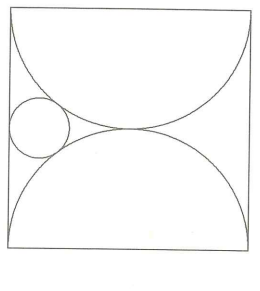
A square of side eighty centimetres contains two semicircles touching at its centre and a small circle tangent to the square and both semicircles, as shown. Find the small radius in centimetres.
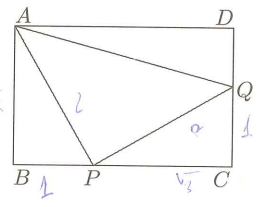
Right isosceles triangle $APQ$ lies in rectangle $ABCD$, with right-angle vertex $P$ on $BC$ and $Q$ on $CD$. Given $BP=1$ cm and $\angle APB=60^\circ$, find $[ADQ]$ in square centimetres.
Lea wears a diamond, a gold and an ivory ring on her right hand. Each can be on any of five fingers; distinct orders on the same finger count differently. How many ways can she wear all three?
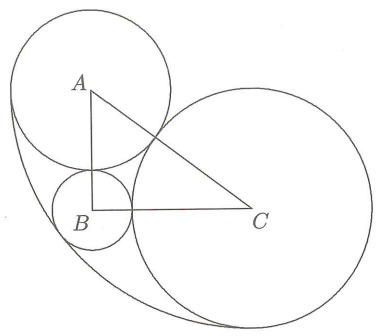
Triangle $ABC$ has $BC=4,CA=5,AB=3$ cm. Circles centred at $A,B,C$ are pairwise tangent. A fourth circle encloses and is tangent to all three, as shown. Find its radius in centimetres.
Positive integers $a\lt b$ have arithmetic mean $(a+b)/2$ and geometric mean $\sqrt{ab}$ which are two-digit positive integers with the same digits in reversed order. Find the minimum $a$.
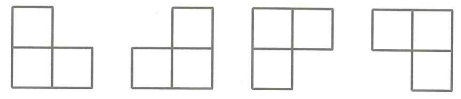
A factory cuts a $7\times7$ metal sheet without waste into $2\times2$ squares and L-shaped three-cell plates formed by removing one cell from a $2\times2$ square. Find the minimum number of L-shaped plates.
Let $$S_n=\sum_{i=1}^n\frac1i+\sum_{j=1}^n\left(\sum_{i=j}^n\frac1i\right)^2.$$ Each successive bracket drops the first term of the preceding bracket. Find $S_{2013}$.
Eight coins in a row initially all show heads. A move flips two adjacent coins only if they currently show the same side. How many different heads-and-tails patterns can be reached after any number of moves?
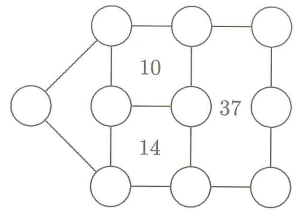
Place the ten digits in the ten circles of the diagram, each once. Consecutive numbers cannot occupy circles joined directly by a segment. The three rectangle perimeter sums are ten, fourteen and thirty-seven as labelled.
A right triangle has relatively prime integral side lengths in centimetres. The line joining its centroid and incentre is perpendicular to one side. Find its minimum perimeter.
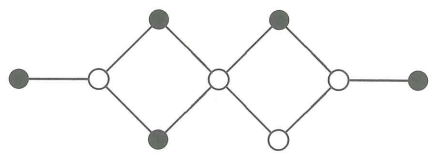
A marker is placed uniformly at random on one of the nine circles in the diagram, then moves uniformly along one incident segment to another circle. What is the probability that it finishes on a black circle?
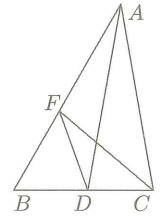
Triangle $ABC$ has $\angle A=40^\circ$, $\angle B=60^\circ$. The bisector of $A$ meets $BC$ at $D$. Point $F$ is on $AB$ with $\angle ADF=30^\circ$. Find $\angle DFC$.
A positive integer has two thousand thirteen digits, its first digit five. Every adjacent digit pair forms a multiple of thirteen or twenty-seven. Find the sum of all distinct possible last digits.