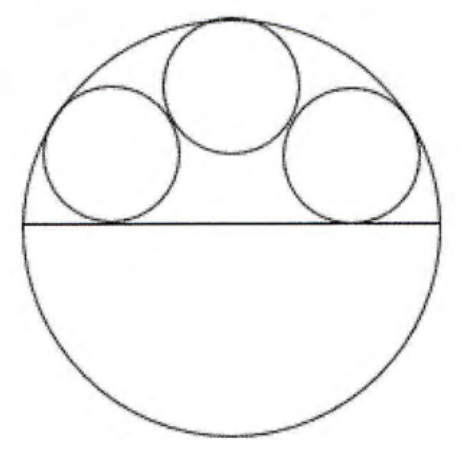
Three identical circles of radius $r$ are drawn tangent to one another and to a circle of radius $R$, as shown. Write $r=(a/b)R$ with $a,b$ relatively prime. Find $a+b$.
Andrew has $20$ chocolates. Each day at $4$ pm he eats one or two. At $7$ pm his brother Bob takes one if and only if the number left is a positive multiple of $3$. How many ways can the chocolates be finished?
Andrew and Bob alternate rounds, Andrew first. A bag contains $3$ white and $3$ black balls. The active player chooses a number from $2$ to $6$; the other draws that many balls without looking. The active player wins if more white than black are drawn. Otherwise all balls are returned and the other player becomes active. Both play optimally. If Bob’s winning probability is $a/b$ in lowest terms, find $a+b$.
Let $[a]$ denote the integer part and $\{a\}$ the fractional part; for example $[6.5]=6$, $\{6.5\}=0.5$. The positive solution of $[x]^2=\{x\}x$ is $x=(a+\sqrt b)/2$. Find $a+b$.
Julian and Caleb alternate removing either one coin or two adjacent coins from a row of $n\ge1$ coins numbered $1$ to $n$. Gaps remain; coins originally separated by a gap are not adjacent. The player removing the last coin wins. Julian starts. Find the sum of all $n\le10$ for which Julian can always win. Example: from $1,2,3$ one may remove any single coin or the pairs $(1,2),(2,3)$; from $1,3$ the pair is forbidden.
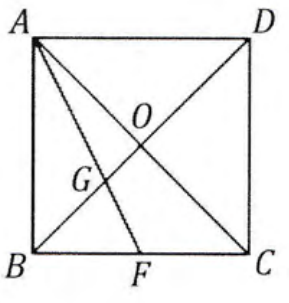
In square $ABCD$, the diagonals meet at $O$. The bisector $AF$ of $\angle BAC$ meets $BD$ at $G$ and $BC$ at $F$. Write $OG:CF=m:n$ in coprime positive integers and find $m+n$.