The remainder on dividing the polynomial $p(x)$ by $x^2 - (a+b)x + ab$ (where $a$ and $b$ are unequal) is $mx + n$. Find the coefficients $m, n$ in terms of $a, b$. Find $m, n$ for the case $p(x) = x^{200}$ divided by $x^2 - x - 2$ and show that they are integers.
Show that the number of positive integer solutions to
$$
x_1 + 2^3 x_2 + 3^3 x_3 + \cdots + 10^3 x_{10} = 3025 \quad (*)
$$
equals the number of non-negative integer solutions to the equation
$$
y_1 + 2^3 y_2 + 3^3 y_3 + \cdots + 10^3 y_{10} = 0
$$
Hence show that (*) has a unique solution in positive integers and find it.
(i) $ABCD$ is a square with side $1$. $M$ is the midpoint of $AB$, and $N$ is the midpoint of $BC$. The lines $CM$ and $DN$ meet at $I$. Find the area of the triangle $CIN$.
(ii) The midpoints of the sides $AB$, $BC$, $CD$, $DA$ of the parallelogram $ABCD$ are $M$, $N$, $P$, $Q$ respectively. Each midpoint is joined to the two vertices not on its side. Show that the area outside the resulting 8-pointed star is $2/5$ the area of the parallelogram.
(iii) $ABC$ is a triangle with $CA = CB$ and centroid $G$. Show that the area of $AGB$ is $1/3$ of the area of $ABC$.
(iv) Is (ii) true for all convex quadrilaterals $ABCD$?
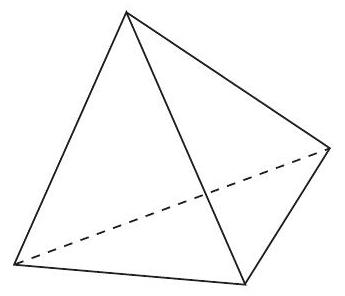
It is known in Euclidean geometry that the sum of the angles of a triangle is constant. Prove, however, that the sum of the dihedral angles of a tetrahedron is not constant.
Note. (i) A tetrahedron is a triangular pyramid, and (ii) a dihedral angle is the interior angle between a pair of faces.
Let $a, b, c, d, e$ be integers such that $1 \leq a \lt b \lt c \lt d \lt e$. Prove that
$$
\frac{1}{[a, b]} + \frac{1}{[b, c]} + \frac{1}{[c, d]} + \frac{1}{[d, e]} \leq \frac{15}{16}
$$
where $[m, n]$ denotes the least common multiple of $m$ and $n$ (e.g. $[4,6]=12$).
A walk consists of a sequence of steps of length $1$ taken in directions north, south, east or west. A walk is self-avoiding if it never passes through the same point twice. Let $f(n)$ denote the number of $n$-step self-avoiding walks which begin at the origin. Compute $f(1)$, $f(2)$, $f(3)$, $f(4)$, and show that
$$
2^{n} \lt f(n) \leq 4 \cdot 3^{n-1}
$$
A dog standing at the centre of a circular arena sees a rabbit at the wall. The rabbit runs around the wall and the dog pursues it along a unique path which is determined by running at the same speed and staying on the radial line joining the centre of the arena to the rabbit. Show that the dog overtakes the rabbit just as it reaches a point one-quarter of the way around the arena.
Given: (i) $a, b \gt 0$; (ii) $a, A_{1}, A_{2}, b$ is an arithmetic progression; (iii) $a, G_{1}, G_{2}, b$ is a geometric progression. Show that
$$
A_{1} A_{2} \geq G_{1} G_{2}
$$
$T$ is an isosceles triangle. Another isosceles triangle $T'$ has one vertex on each side of $T$. What is the smallest possible value of $\dfrac{\text{area } T'}{\text{area } T}$?
Given a finite set $X$ of points in the plane. $S$ is a set of vectors $AB$ where $(A, B)$ are some pairs of points in $X$. For every point $A$ the number of vectors $AB$ (starting at $A$) in $S$ equals the number of vectors $CA$ (ending at $A$) in $S$. Show that the sum of the vectors in $S$ is zero.
A convex quadrilateral is divided by its diagonals into four triangles. The incircles of each of the four are equal. Show that the quadrilateral has all its sides equal.
In a group of people every person has less than $4$ enemies. Assume that $A$ is $B$'s enemy iff $B$ is $A$'s enemy. Show that we can divide the group into two parts, so that each person has at most one enemy in his part.
What is the smallest number of pieces that can be placed on an $8 \times 8$ chessboard so that every row, column and diagonal has at least one piece? [A diagonal is any line of squares parallel to one of the two main diagonals, so there are 30 diagonals in all.] What is the smallest number for an $n \times n$ board?
Find a sequence $a_{1}$, $a_{2}$, ..., $a_{25}$ of 0s and 1s such that the following sums are all odd:
$$
\begin{array}{rl}
& a_{1}a_{1} + a_{2}a_{2} + \ldots + a_{25}a_{25} \\
& a_{1}a_{2} + a_{2}a_{3} + \ldots + a_{24}a_{25} \\
& a_{1}a_{3} + a_{2}a_{4} + \ldots + a_{23}a_{25} \\
& \ldots \\
& a_{1}a_{24} + a_{2}a_{25}
\end{array}
$$
Show that we can find a similar sequence of $n$ terms for some $n \gt 1000$.
Given a point $P$ in space and 1979 lines $L_1$, $L_2$, ..., $L_{1979}$ containing it. No two lines are perpendicular. $P_1$ is a point on $L_1$. Show that we can find a point $A_n$ on $L_n$ (for $n = 2$, $3$, ..., $1979$) such that the following 1979 pairs of lines are all perpendicular: $A_{n-1}A_{n+1}$ and $L_n$ for $n = 1$, ..., $1979$. [We regard $A_{-1}$ as $A_{1979}$ and $A_{1980}$ as $A_1$.]
Let $S$ be the set $\{0, 1\}$. Given any subset of $S$ we may add its arithmetic mean to $S$ (provided it is not already included -- $S$ never includes duplicates). Show that by repeating this process we can include the number $1/5$ in $S$. Show that we can eventually include any rational number between $0$ and $1$.