Let $ABCD$ be a rectangle with $BC = 3 AB$. Show that if $P, Q$ are the points on side $BC$ with $BP = PQ = QC$, then
$$
\angle DBC + \angle DPC = \angle DQC.
$$
Given a circle with diameter $AB$ and a point $X$ on the circle different from $A$ and $B$, let $t_{a}$, $t_{b}$ and $t_{x}$ be the tangents to the circle at $A$, $B$ and $X$ respectively. Let $Z$ be the point where line $AX$ meets $t_{b}$ and $Y$ the point where line $BX$ meets $t_{a}$. Show that the three lines $YZ$, $t_{x}$ and $AB$ are either concurrent (i.e., all pass through the same point) or parallel.
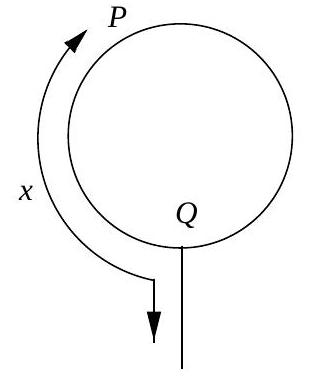
A bus route consists of a circular road of circumference $10$ miles and a straight road of length $1$ mile which runs from a terminus to the point $Q$ on the circular road (see diagram). It is served by two buses, each of which requires $20$ minutes for the round trip. Bus No. $1$, upon leaving the terminus, travels along the straight road, once around the circle clockwise and returns along the straight road to the terminus. Bus No. $2$, reaching the terminus $10$ minutes after Bus No. $1$, has a similar route except that it proceeds counterclockwise
Terminus
around the circle. Both buses run continuously and do not wait at any point on the route except for a negligible amount of time to pick up and discharge passengers.
A man plans to wait at a point $P$ which is $x$ miles $(0 \leq x \lt 12)$ from the terminus along the route of Bus No. $1$ and travel to the terminus on one of the buses.
Assuming that he chooses to board that bus which will bring him to his destination at the earliest moment, there is a maximum time $w(x)$ that his journey (waiting plus travel time) could take.
Find $w(2)$; find $w(4)$.
For what value of $x$ will the time $w(x)$ be the longest?
Sketch a graph of $y = w(x)$ for $0 \leq x \lt 12$.
Let $n$ be a fixed positive integer. To any choice of $n$ real numbers satisfying
$$
0 \leq x_{i} \leq 1, \quad i=1,2, \ldots, n
$$
there corresponds the sum
(*)
$$
\begin{aligned}
& \sum_{1 \leq i\lt j \leq n}\left|x_{i}-x_{j}\right| \\
& \qquad \begin{aligned}
= & \left|x_{1}-x_{2}\right|+\left|x_{1}-x_{3}\right|+\left|x_{1}-x_{4}\right|+\cdots+\left|x_{1}-x_{n-1}\right|+\left|x_{1}-x_{n}\right| \\
& \quad+\left|x_{2}-x_{3}\right|+\left|x_{2}-x_{4}\right|+\cdots+\left|x_{2}-x_{n-1}\right|+\left|x_{2}-x_{n}\right| \\
& \quad+\left|x_{3}-x_{4}\right|+\cdots+\left|x_{3}-x_{n-1}\right|+\left|x_{3}-x_{n}\right| \\
& \quad+\cdots+\left|x_{n-2}-x_{n-1}\right|+\left|x_{n-2}-x_{n}\right| \\
& \quad+\left|x_{n-1}-x_{n}\right| .
\end{aligned}
\end{aligned}
$$
Let $S(n)$ denote the largest possible value of the sum (*). Find $S(n)$.
A collection of $n$ cards is numbered from $1$ to $n$. Each card has either $1$ or $-1$ on the back. You are allowed to ask for the product of the numbers on the back of any three cards. What is the smallest number of questions which will allow you to determine the numbers on the backs of all the cards if $n$ is (1) $30$, (2) $31$, (3) $32$? If $50$ cards are arranged in a circle and you are only allowed to ask for the product of the numbers on the backs of three adjacent cards, how many questions are needed to determine the product of the numbers on the backs of all $50$ cards?
The triangle $ABC$ has area $1$. $D$, $E$, $F$ are the midpoints of the sides $BC$, $CA$, $AB$. $P$ lies in the segment $BF$, $Q$ lies in the segment $CD$, $R$ lies in the segment $AE$. What is the smallest possible area for the intersection of triangles $DEF$ and $PQR$?
In the triangle $ABC$, $\angle C = 90^\circ$ and $AC = BC$. Take points $D$ on $CA$ and $E$ on $CB$ such that $CD = CE$. Let the perpendiculars from $D$ and $C$ to $AE$ meet $AB$ at $K$ and $L$ respectively. Show that $KL = LB$.
The $n$ points of a graph are each colored red or blue. At each move we select a point which differs in color from more than half of the points to which it is joined and we change its color. Prove that this process must finish after a finite number of moves.
Find all three-digit decimal numbers $a_1a_2a_3$ which equal the mean of the six numbers $a_1a_2a_3$, $a_1a_3a_2$, $a_2a_1a_3$, $a_2a_3a_1$, $a_3a_1a_2$, $a_3a_2a_1$.
$f$ is a function on the closed interval $[0, 1]$ with non-negative real values. $f(1) = 1$ and $f(x + y) \geq f(x) + f(y)$ for all $x, y$. Show that $f(x) \leq 2x$ for all $x$. Is it necessarily true that $f(x) \leq 1.9x$ for all $x$?
Given $n$ unit vectors in the plane whose sum has length less than one. Show that you can arrange them so that the sum of the first $k$ has length less than $2$ for every $1 \lt k \lt n$.
Each side of a convex hexagon is longer than $1$. Is there always a diagonal longer than $2$? If each of the main diagonals of a hexagon is longer than $2$, is there always a side longer than $1$?
Circles radius $r$ and $R$ touch externally. $AD$ is parallel to $BC$. $AB$ and $CD$ touch both circles. $AD$ touches the circle radius $r$, but not the circle radius $R$, and $BC$ touches the circle radius $R$, but not the circle radius $r$. What is the smallest possible length for $AB$?
One rat and two cats are placed on a chessboard. The rat is placed first and then the two cats choose positions on the border squares. The rat moves first. Then the cats and the rat move alternately. The rat can move one square to an adjacent square (but not diagonally). If it is on a border square, then it can also move off the board. On a cat move, both cats move one square. Each must move to an adjacent square, and not diagonally. The cats win if one of them moves onto the same square as the rat. The rat wins if it moves off the board. Who wins? Suppose there are three cats (and all three cats move when it is the cats' turn), but that the rat gets an extra initial turn. Prove that the rat wins.
$ABCD$ is a square. $P$ is on the segment $AB$ and $Q$ is on the segment $BC$ such that $BP = BQ$. $H$ lies on $PC$ such that $BHC$ is a right angle. Show that $DHQ$ is a right angle.
Arrange the numbers $1, 2, \ldots, 32$ in a sequence such that the arithmetic mean of two numbers does not lie between them. (For example, $\ldots, 3, 4, 5, 2, 1, \ldots$ is invalid, because $2$ lies between $1$ and $3$.) Can you arrange the numbers $1, 2, \ldots, 100$ in the same way?