Among the $900$ residents of Aimeville, there are $195$ who own a diamond ring, $367$ who own a set of golf clubs, and $562$ who own a garden spade. In addition, each of the $900$ residents owns a bag of candy hearts. There are $437$ residents who own exactly two of these things, and $234$ residents who own exactly three of these things. Find the number of residents of Aimeville who own all four of these things.
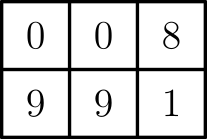
Find the number of ways to place a digit in each cell of a $2 \times 3$ grid so that the sum of the two numbers formed by reading left to right is $999,$ and the sum of the three numbers formed by reading top to bottom is $99.$ The grid below is an example of such an arrangement because $8 + 991 = 999$ and $9 + 9 + 81 = 99.$
Let $x,$ $y,$ and $z$ be positive real numbers that satisfy the following system of equations: $$
\log_2\left(\frac{x}{yz}\right) = \frac{1}{2}
$$ $$
\log_2\left(\frac{y}{xz}\right) = \frac{1}{3}
$$ $$
\log_2\left(\frac{z}{xy}\right) = \frac{1}{4}
$$
Then the value of $\left|\log_2(x^4 y^3 z^2)\right|$ is $\frac{m}{n}$ where $m$ and $n$ are relatively prime positive integers. Find $m + n.$
Let $ABCDEF$ be a convex equilateral hexagon in which all pairs of opposite sides are parallel. The triangle whose sides are extensions of segments $\overline{AB},$ $\overline{CD},$ and $\overline{EF}$ has side lengths $200,$ $240,$ and $300.$ Find the side length of the hexagon.
Alice chooses a set $A$ of positive integers. Then Bob lists all finite nonempty sets $B$ of positive integers with the property that the maximum element of $B$ belongs to $A.$ Bob’s list has $2024$ sets. Find the sum of the elements of $A.$
Let $N$ be the greatest four-digit integer with the property that whenever one of its digits is changed to $1,$ the resulting number is divisible by $7.$ Let $Q$ and $R$ be the quotient and remainder, respectively, when $N$ is divided by $1000.$ Find $Q + R.$
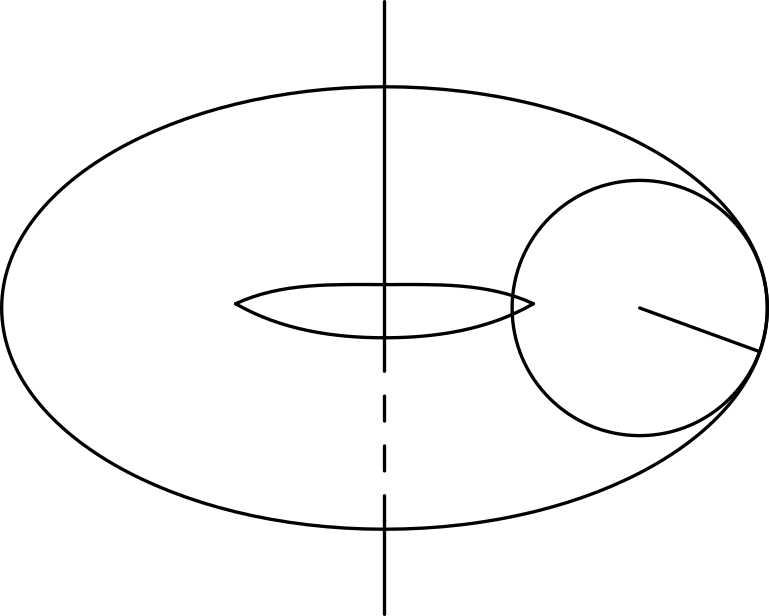
Torus $T$ is the surface produced by revolving a circle with radius $3$ around an axis in the plane of the circle that is a distance $6$ from the center of the circle (so like a donut).
Let $S$ be a sphere with a radius $11.$ When $T$ rests on the inside of $S,$ it is internally tangent to $S$ along a circle with radius $r_i,$ and when $T$ rests on the outside of $S,$ it is externally tangent to $S$ along a circle with radius $r_o.$ The difference $r_i - r_o$ can be written as $\frac{m}{n},$ where $m$ and $n$ are relatively prime positive integers. Find $m + n.$
There is a collection of $25$ indistinguishable white chips and $25$ indistinguishable black chips. Find the number of ways to place some of these chips in a $5 \times 5$ grid such that:
• each cell contains at most one chip
• all chips in the same row and all chips in the same column have the same color, and
• any additional chip placed on the grid would violate one or more of the previous two conditions.
Find the number of triples of nonnegative integers $(a, b, c)$ satisfying $a + b + c = 300$ and $$
\begin{aligned} &a^2 b + a^2 c \\ &\quad {}+ b^2 a + b^2 c \\ &\quad {}+ c^2 a + c^2 b = 6{,}000{,}000. \end{aligned}
$$
Let $O = (0, 0),$ $A = \left(\tfrac{1}{2}, 0\right),$ and $B = \left(0, \tfrac{\sqrt{3}}{2}\right)$ be points in the coordinate plane. Let $\mathcal{F}$ be the family of segments $\overline{PQ}$ of unit length lying in the first quadrant with $P$ on the $x$-axis and $Q$ on the $y$-axis. There is a unique point $C$ on $\overline{AB},$ distinct from $A$ and $B,$ that does not belong to any segment from $\mathcal{F}$ other than $\overline{AB}.$ Then $OC^2 = \tfrac{p}{q},$ where $p$ and $q$ are relatively prime positive integers. Find $p + q.$
Let $\omega \neq 1$ be a $13$th root of unity. Find the remainder when $$
\prod_{k=0}^{12} \left(2 - 2\omega^k + \omega^{2k}\right)
$$ is divided by $1000.$
Let $b \ge 2$ be an integer. Call a positive integer $n$ *$b$-eautiful* if it has exactly two digits when expressed in base $b$ and these two digits sum to $\sqrt{n}.$ For example, $81$ is $13$-eautiful because $81 = \underline{6}\,\underline{3}_{13}$ and $6 + 3 = \sqrt{81}.$ Find the least integer $b \ge 2$ for which there are more than ten $b$-eautiful integers.
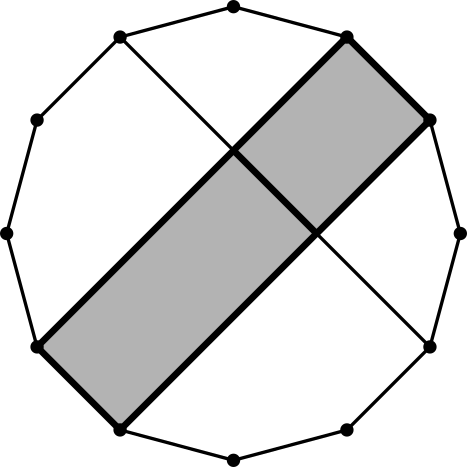
Find the number of rectangles that can be formed inside a fixed regular dodecagon ($12$-gon) where each side of the rectangle lies on either a side or a diagonal of the dodecagon. The diagram below shows three of those rectangles.
Every morning Aya goes for a $9$-kilometer-long walk and stops at a coffee shop afterwards. When she walks at a constant speed of $s$ kilometers per hour, the walk takes her $4$ hours, including $t$ minutes spent in the coffee shop. When she walks $s + 2$ kilometers per hour, the walk takes her $2$ hours and $24$ minutes, including $t$ minutes spent in the coffee shop. Suppose Aya walks at $s + \frac{1}{2}$ kilometers per hour. Find the number of minutes the walk takes her, including the $t$ minutes spent in the coffee shop.
Alice and Bob play the following game. A stack of $n$ tokens lies before them. The players take turns with Alice going first. On each turn, the player removes $1$ token or $4$ tokens from the stack. The player who removes the last token wins. Find the number of positive integers $n$ less than or equal to $2024$ such that there is a strategy that guarantees that Bob wins, regardless of Alice’s moves.
Jen enters a lottery by selecting $4$ distinct elements of $S = \{1, 2, 3, \ldots, 9, 10\}.$ Then four elements of $S$ are drawn at random. Jen wins a prize if at least two of her numbers were drawn, and wins the grand prize if all four of her numbers were drawn. The probability that Jen wins the grand prize given that Jen wins a prize is $\frac{m}{n}$ where $m$ and $n$ are relatively prime positive integers. Find $m + n.$
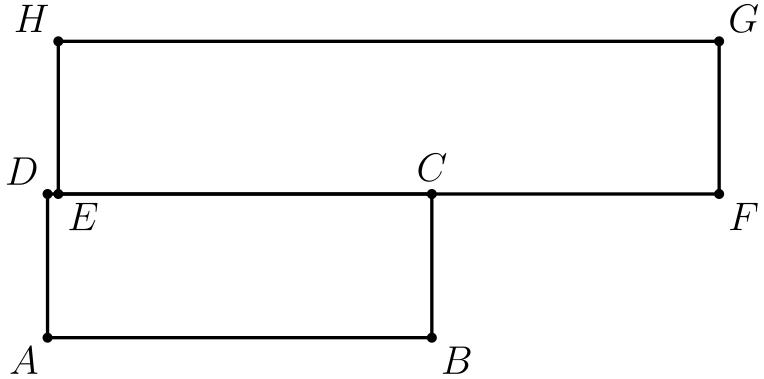
Rectangle $ABCD$ has dimensions $AB = 107$ and $BC = 16,$ and rectangle $EFGH$ has dimensions $EF = 184$ and $FG = 17.$ Points $D,$ $E,$ $C,$ and $F$ lie on line $DF$ in that order, and $A$ and $H$ lie on opposite sides of line $DF,$ as shown. Points $A,$ $D,$ $H,$ and $G$ lie on a common circle. Find $CE.$