Stekel and Prik play a game on an $m\times n$ board, where $m,n$ are positive integers. They take turns, with Stekel going first. On each turn, Stekel places a pawn on an unoccupied square. Prik does the same on his turn, but his chosen square must share a side with the square where Stekel placed his pawn on the immediately preceding turn. Prik wins when the whole board is filled with pawns. Stekel wins if Prik cannot place a pawn on his turn while at least one square is still empty. Determine, for every pair $(m,n)$, which player has a winning strategy.
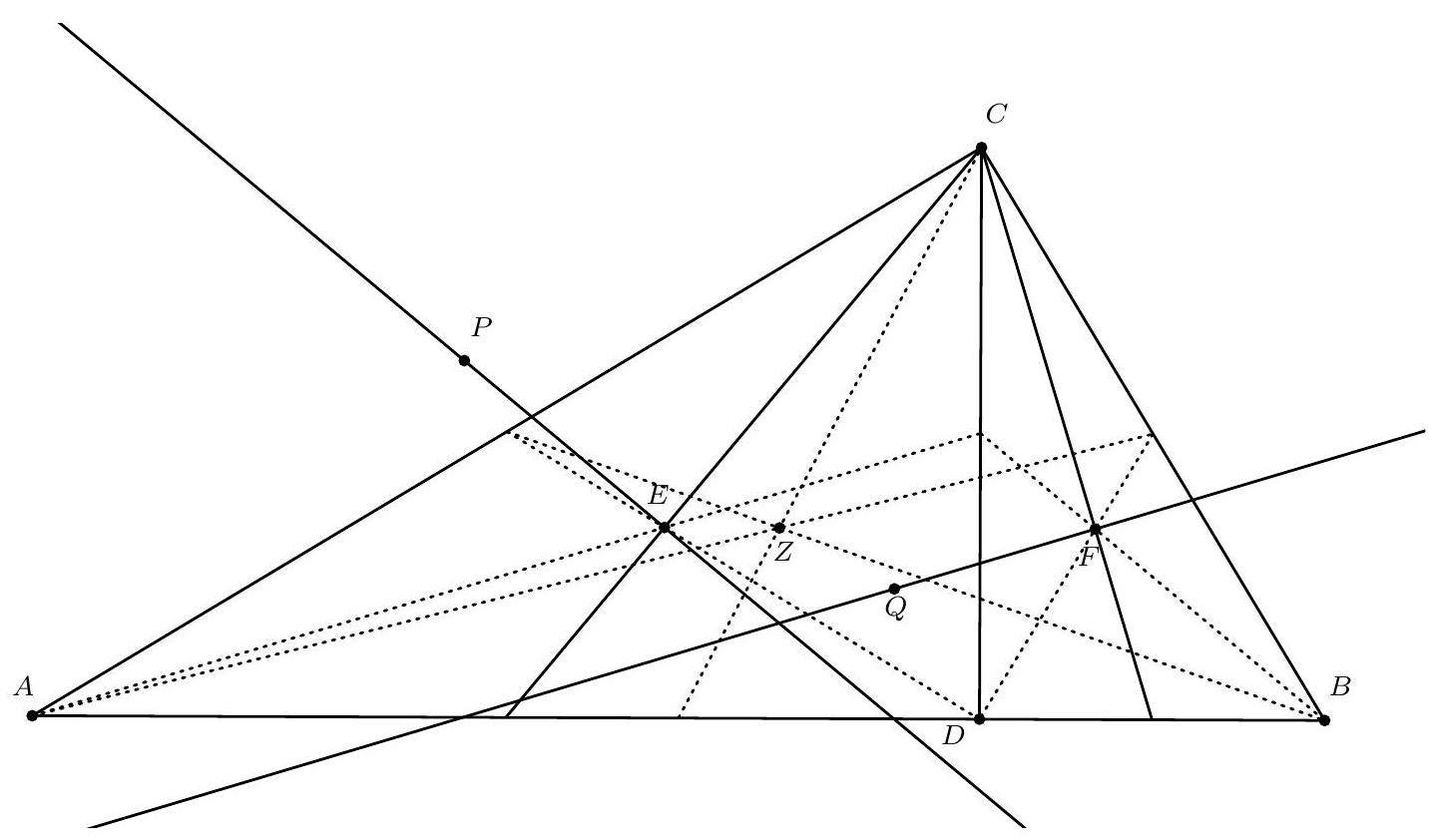
Let $ABC$ be a right triangle with $\angle C=90^\circ$, and let $D$ be the foot of the altitude from $C$. Let $E$ be the centroid of $\triangle ACD$ and $F$ the centroid of $\triangle BCD$. The point $P$ satisfies $\angle CEP=90^\circ$ and $|CP|=|AP|$, while the point $Q$ satisfies $\angle CFQ=90^\circ$ and $|CQ|=|BQ|$.
Prove that $PQ$ passes through the centroid of $\triangle ABC$.
Find all quadruples $(x_1,x_2,x_3,x_4)$ of real numbers satisfying the following six equalities:
$$
\begin{aligned}
x_1+x_2&=x_3^2+x_4^2+6x_3x_4,\\
x_1+x_3&=x_2^2+x_4^2+6x_2x_4,\\
x_1+x_4&=x_2^2+x_3^2+6x_2x_3,\\
x_2+x_3&=x_1^2+x_4^2+6x_1x_4,\\
x_2+x_4&=x_1^2+x_3^2+6x_1x_3,\\
x_3+x_4&=x_1^2+x_2^2+6x_1x_2.
\end{aligned}
$$
For each prime $p$, somewhere in the multiverse there exists a kingdom consisting of $p$ islands numbered from $1$ to $p$ with a bridge between any pair of them. When Jana visits a kingdom, coronavirus restrictions mean she must obey the following rule: Directly after visiting island $m$, she can only cross over to island $n$ if
$$
p \mid (m^{2}-n+1)(n^{2}-m+1)
$$
Show that there are infinitely many kingdoms such that Jana cannot travel to every island in this manner.
In a board of $2021 \times 2021$ grids, we pick $k$ unit squares such that every picked square shares at least one vertex with at most one other picked square. Determine the maximum of $k$.
Let $ABCD$ be a convex parallelogram whose angle at $A$ is acute. Let $P$ and $Q$ be the reflections of $A$ in the lines $BC$ and $CD$, respectively. Moreover, the line $BD$ intersects the interiors of the segments $AP$ and $AQ$ at $R$ and $S$, respectively. Prove that the circumcircles of triangles $BRP$ and $DQS$ are tangent.
Consider all positive real numbers $a,b,c,d$ satisfying $(a+c)(b+d)=ac+bd$. Determine the least possible value of
$$
S=\frac ab+\frac bc+\frac cd+\frac da.
$$
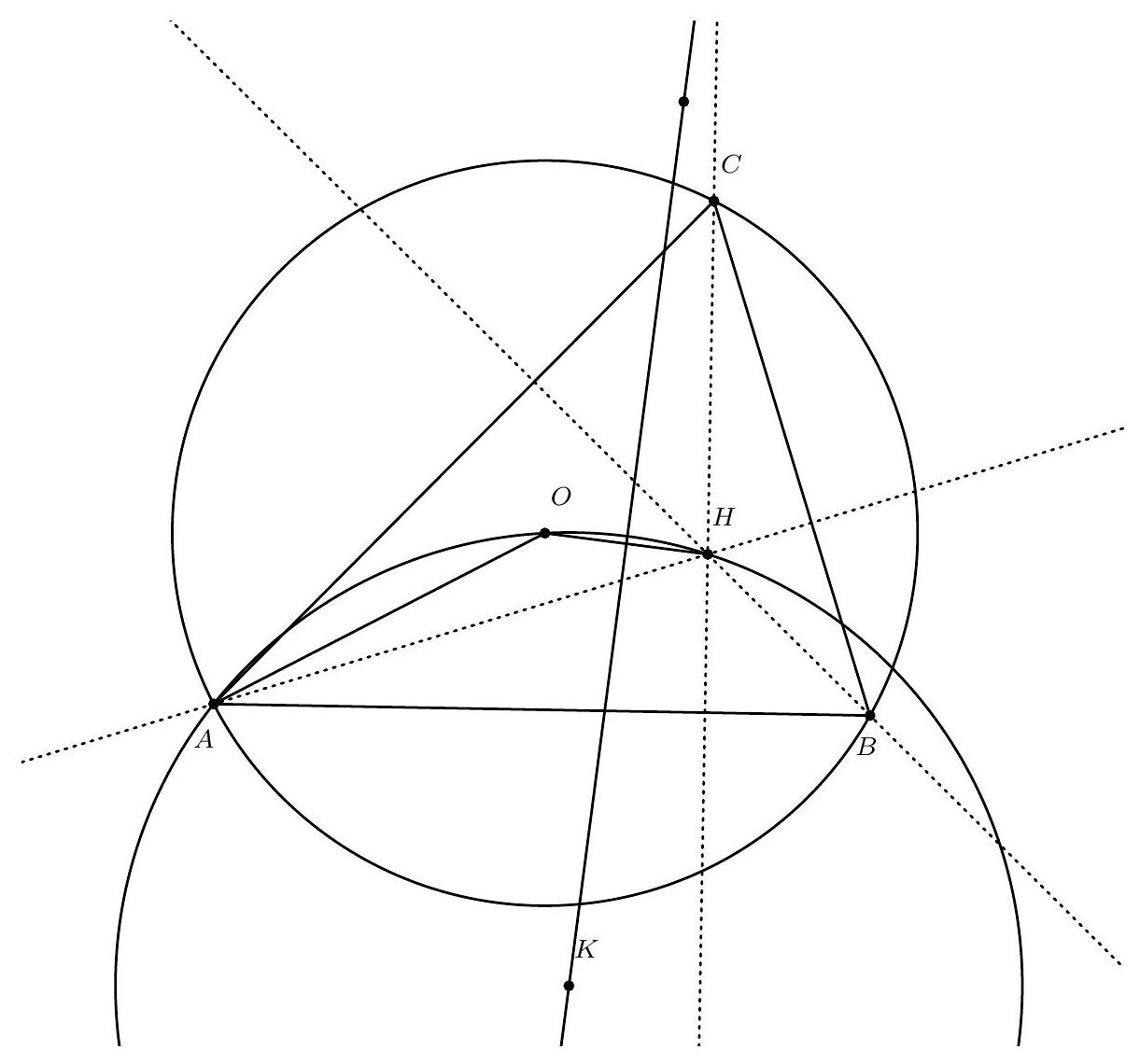
Let $ABC$ be an acute non-isosceles triangle with orthocentre $H$. Let $O$ be the circumcentre of triangle $ABC$, and let $K$ be the circumcentre of triangle $AHO$. Prove that the reflection of $K$ in $OH$ lies on $BC$.
Let $ABC$ be an acute non-isosceles triangle with orthocentre $H$. Let $O$ be the circumcentre of triangle $ABC$, and let $K$ be the circumcentre of triangle $AHO$. Prove that the reflection of $K$ in $OH$ lies on $BC$.
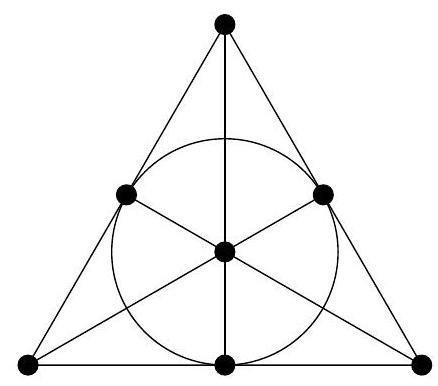
Let $p$ be a prime greater than $2$. Patricia wants to assign seven not necessarily distinct numbers from $\{1,2,\ldots,p\}$ to the black dots in the following figure, so that the product of the three numbers on any line or circle always has the same remainder upon division by $p$.
(a) Suppose Patricia uses the number $p$ at least once. What is the minimum total number of times she must use $p$?
(b) Suppose Patricia does not use $p$. In how many ways can she assign the numbers? Two assignments are different if at least one black dot receives different numbers. The figure is not rotated or reflected.
On a rectangular board consisting of $m \times n$ squares ($m, n \ge 3$), dominos have been placed (2 × 1- or 1 × 2-tiles), not overlapping each other. Each domino covers exactly two squares of the board. Suppose that the placement of the dominos has the property that no extra domino can be placed on the board, and the four corners of the board are not all empty. Prove that at least $\frac{2}{3}$ of the squares of the board is covered by dominos.
Determine all positive integers $n$ with the following property: for every triple $(a, b, c)$ of positive real numbers there exists a triple $(k, \ell, m)$ of non-negative integers such that $an^k, bn^\ell, cn^m$ are the lengths of sides of a (non-degenerate) triangle.
On a rectangular board consisting of $m\times n$ squares, where $m,n\ge3$, dominos ($2\times1$ or $1\times2$ tiles) are placed without overlapping or extending beyond the board. Each domino covers exactly two squares. Suppose no additional domino can be placed on the board and the four corner squares are not all empty. Prove that at least $\frac23$ of the squares are covered by dominos.
Determine all positive integers $n$ with the following property: for every triple $(a,b,c)$ of positive real numbers, there is a triple $(k,\ell,m)$ of nonnegative integers such that $an^k,bn^\ell,cn^m$ are the side lengths of a nondegenerate triangle.