Given two circles $(O_1), (O_2)$ with different radii and intersecting at two points $A, B$. The tangent $CD$ of the two circles (closer to point $B$) with $C \in (O_1)$ and $D \in (O_2)$. Draw diameters $BP, BQ$ of $(O_1), (O_2)$. The line through $B$, and perpendicular to $CD$ cuts $PQ$ at $K$.
a) Prove that $B$ is the orthocenter of triangle $KCD$.
b) Draw the angle bisectors $BX, BY$ of the triangles $KBP, KBQ$ respectively with $X, Y \in PQ$. Prove that $KX = KY$.
Prove that for every $n \ge 1$, then $v_3(u_n) = v_3(n)$, where $(u_n)$ is the sequence with $u_0 = 0$, $u_1 = 1$ and
$$
u_{n+2} = 2u_{n+1} + 2u_n, \forall n \ge 0.$$
In each square of a garden shaped like $2022 \times 2022$ board, there is initially a tree of height $0$. A gardener and a lumberjack alternate turns playing the following game, with the gardener taking the first turn:
* The gardener chooses a square in the garden. Each tree on that square and all the surrounding squares (of which there are at most eight) then becomes one unit taller.
* The lumberjack then chooses four different squares on the board. Each tree of positive height on those squares then becomes one unit shorter.
We say that a tree is majestic if its height is at least $10^6$. Determine the largest number $K$ such that the gardener can ensure there are eventually $K$ majestic trees on the board, no matter how the lumberjack plays.
Let $n \ge 3$ be an integer and let $x_1, x_2, \dots, x_n$ be real numbers in the interval $[0, 1]$. Let $s = x_1 + x_2 + \dots + x_n$, with $s \ge 3$. Prove that there exist integers $i$ and $j$ with $1 \le i \lt j \le n$ such that
$$
2^{j-i} x_i x_j \gt 2^{s-3}.
$$
For each $1 \le i \le 9$ and $T \in \mathcal{N}$, define $d_i(T)$ to be the total number of times the digit $i$ appears when all the multiples of $2023$ between $1$ and $T$ inclusive are written out in base $10$. Show that there are infinitely many $T \in \mathcal{N}$ such that there are precisely two distinct values among $d_1(T), d_2(T), \dots, d_9(T)$.
Prove that it is possible to pick 20 numbers among $1, 2, \ldots, 10000$ such that the members of any non-empty subset of these 20 numbers has a sum which is not an $n$-th power of some number (for any $n \gt 1$).
Find all positive integer $n \gt 1$ such that: there exist some real coefficient polynomial $P(x)$ of degree $n$, having the leading coefficient as $1$ and there exist distinct real numbers $r, s, t$ with the sum is $-2023$ and $P(k) \in \{r, s, t\}$ for all $k = 1, 2, 3, \dots, 3n - 1, 3n$.
Define a domino to be a $1 \times 2$ rectangular block. A $2023 \times 2023$ square grid is filled with non-overlapping dominoes, leaving a single $1 \times 1$ gap. John then repeatedly slides dominoes into the gap; each domino is moved at most once. What is the maximum number of times that John could have moved a domino? (Example: In the $3 \times 3$ grid shown below, John could move 2 dominoes: D, followed by A.)
Let $n \ge 2$ be a positive integer. For any integer $a$, let $Q_a(x)$ denote the polynomial $x^n + ax$. Let $p$ be a prime number and $S_a$ be the set
$$
S_a = \{b \mid 0 \le b \le p-1, \exists c \in \mathbb{Z}, Q_a(c) \equiv b \pmod{p}\}.
$$
Show that the expression $\frac{1}{p-1} \sum_{a=1}^{p-1} |S_a|$ is an integer.
Determine all real numbers $x$ between $0$ and $180$ such that it is possible to partition an equilateral triangle into finitely many triangles, each of which has an angle of $x^\circ$.
Let $ABCD$ be a square, $E$ be a point on the side $DC$, $F$ and $G$ be the feet of the altitudes from $B$ to $AE$ and from $A$ to $BE$, respectively. Suppose $DF$ and $CG$ intersect at $H$. Prove that $\angle AHB = 90^\circ$.
Colour a $20000 \times 20000$ square grid using $2000$ different colours with $1$ colour in each square. Two squares are neighbours if they share a vertex. A path is a sequence of squares so that $2$ successive squares are neighbours. Mark $k$ of the squares. For each unmarked square $x$, there is exactly $1$ marked square $y$ of the same colour so that $x$ and $y$ are connected by a path of squares of the same colour. For any $2$ marked squares of the same colour, any path connecting them must pass through squares of all the colours. Find the maximum value of $k$.
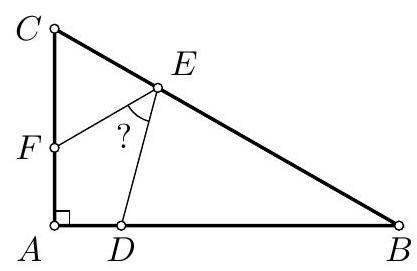
A right triangle $ABC$ with the right angle at $A$ is given. Points $D$, $E$ and $F$ lie on the sides $AB$, $BC$ and $CA$, respectively, such that $|BD| = |BE|$ and $|CF| = |CE|$ (see the figure). What is the size of the angle $\angle FED$ in degrees?
(A) 30
(B) 37.5
(C) 45
(D) 52.5
(E) It is impossible to determine, since the answer depends on the size of the angle $\angle CBA$.
A goldsmith has two alloys. The first alloy contains $90\%$ gold and the second $54\%$ gold. The goldsmith mixed $320~\mathrm{g}$ of the first alloy and $160~\mathrm{g}$ of the second alloy to obtain a new alloy. What percentage of gold does the new alloy contain?
(A) 33
(B) 48
(C) 65
(D) 72
(E) 78