We are given a positive integer $n$ which is not a power of $2$. Show that there exists a positive integer $m$ with the following two properties:
(i) $m$ is the product of two consecutive positive integers;
(ii) the decimal representation of $m$ consists of two identical blocks of $n$ digits.
The incircle of the triangle $ABC$ touches the sides $BC$, $CA$, and $AB$ in the points $D$, $E$, and $F$, respectively. Let $K$ be the point symmetric to $D$ with respect to the incenter. The lines $DE$ and $FK$ intersect at $S$. Prove that $AS$ is parallel to $BC$.
Let $A, B, C, D, E$ be points such that $A B C D$ is a cyclic quadrilateral and $A B D E$ is a parallelogram. The diagonals $A C$ and $B D$ intersect at $S$ and the rays $A B$ and $D C$ intersect at $F$. Prove that $\angle A F S=\angle E C D$.
In each vertex of a regular $n$-gon there is a fortress. At the same moment each fortress shoots at one of the two nearest fortresses and hits it. The result of the shooting is the set of the hit fortresses; we do not distinguish whether a fortress was hit once or twice. Let $P(n)$ be the number of possible results of the shooting. Prove that for every positive integer $k \geq 3$, $P(k)$ and $P(k+1)$ are relatively prime.
For each integer $n \geq 2$, determine the largest real constant $C_n$ such that for all positive real numbers $a_1, \ldots, a_n$, we have
$$
\frac{a_1^2+\cdots+a_n^2}{n} \geq\left(\frac{a_1+\cdots+a_n}{n}\right)^2+C_n \cdot\left(a_1-a_n\right)^2
$$
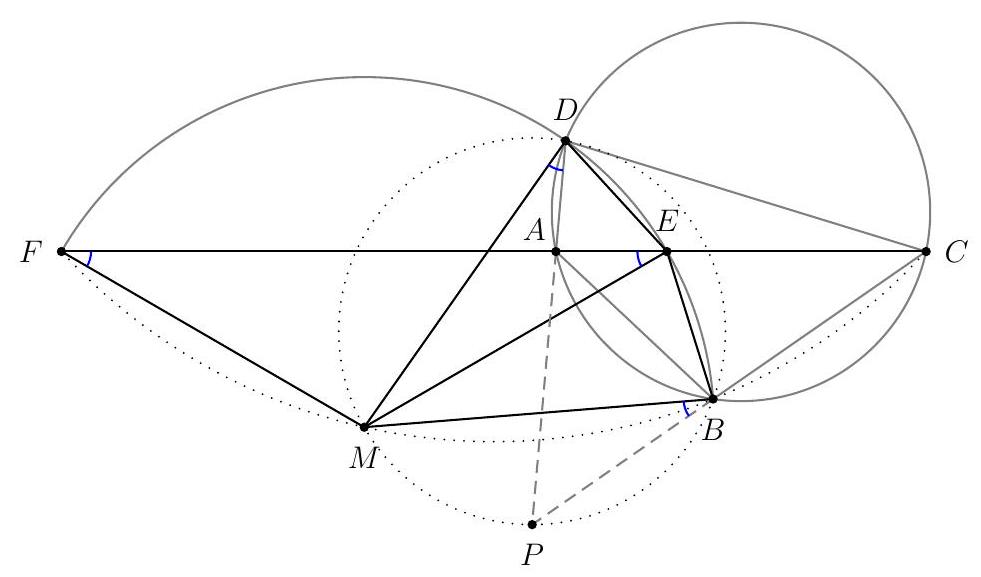
We are given a cyclic quadrilateral $A B C D$ with a point $E$ on the diagonal $A C$ such that $A D = A E$ and $C B = C E$. Let $M$ be the center of the circumcircle $k$ of the triangle $B D E$. The circle $k$ intersects the line $A C$ in the points $E$ and $F$. Prove that the lines $F M$, $A D$, and $B C$ meet at one point.
Let $f: \mathbb{R} \to \mathbb{R}$ and let:
$$
f(f(x)+f(y))+f(f(x)-f(y)) = x^k f(x) + y^k f(y)
$$
hold, where $k$ is a given natural number. What values can $f(1)$ have? (easier case: $k=2$).
The real numbers $a, b, c, d$ satisfy simultaneously the equations
$$
abc - d = 1, \quad bcd - a = 2, \quad cda - b = 3, \quad dab - c = -6.
$$
Prove that $a + b + c + d \neq 0$.
Let $p_1, p_2, \dots, p_{2009} \in \mathbb{R}^+$. Prove the inequality
$$
\sum_{i=1}^{2009} \frac{p_i}{p_{i+1} + p_{i+2} + \dots + p_{i+1004}} \ge \frac{2009}{1004},
$$
where the indexes are taken mod $2009$.
A natural number is called "happy" if the sum of its digits is $7$. Let $(a_n)_{n=1}^\infty$ be the increasing sequence of happy numbers. If $a_n = 2005$, compute $a_{5n}$.
Let $ABC$ be an acute triangle with orthocenter $H$, and let $M$ be the midpoint of $AC$. The point $C_1$ on $AB$ is such that $CC_1$ is an altitude of the triangle $ABC$. Let $H_1$ be the reflection of $H$ in $AB$. The orthogonal projections of $C_1$ onto the lines $AH_1$, $AC$ and $BC$ are $P$, $Q$ and $R$, respectively. Let $M_1$ be the point such that the circumcentre of triangle $PQR$ is the midpoint of the segment $MM_1$.
Prove that $M_1$ lies on the segment $BH_1$.
Find all functions $f: \mathbb{R}^2 \rightarrow \mathbb{R}$, for which:
$$
f(xf(x,z), yf(y,z)) = f(x,z)f(y,z)
$$
for every real numbers $x$, $y$ and $z$ and $f(0,0) \neq 0$.
For each integer $n$ ($n \ge 2$) let $f(n)$ denote the sum of all positive integers that are at most $n$ and not relatively prime to $n$.
Prove that $f(n+p) \neq f(n)$ for each such $n$ and for every prime $p$.
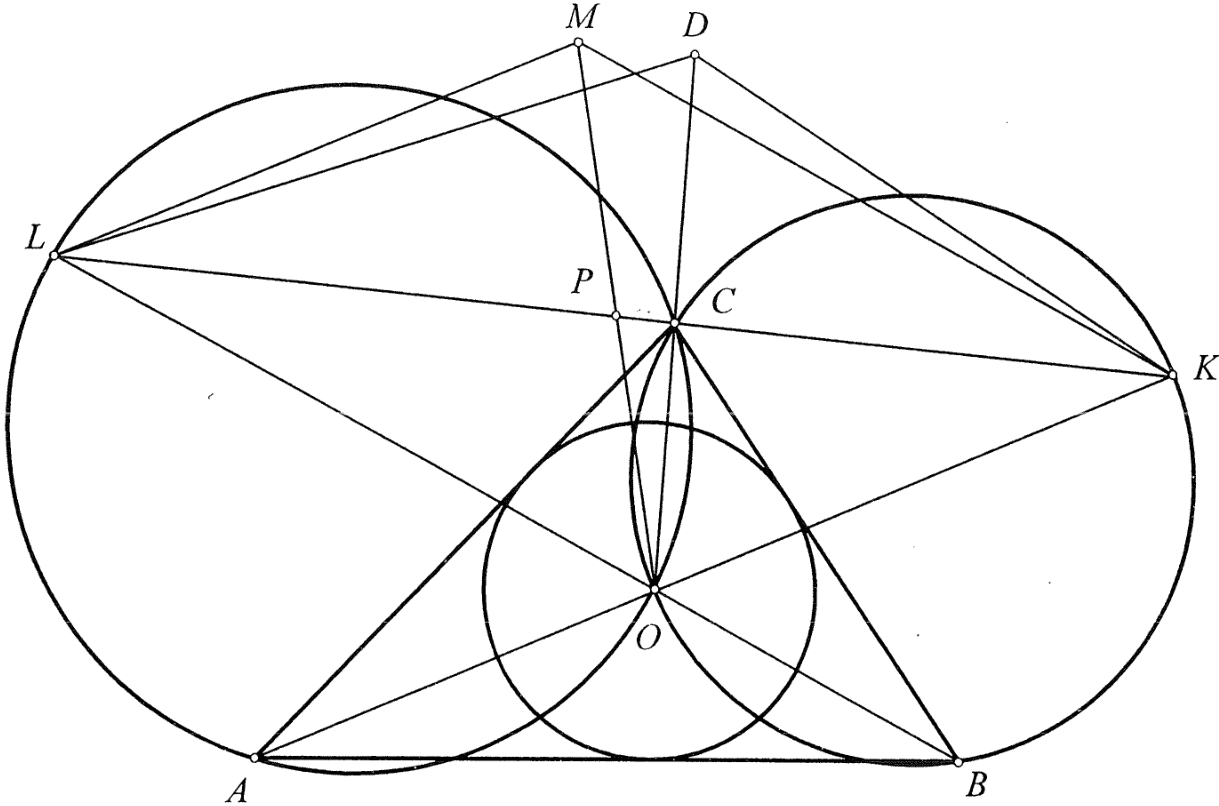
Let $O$ be the center of the incircle of triangle $ABC$. The points $K$ and $L$ are the intersection points of the circumcircles of triangles $BOC$ and $AOC$, respectively with the bisectors of the angles at $A$ and $B$, $P$ is the middle point of $\overline{KL}$, $M$ is symmetrical to $O$ with respect to $P$ and $N$ is symmetrical to $O$ with respect to the line $KL$. Prove that the quadrilateral $KLMN$ is inscribed.
The number $2009^{2009^{2009}}$ is given, written in base 10. In one step we make the following operation: we delete the first and last digit, and we add their sum to the number which remained after deleting the first and last digit.
a) If after a finite number of steps there remains a two-digit number, is it possible that that number is a perfect square?
b) If after a finite number of steps there remains a one-digit number. Determine that number.
A trapezoid $ABCD$ is given, such that $\overline{AB} = \overline{AC} = \overline{BD}$. Let $M$ be the midpoint of $CD$. Find the angles of the trapezoid if $\angle MBC = \angle CAB$.