Prove that for all real $x$ and $y$ the inequality
$$
|x + y| + |x + 1| + |y + 1| \geq 2
$$
holds. For what $x$ does there exist $y$ such that $|x+y|+|x+1|+|y+1| = 2$?
Find all real numbers $x$ that solve the equation
$$
\log_2(10x) + \log_4(100x) + \log_8(1000x) - 2\log_{64} x = 9.
$$
Write the result as a reduced fraction.
Let $x_1, \ldots, x_{100}$ be nonnegative real numbers such that $x_i + x_{i+1} + x_{i+2} \le 1$ for all $i = 1, \ldots, 100$ (we put $x_{101} = x_1, x_{102} = x_2$).
Find the maximal possible value of the sum $S = \sum_{i=1}^{100} x_i x_{i+2}$.
Let $\omega$ be a circle, and let $A$ and $B$ be points on a line not intersecting $\omega$. Given a point $X_0$ on $\omega$, define a sequences $X_0, X_1, X_2, \ldots$ and $Y_0, Y_1, Y_2, \ldots$ as follows: $Y_n$ is the second intersection of the line $AX_n$ with $\omega$ and $X_{n+1}$ is the second intersection of the line $BY_n$ with $\omega$. Prove that if for some integer $k$, it happens that $X_k = X_0$ for some choice of $X_0$ then $X_k = X_0$ for any choice of $X_0$.
Find all polynomials $P$ with integer coefficients and the following property: for any integer $a$ and any prime $p$ that divides $P(a)$ the prime $p$ also divides $a$.
$B_1$ and $C_1$ are marked on the bisector of angle $A$ in triangle $ABC$ so that $BB_1 \perp AB$, $CC_1 \perp AC$. Let $M$ be the midpoint of $B_1C_1$. Prove that $MB = MC$.
In the triangle $ABC$ the bisector of the angle $\angle BAC$ meets the segment $BC$ at $D$. The triangle $ADC$ is isosceles with the apex at $D$ and the lengths of the segments $CD$ and $BD$ are $|CD| = 36$ and $|BD| = 64$. Find the lengths of the sides of the triangle $ABC$.
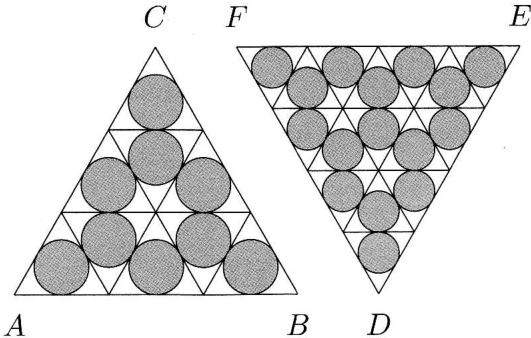
The equilateral triangles $ABC$ and $DEF$ with the sides of length $1$ are divided into congruent equilateral triangles as shown in the figure. A circle is inscribed into each smaller triangle. What is the ratio of the shaded area of the triangle $ABC$ to the shaded area of the triangle $DEF$?
(A) $\frac{9}{16}$ (B) $\frac{3}{4}$ (C) $1$ (D) $\frac{4}{3}$ (E) $\frac{16}{9}$
For non-zero real numbers $a$, $b$ and $c$ we have
$$
a = b + 2c, \quad a + c = b + d, \quad b = d + c.
$$
Which of the following equalities is certainly true?
(A) $d = 2c$
(B) $a = 3c$
(C) $a = 6c$
(D) $a = b + 2d$
(E) $b = 2a + 2d$
Twelve balls are numbered by the numbers $1$, $2$, $3$, $\ldots$, $12$. Each ball is coloured either red or green, so that the following two conditions are satisfied:
a. If two balls marked by different numbers $a$ and $b$ are coloured red and $a+b \lt 13$, then the ball marked by the number $a+b$ is coloured red, too.
b. If two balls marked by different numbers $a$ and $b$ are coloured green and $a+b \lt 13$, then the ball marked by the number $a+b$ is also coloured green.
Let $\{a_1, a_2, ..., a_m\}$ and $\{b_1, b_2, ..., b_n\}$ be two sets of reals with the same sum. Prove that you can find an $m \times n$ array so that the row sums are $a_1, a_2, ..., a_m$ and the column sums are $b_1, b_2, ..., b_n$.
Peter has $111$ red and $111$ blue marbles. Every day, Peter's uncle lets him exchange either $11$ red marbles for $7$ blue marbles or $20$ blue marbles for $28$ red marbles.
a. Can Peter increase the total number of marbles he has by $20$ after several exchanges?
b. Can Peter increase the total number of marbles he has by $33$ after several exchanges?
c. Can Peter ever have three times as many blue marbles as he has red ones?
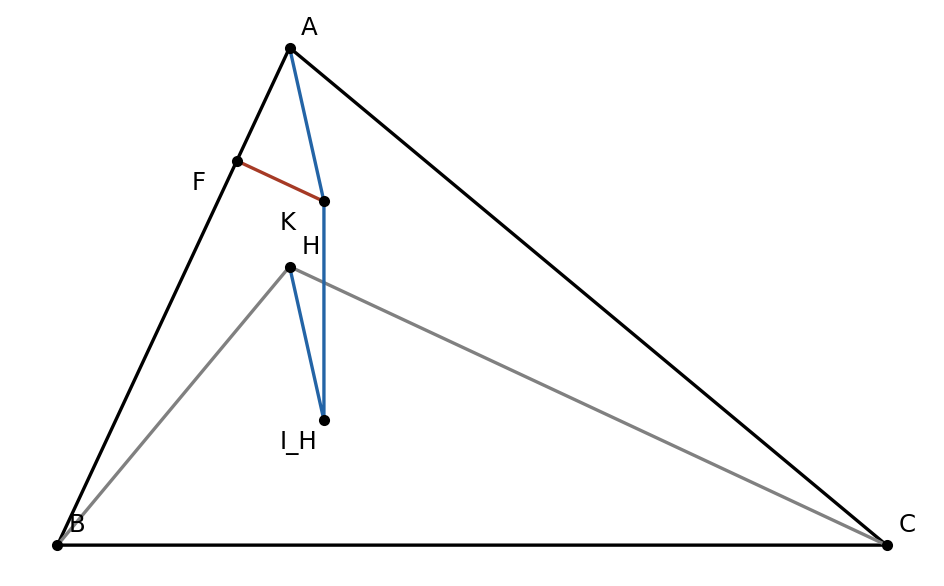
In an acute-angled triangle $ABC$ the orthocenter is $H$. $I_H$ is the incenter of $\triangle BHC$. The bisector of $\angle BAC$ intersects the perpendicular from $I_H$ to the side $BC$ at point $K$. Let $F$ be the foot of the perpendicular from $K$ to $AB$.