Among a group of $451$ persons, every pair of persons together know exactly one other person (knowing is mutual). Denote by $n$ the difference between the number of persons known by a member of the group who knows the largest number of persons among the group, and the number of persons known by another member who knows the smallest number of persons among the group. Find the maximum possible value of $n$ and all other possible value(s) of $n$.
Prove that if $n$ and $k$ are positive integers such that $1 \lt k \lt n-1$, then the binomial coefficient $\binom{n}{k}$ is divisible by at least two different primes.
A sequence $x_1,x_2,\ldots$ is defined by $x_1=1$, $x_{2k}=-x_k$, and $x_{2k-1}=(-1)^{k+1}x_k$ for every $k\ge1$. Prove that $x_1+x_2+\ldots+x_n\ge0$ for every $n\ge1$.
How many ways are there to color the vertices of a $2n$-gon with three colors such that no vertex has the same color as either of its two neighbors or the vertex directly across from it?
In the Cartesian plane $Oxy$ we consider the points $A_1(40,1)$, $A_2(40,2)$, ..., $A_{40}(40,40)$, as well as the line segments $OA_1, OA_2, ..., OA_{40}$. A point of the Cartesian plane will be called "good" if its coordinates are integers and lies in the interior of a line segment $OA_i$, $i = 1, 2, 3, ..., 40$. Also a line segment from $OA_1, OA_2, ..., OA_{40}$, will be called "good" if it contains at least one "good" point. Determine the number of "good" points and the number of "good" segments.
We consider the set of four digit positive integers $x = \overline{\alpha\beta\gamma\delta}$ with digits different than zero and pairwise different. We also consider the integers $y = \overline{\delta\gamma\beta\alpha}$ and we suppose that $x \gt y$. Find the greatest and the lowest value of the difference $x - y$, as well as the corresponding four digit integers for which these values are obtained.
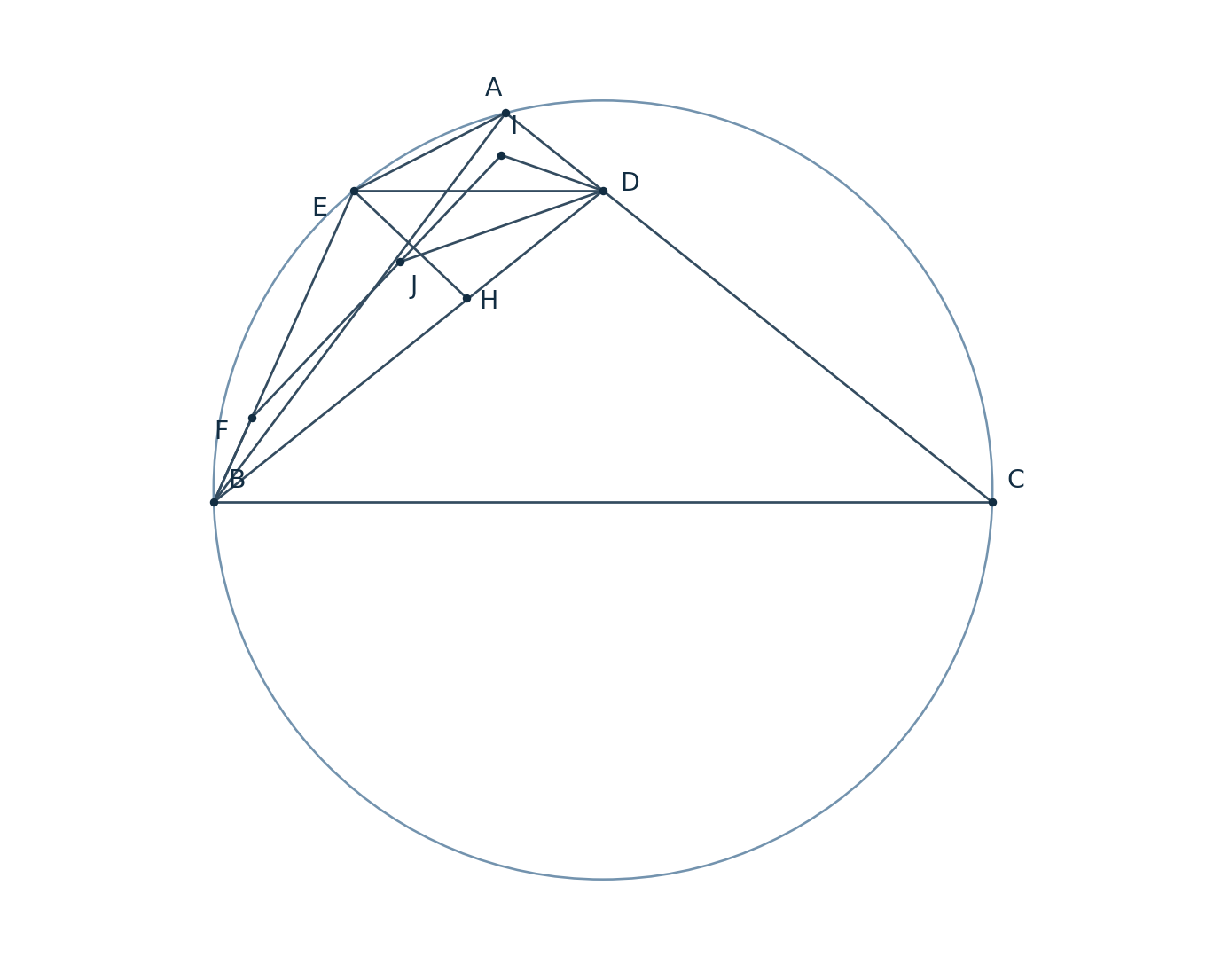
Let $ABC$ be a triangle such that $AB \lt AC$. The perpendicular bisector of the side $BC$ meets the side $AC$ at the point $D$, and the (interior) bisectrix of the angle $ADB$ meets the circumcircle $ABC$ at the point $E$. Prove that the (interior) bisectrix of the angle $AEB$ and the line through the incentres of the triangles $ADE$ and $BDE$ are perpendicular.
Let $A=\{1,2,3, \ldots, 9\}$. Find the number of bijective functions $f: A \rightarrow A$ for which there exists at least one $i \in A$ such that
$$
\left|f(i)-f^{-1}(i)\right|\gt 1
$$
Find a real number $t$ such that for any set of 120 points $P_1, \dots, P_{120}$ on the boundary of a unit square, there exists a point $Q$ on this boundary with $|P_1Q| + \dots + |P_{120}Q| = t$.
Let $n$ be a positive integer and let $W = \ldots x_{-1} x_{0} x_{1} x_{2} \ldots$ be an infinite periodic word consisting of the letters $a$ and $b$. Suppose that the minimal period $N$ of $W$ is greater than $2^{n}$.
A finite nonempty word $U$ is said to appear in $W$ if there exist indices $k \leq \ell$ such that $U = x_{k} x_{k+1} \ldots x_{\ell}$. A finite word $U$ is called ubiquitous if the four words $U a$, $U b$, $a U$, and $b U$ all appear in $W$. Prove that there are at least $n$ ubiquitous finite nonempty words.
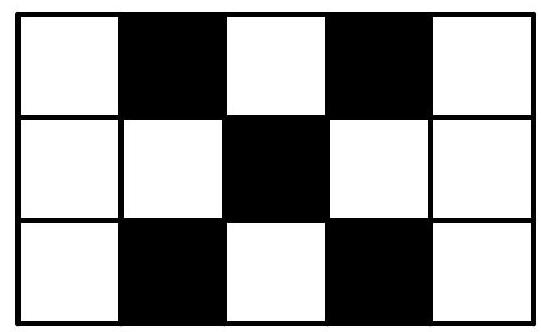
Each square in a $3 \times 10$ grid is colored black or white. Let $N$ be the number of ways this can be done in such a way that no five squares in an 'X' configuration (as shown by the black squares below) are all white or all black. Determine $\sqrt{N}$.
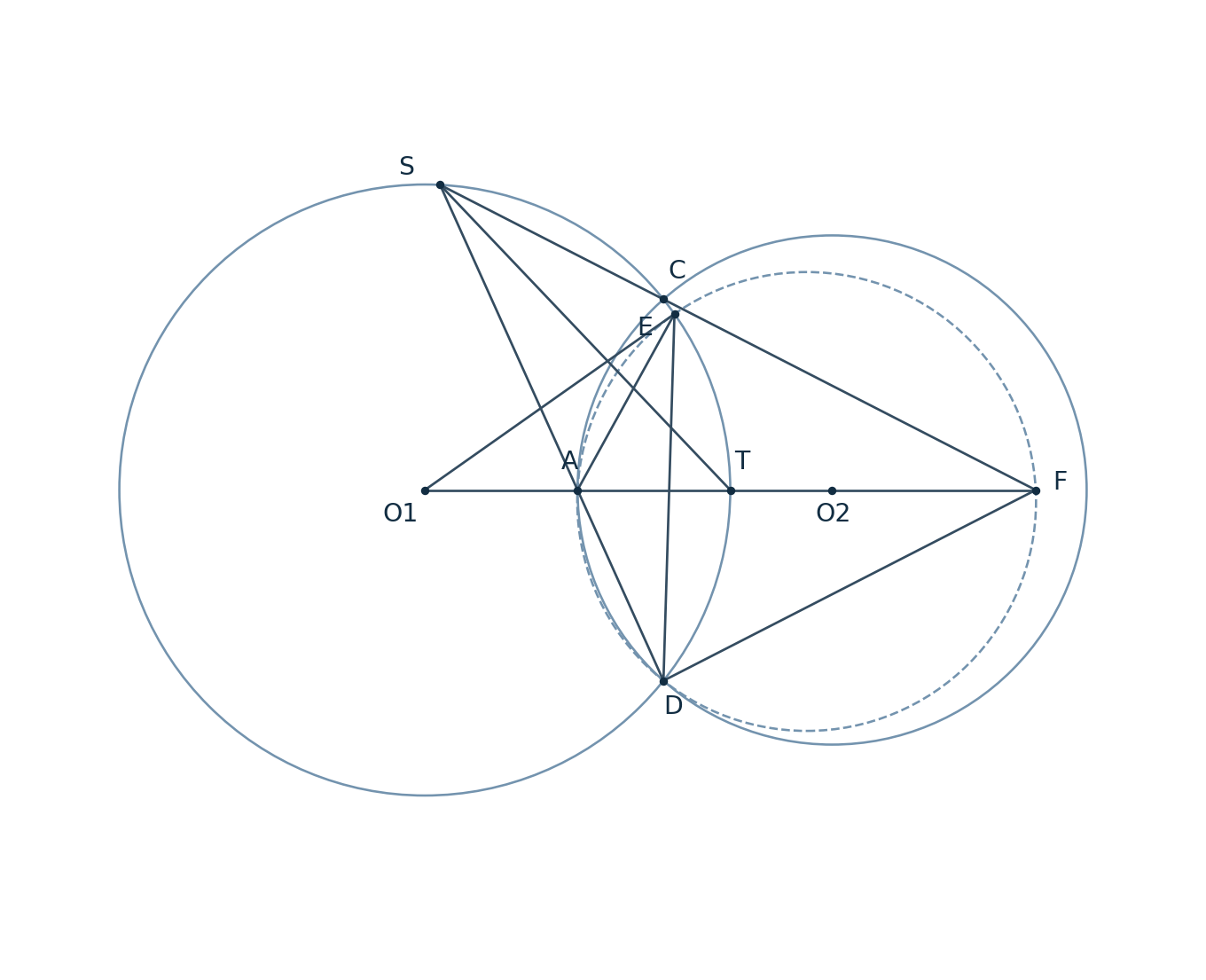
Let $\Gamma_1,\Gamma_2$ be intersecting circles with centers $O_1,O_2$, respectively, such that $\Gamma_2$ meets the segment $O_1O_2$ at $A$. Their intersection points are $C,D$. The line $AD$ meets $\Gamma_1$ again at $S$. The line $CS$ meets $O_1O_2$ at $F$. Let $\Gamma_3$ be the circumcircle of triangle $ADF$, and let $E$ be the second intersection of $\Gamma_1$ and $\Gamma_3$. Prove that $O_1E$ is tangent to $\Gamma_3$.
In-Young generates a string of $B$ zeroes and ones using the following method:
- First, she flips a fair coin. If it lands heads, her first digit will be a $0$, and if it lands tails, her first digit will be a $1$.
- For each subsequent bit, she flips an unfair coin, which lands heads with probability $A$. If the coin lands heads, she writes down the number (zero or one) different from previous digit, while if the coin lands tails, she writes down the previous digit again.
What is the expected value of the number of zeroes in her string?
Let $I$ be the incenter and $AD$ be a diameter of the circumcircle of a triangle $ABC$. If the point $E$ on the ray $BA$ and the point $F$ on the ray $CA$ satisfy the condition
$$
BE = CF = \frac{AB + BC + CA}{2},
$$
show that the lines $EF$ and $DI$ are perpendicular.
Let $n$ be a natural number. In a cage containing $n$ monkeys there are $n$ climbing poles. To give the monkeys exercise, the keepers put a banana at the top of each pole at feeding time. They also connect the poles by finitely many ropes, with different rope ends attached at different points. When a monkey climbs a pole and encounters a rope, it cannot resist swinging along it before continuing upward. Each monkey starts at a different pole. Show that every monkey gets a banana.
In an acute scalene triangle $ABC$, points $D$, $E$, $F$ lie on sides $BC$, $CA$, $AB$, respectively, such that $AD \perp BC$, $BE \perp CA$, $CF \perp AB$. Altitudes $AD$, $BE$, $CF$ meet at orthocenter $H$. Points $P$ and $Q$ lie on segment $EF$ such that $AP \perp EF$ and $HQ \perp EF$. Lines $DP$ and $QH$ intersect at point $R$. Compute $HQ/HR$.
Let $D$ be a point different from the vertices on the side $BC$ of a triangle $ABC$. Let $I, I_1$ and $I_2$ be the incenters of the triangles $ABC$, $ABD$ and $ADC$, respectively. Let $E$ be the second intersection point of the circumcircles of the triangles $AI_1I$ and $ADI_2$, and $F$ be the second intersection point of the circumcircles of the triangles $AII_2$ and $AI_1D$. Prove that if $AI_1 = AI_2$, then
$$
\frac{EI}{FI} \cdot \frac{ED}{FD} = \frac{EI_1^2}{FI_2^2}.
$$