Let for $k$, $0 \le k \le 9$, $a_k$ be the coefficient of the $x^k$-term in the polynomial $(x+1)^3(x+2)^3(x+3)^3$. Find the value of $a_2 + a_4 + a_6 + a_8$.
Suppose the least common multiple of three positive integers $x$, $y$, $z$ is $2100$. What is the minimum possible value that the sum $x + y + z$ can take?
How many 25-tuples $(x_1, x_2, \dots, x_{25})$ of non-negative integers are there which satisfy the following identity?
$$
x_1^2 + x_2^2 + \dots + x_{25}^2 = 2 + x_1x_2 + x_2x_3 + \dots + x_{24}x_{25}.
$$
In the acute-angled triangle $ABC$, with $AB \neq AC$, $D$ is the foot of the angle bisector of angle $A$, and $E$, $F$ are the feet of the altitudes from $B$ and $C$, respectively. The circumcircles of triangles $DBF$ and $DCE$ intersect for the second time at $M$. Prove that $ME = MF$.
Let $n$ be a positive integer. Determine all positive integers $p$ for which there exist positive integers $x_1 \lt x_2 \lt \dots \lt x_n$ such that
$$
\frac{1}{x_1} + \frac{2}{x_2} + \dots + \frac{n}{x_n} = p.
$$
Let $a$, $b$ be relatively prime positive integers and let $a_n$ and $b_n$ be integer sequences satisfying $(a + b\sqrt{2})^{2n} = a_n + b_n\sqrt{2}$. Find all primes $p$ such that there is a positive integer $n$ less than or equal to $p$ satisfying $b_n \equiv 0 \pmod{p}$.
Let $AB$ be a diameter of a circle $\omega$ with center $O$ and $OC$ be a radius of $\omega$ which is perpendicular to $AB$. Let $M$ be a point on the line segment $OC$. Let $N$ be the second point of intersection of the line $AM$ with $\omega$, and let $P$ be the point of intersection of the lines tangent to $\omega$ at $N$ and at $B$. Show that the points $M, O, P, N$ are concyclic.
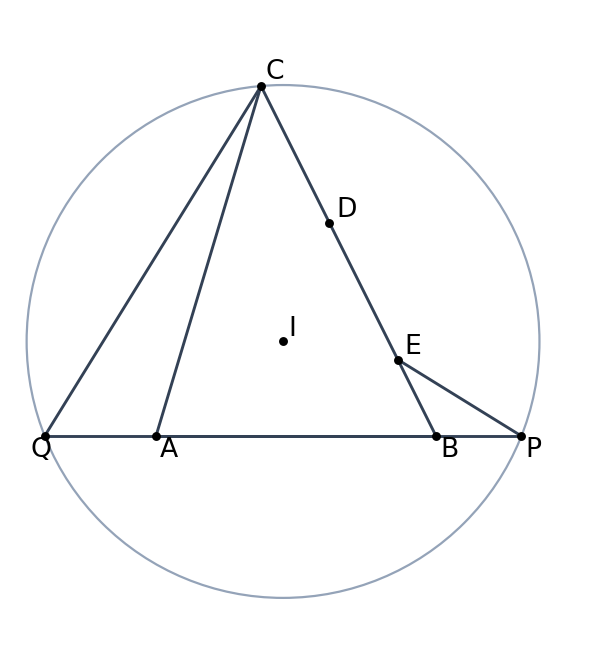
Let $I$ be the incenter and $AB$ the shortest side of a triangle $ABC$. The circle with center $I$ and passing through $C$ intersects the ray $AB$ at the point $P$ and the ray $BA$ at the point $Q$. Let $D$ be the point where the excircle of the triangle $ABC$ belonging to angle $A$ touches the side $BC$, and let $E$ be the symmetric of the point $C$ with respect to $D$. Show that the lines $PE$ and $CQ$ are perpendicular.
Let $n$ be a positive integer. A flea on the real line makes $n$ jumps of lengths $1,2,3,\ldots,n$. It may choose the order of the lengths and whether each jump goes right or left.
a. Prove that for $n=2012$ it can finish at its starting point.
b. Prove that for $n=2013$ this is impossible.
c. In general, for which $n$ can it return to its starting point?
Prove that for each $n \in \mathbb{N}$ there exist natural numbers $a_1 \lt a_2 \lt \dots \lt a_n$ such that $\phi(a_1) \gt \phi(a_2) \gt \dots \gt \phi(a_n)$.
Let $\Gamma_{1}$ and $\Gamma_{2}$ be two circles touching each other externally at $R$. Let $l_{1}$ be a line which is tangent to $\Gamma_{2}$ at $P$ and passing through the center $O_{1}$ of $\Gamma_{1}$. Similarly, let $l_{2}$ be a line which is tangent to $\Gamma_{2}$ at $Q$ and passing through the center $O_{2}$ of $\Gamma_{2}$. Suppose $l_{1}$ and $l_{2}$ are not parallel and intersect at $K$. If $K P = K Q$, prove that the triangle $P Q R$ is equilateral.
Suppose two $20 \times 13$ rectangular grids consisting of $260$ small squares are given.
We insert into each square box of the two grids, numbers $1, 2, \ldots, 260$ in the following way:
* For the first grid, we start inserting numbers $1, 2, \ldots, 13$ into the boxes on the top row from left to right. Continue to insert numbers $14, 15, \ldots, 26$ into the boxes on the second row from left to right. Keep on going until you finish inserting numbers $248, 249, \ldots, 260$ from left to right into the boxes on the bottom row.
* For the second grid, we start inserting numbers $1, 2, \ldots, 20$ into the boxes on the right-most column from top to bottom. Continue to insert numbers $21, 22, \ldots, 40$ into the boxes on the second column from the right from top to bottom. Keep on doing until you finish inserting numbers $241, 242, \ldots, 260$ into the boxes on the left most column from top to bottom.
List all the positive integers which get inserted into the boxes located in the same position in the two grids in the two ways of distributing numbers described above.
For a triangle $ABC$ let $B_1$, $C_1$ be the excenters corresponding to $B$, $C$, respectively. The line $B_1C_1$ intersects the circumcircle of $ABC$ at $D$ ($\neq A$). Let $E$ be the intersection of the perpendiculars from $B_1$ to $CA$ and from $C_1$ to $AB$. Let $\omega$ be the circumcircle of the triangle $ADE$. The tangent to $\omega$ at $D$ intersects the line $AE$ at $F$. The perpendicular from $D$ to $AE$ intersects $AE$ at $G$ and this line intersects $\omega$ at $H$ ($\neq D$). The circumcircle of the triangle $HGF$ intersects $\omega$ at $I$ ($\neq H$). Let $J$ be the perpendicular foot at $AH$ from $D$. Show that $AI$ passes through the midpoint of $DJ$.
Let $a, b, c, d$ be positive integers such that $a \geq b \geq c \geq d$. Prove that the equation $x^{4}-a x^{3}-b x^{2}-c x-d=0$ has no integer solution.
Determine if there exists a (three-variable) polynomial $P(x, y, z)$ with integer coefficients satisfying the following property: A positive integer $n$ is *not* a perfect square if and only if there is a triple $(x, y, z)$ of positive integers such that $P(x, y, z) = n$.
(This problem was suggested by Gerhard Woeginger.)
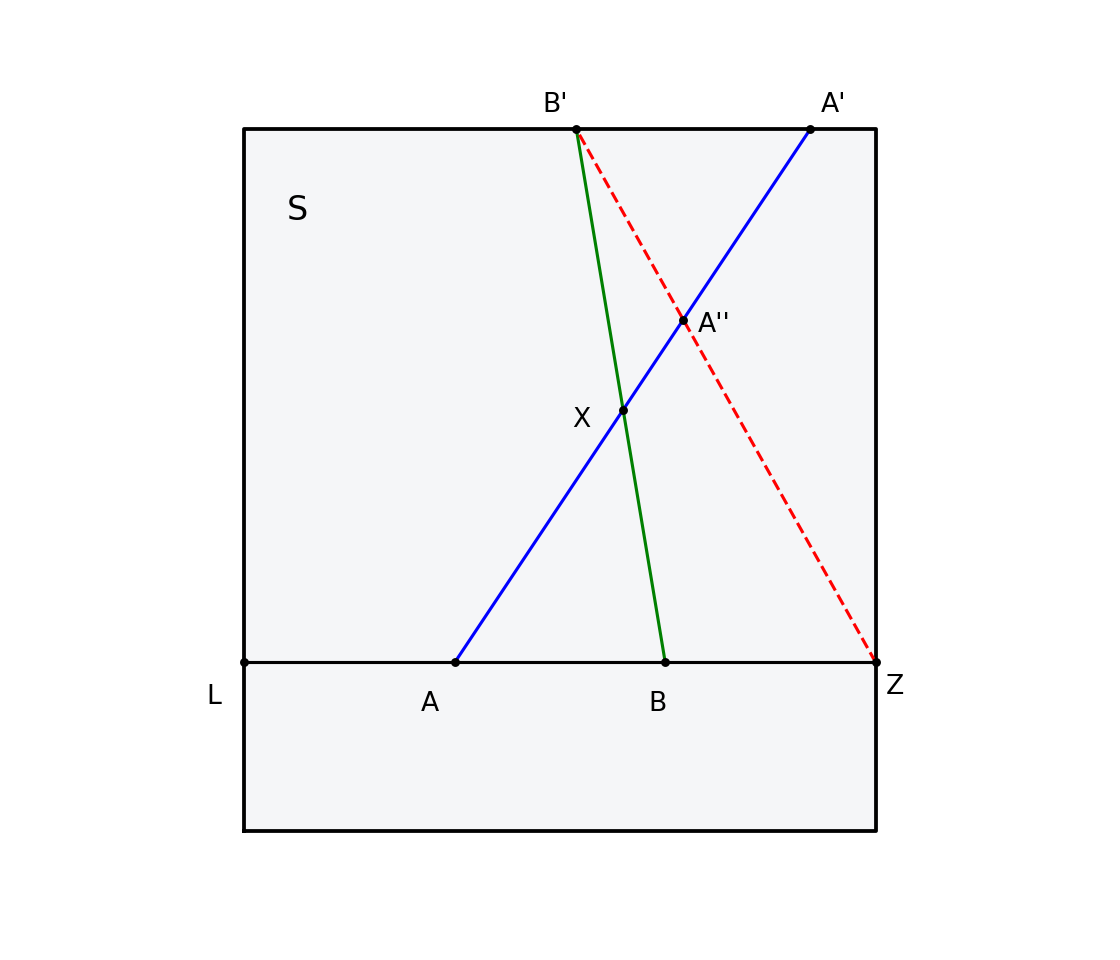
Suppose $S$ is a convex figure in plane with area $10$. Consider a chord of length $3$ in $S$ and let $A$ and $B$ be two points on this chord which divide it into three equal parts. For a variable point $X$ in $S - \{A, B\}$, let $A'$ and $B'$ be the intersection points of rays $AX$ and $BX$ with the boundary of $S$. Let $S'$ be those points of $X$ for which $AA' \gt \frac{1}{3} BB'$. Prove that the area of $S'$ is at least $6$.
Let $n$ be a positive integer. Points $P_1, P_2, \dots, P_{4n}$ are placed in a plane in such a way that no 3 points among them lie on any straight line. Furthermore, for each $i = 1, 2, \dots, 4n$ if we rotate the half-line $P_i P_{i-1}$ starting at $P_i$ around the point $P_i$ by $90^\circ$ clockwise, then the half line falls onto the half-line $P_i P_{i+1}$ starting at $P_i$. Determine the maximum possible number of the pairs $(i, j)$ for which the line segments $P_i P_{i+1}$ and $P_j P_{j+1}$ intersect at a point different from the end points of the line segments. Here we let $P_0 = P_{4n}, P_{4n+1} = P_1$ and assume that $1 \le i \lt j \le 4n$.
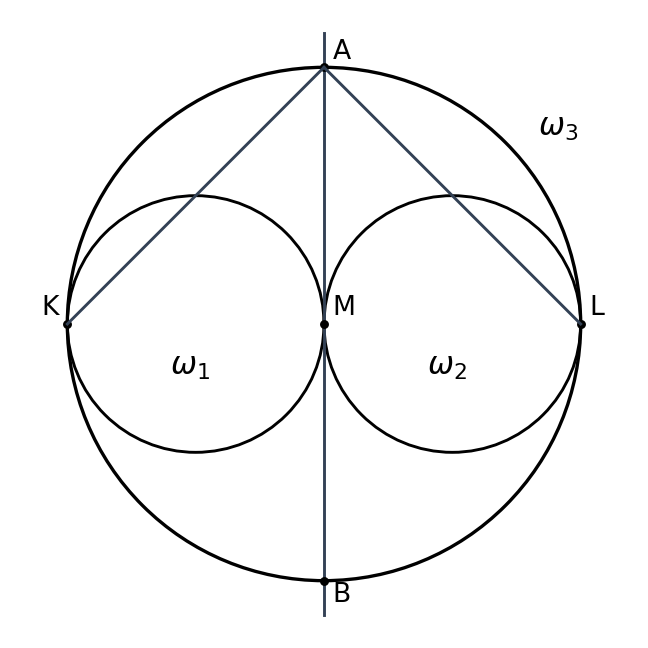
$\omega_{1}$ and $\omega_{2}$ are two circles that are externally tangent to each other at the point $M$ and internally tangent to a circle $\omega_{3}$ at the points $K$ and $L$, respectively. Let $A$ and $B$ be the two points where the common tangent line at $M$ to $\omega_{1}$ and $\omega_{2}$ intersects $\omega_{3}$. Show that if $\angle K A B = \angle L A B$ then the line segment $A B$ is a diameter of $\omega_{3}$.