In convex hexagon $ABCDEF,$ all six sides are congruent, $\angle A$ and $\angle D$ are right angles, and $\angle B,$ $\angle C,$ $\angle E,$ and $\angle F$ are congruent. The area of the hexagonal region is $2116(\sqrt{2} + 1).$ Find $AB.$
The lengths of the sides of a triangle with positive area are $\log_{10} 12,$ $\log_{10} 75,$ and $\log_{10} n,$ where $n$ is a positive integer. Find the number of possible values for $n.$
Let $(a_1, a_2, a_3, \ldots, a_{12})$ be a permutation of $(1, 2, 3, \ldots, 12)$ for which $$
a_1 \gt a_2 \gt a_3 \gt a_4 \gt a_5 \gt a_6
$$ and $$
\begin{aligned} &a_6 \lt a_7 \lt a_8 \lt a_9 \\ &\lt a_{10} \lt a_{11} \lt a_{12}. \end{aligned}
$$ An example of such a permutation is $(6, 5, 4, 3, 2, 1, 7, 8, 9, 10, 11, 12).$ Find the number of such permutations.
When rolling a certain unfair six-sided die with faces numbered $1,$ $2,$ $3,$ $4,$ $5,$ and $6,$ the probability of obtaining face $F$ is greater than $\frac{1}{6},$ the probability of obtaining the face opposite face $F$ is less than $\frac{1}{6},$ the probability of obtaining each of the other faces is $\frac{1}{6},$ and the sum of the numbers on each pair of opposite faces is $7.$ When two such dice are rolled, the probability of obtaining a sum of $7$ is $\frac{47}{288}.$ Given that the probability of obtaining face $F$ is $\frac{m}{n},$ where $m$ and $n$ are relatively prime positive integers, find $m + n.$
Square $ABCD$ has sides of length $1.$ Points $E$ and $F$ are on $\overline{BC}$ and $\overline{CD},$ respectively, so that $\triangle AEF$ is equilateral. A square with vertex $B$ has sides that are parallel to those of $ABCD$ and a vertex on $\overline{AE}.$ The length of a side of this smaller square is $\frac{a - \sqrt{b}}{c},$ where $a,$ $b,$ and $c$ are positive integers and $b$ is not divisible by the square of any prime. Find $a + b + c.$
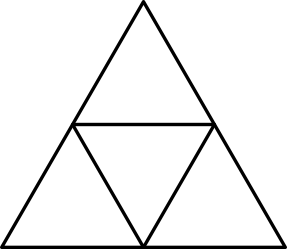
There is an unlimited supply of congruent equilateral triangles made of colored paper. Each triangle is a solid color with the same color on both sides of the paper. A large equilateral triangle is constructed from four of these paper triangles as shown. Two large triangles are considered distinguishable if it is not possible to place one on the other, using translations, rotations, and/or reflections, so that their corresponding small triangles are of the same color. Given that there are six different colors of triangles from which to choose, how many distinguishable large equilateral triangles can be constructed?
Circles $\mathcal{C}_1,$ $\mathcal{C}_2,$ and $\mathcal{C}_3$ have their centers at $(0, 0),$ $(12, 0),$ and $(24, 0),$ and have radii $1,$ $2,$ and $4,$ respectively. Line $t_1$ is a common internal tangent to $\mathcal{C}_1$ and $\mathcal{C}_2$ and has a positive slope, and line $t_2$ is a common internal tangent to $\mathcal{C}_2$ and $\mathcal{C}_3$ and has a negative slope. Given that lines $t_1$ and $t_2$ intersect at $(x, y),$ and that $x = p - q\sqrt{r},$ where $p,$ $q,$ and $r$ are positive integers and $r$ is not divisible by the square of any prime, find $p + q + r.$
Seven teams play a soccer tournament in which each team plays every other team exactly once. No ties occur, each team has a $50\%$ chance of winning each game it plays, and the outcomes of the games are independent. In each game, the winner is awarded $1$ point and the loser gets $0$ points. The total points are accumulated to decide the ranks of the teams. In the first game of the tournament, team $A$ beats team $B.$ The probability that team $A$ finishes with more points than team $B$ is $\frac{m}{n},$ where $m$ and $n$ are relatively prime positive integers. Find $m + n.$
A sequence is defined as follows: $a_1 = a_2 = a_3 = 1,$ and, for all positive integers $n,$ $a_{n+3} = a_{n+2} + a_{n+1} + a_n.$ Given that $a_{28} = 6090307,$ $a_{29} = 11201821,$ and $a_{30} = 20603361,$ find the remainder when $\sum_{k=1}^{28} a_k$ is divided by $1000.$
Equilateral $\triangle ABC$ is inscribed in a circle of radius $2.$ Extend $\overline{AB}$ through $B$ to point $D$ so that $AD = 13,$ and extend $\overline{AC}$ through $C$ to point $E$ so that $AE = 11.$ Through $D,$ draw a line $\ell_1$ parallel to $\overline{AE},$ and through $E,$ draw a line $\ell_2$ parallel to $\overline{AD}.$ Let $F$ be the intersection of $\ell_1$ and $\ell_2.$ Let $G$ be the point on the circle that is collinear with $A$ and $F$ and distinct from $A.$ Given that the area of $\triangle CBG$ can be expressed in the form $\frac{p\sqrt{q}}{r},$ where $p,$ $q,$ and $r$ are positive integers, $p$ and $r$ are relatively prime, and $q$ is not divisible by the square of any prime, find $p + q + r.$
Let $S_n$ be the sum of the reciprocals of the nonzero digits of the integers from $1$ to $10^n,$ inclusive. Find the smallest positive integer $n$ for which $S_n$ is an integer.
Given that $x,$ $y,$ and $z$ are real numbers that satisfy $$
x = \sqrt{y^2 - \frac{1}{16}} + \sqrt{z^2 - \frac{1}{16}},
$$ $$
y = \sqrt{z^2 - \frac{1}{25}} + \sqrt{x^2 - \frac{1}{25}},
$$ $$
z = \sqrt{x^2 - \frac{1}{36}} + \sqrt{y^2 - \frac{1}{36}},
$$ and that $x + y + z = \frac{m}{\sqrt{n}},$ where $m$ and $n$ are positive integers, and $n$ is not divisible by the square of any prime, find $m + n.$