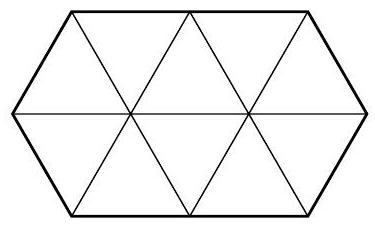
Alice writes $1001$ letters on a blackboard, each one chosen independently and uniformly at random from the set $S=\{a, b, c\}$. A move consists of erasing two distinct letters from the board and replacing them with the third letter in $S$. What is the probability that Alice can perform a sequence of moves which results in one letter remaining on the blackboard?
Let $ABC$ be a triangle with $AB = 5$, $BC = 6$, $CA = 7$. Let $D$ be a point on ray $AB$ beyond $B$ such that $BD = 7$, $E$ be a point on ray $BC$ beyond $C$ such that $CE = 5$, and $F$ be a point on ray $CA$ beyond $A$ such that $AF = 6$. Compute the area of the circumcircle of $DEF$.
The elevator buttons in Harvard's Science Center form a $3 \times 2$ grid of identical buttons, and each button lights up when pressed. One day, a student is in the elevator when all the other lights in the elevator malfunction, so that only the buttons which are lit can be seen, but one cannot see which floors they correspond to. Given that at least one of the buttons is lit, how many distinct arrangements can the student observe? (For example, if only one button is lit, then the student will observe the same arrangement regardless of which button it is.)
Regular hexagon $P_{1} P_{2} P_{3} P_{4} P_{5} P_{6}$ has side length $2$. For $1 \leq i \leq 6$, let $C_{i}$ be a unit circle centered at $P_{i}$ and $\ell_{i}$ be one of the internal common tangents of $C_{i}$ and $C_{i+2}$, where $C_{7}=C_{1}$ and $C_{8}=C_{2}$. Assume that the lines $\{\ell_{1}, \ell_{2}, \ell_{3}, \ell_{4}, \ell_{5}, \ell_{6}\}$ bound a regular hexagon. The area of this hexagon can be expressed as $\sqrt{\frac{a}{b}}$, where $a$ and $b$ are relatively prime positive integers. Compute $100a+b$.
Let $n \gt 1$ be a positive integer and $S$ be a collection of $\frac{1}{2}\binom{2n}{n}$ distinct $n$-element subsets of $\{1,2, \ldots, 2n\}$. Show that there exists $A, B \in S$ such that $|A \cap B| \leq 1$.
Ana and Banana are rolling a standard six-sided die. Ana rolls the die twice, obtaining $a_{1}$ and $a_{2}$, then Banana rolls the die twice, obtaining $b_{1}$ and $b_{2}$. After Ana's two rolls but before Banana's two rolls, they compute the probability $p$ that $a_{1} b_{1} + a_{2} b_{2}$ will be a multiple of $6$. What is the probability that $p = \frac{1}{6}$?
Anne-Marie has a deck of 16 cards, each with a distinct positive factor of $2002$ written on it. She shuffles the deck and begins to draw cards from the deck without replacement. She stops when there exists a nonempty subset of the cards in her hand whose numbers multiply to a perfect square. What is the expected number of cards in her hand when she stops?
In triangle $ABC$ with $AB=8$ and $AC=10$, the incenter $I$ is reflected across side $AB$ to point $X$ and across side $AC$ to point $Y$. Given that segment $XY$ bisects $AI$, compute $BC^{2}$. (The incenter $I$ is the center of the inscribed circle of triangle $ABC$.)
Roger the ant is traveling on a coordinate plane, starting at $(0,0)$. Every second, he moves from one lattice point to a different lattice point at distance $1$, chosen with equal probability. He will continue to move until he reaches some point $P$ for which he could have reached $P$ more quickly had he taken a different route. For example, if he goes from $(0,0)$ to $(1,0)$ to $(1,1)$ to $(1,2)$ to $(0,2)$, he stops at $(0,2)$ because he could have gone from $(0,0)$ to $(0,1)$ to $(0,2)$ in only $2$ seconds. The expected number of steps Roger takes before he stops can be expressed as $\frac{a}{b}$, where $a$ and $b$ are relatively prime positive integers. Compute $100a + b$.
While waiting for their food at a restaurant in Harvard Square, Ana and Banana draw 3 squares $\square_{1}, \square_{2}, \square_{3}$ on one of their napkins. Starting with Ana, they take turns filling in the squares with integers from the set $\{1,2,3,4,5\}$ such that no integer is used more than once. Ana's goal is to minimize the minimum value $M$ that the polynomial $a_{1} x^{2}+a_{2} x+a_{3}$ attains over all real $x$, where $a_{1}, a_{2}, a_{3}$ are the integers written in $\square_{1}, \square_{2}, \square_{3}$ respectively. Banana aims to maximize $M$. Assuming both play optimally, compute the final value of $100 a_{1}+10 a_{2}+a_{3}$.
Let $\Gamma$ be a circle, and $\omega_{1}$ and $\omega_{2}$ be two non-intersecting circles inside $\Gamma$ that are internally tangent to $\Gamma$ at $X_{1}$ and $X_{2}$, respectively. Let one of the common internal tangents of $\omega_{1}$ and $\omega_{2}$ touch $\omega_{1}$ and $\omega_{2}$ at $T_{1}$ and $T_{2}$, respectively, while intersecting $\Gamma$ at two points $A$ and $B$. Given that $2 X_{1} T_{1}=X_{2} T_{2}$ and that $\omega_{1}, \omega_{2}$, and $\Gamma$ have radii 2, 3, and 12, respectively, compute the length of $A B$.
Tessa picks three real numbers $x, y, z$ and computes the values of the eight expressions of the form $\pm x \pm y \pm z$. She notices that the eight values are all distinct, so she writes the expressions down in increasing order. For example, if $x=2, y=3, z=4$, then the order she writes them down is
$$
-x-y-z,+x-y-z,-x+y-z,-x-y+z,+x+y-z,+x-y+z,-x+y+z,+x+y+z
$$
How many possible orders are there?
A small village has $n$ people. During their yearly elections, groups of three people come up to a stage and vote for someone in the village to be the new leader. After every possible group of three people has voted for someone, the person with the most votes wins.
This year, it turned out that everyone in the village had the exact same number of votes! If $10 \leq n \leq 100$, what is the number of possible values of $n$ ?
Proposed by: Vincent Bian
Let $\Gamma_{1}$ and $\Gamma_{2}$ be concentric circles with radii $1$ and $2$, respectively. Four points are chosen on the circumference of $\Gamma_{2}$ independently and uniformly at random, and are then connected to form a convex quadrilateral. What is the probability that the perimeter of this quadrilateral intersects $\Gamma_{1}$?