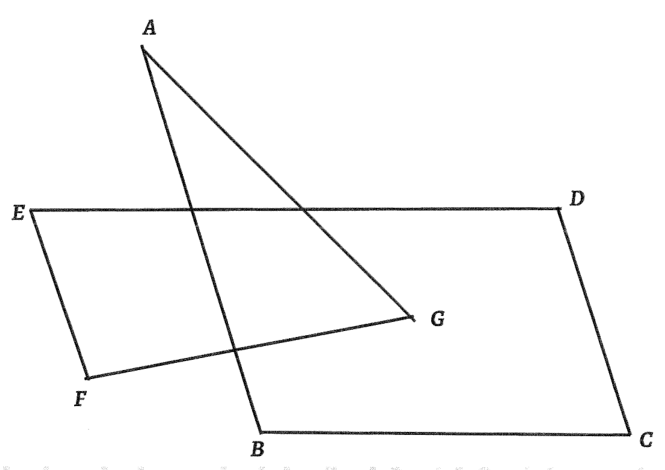
Two rhombi $ABCD$ and $AXYZ$ are external to each other with a common vertex $A$. The vertices of the rhombi are labelled clockwise. If $\angle DAX=\angle BAZ$, prove that the centres of the rhombi and the midpoint of the segment $BZ$ form an isosceles triangle.
Find all 6-digit integers $n$ such that $n$ is a perfect square and that the number formed by the last 3 digits of $n$ is 1 more than the number formed by the first 3 digits of $n$.
Jack and Jill play the following game: Jack throws 3 dice and Jill can select some of them, possibly none, and turn each of them to the opposite side. Jill wins if the sum of the values on the dice is a multiple of 4. Can Jill always win? (Note the game is played with standard dice where the sum of the numbers on opposite sides is 7.)
Let $A,B,C,D$ be the 4 squares in the centre of a $4\times4$ grid of squares. These 4 squares form the centre of the grid. A frog can jump from one of the 4 squares in the centre to any square in the grid which shares a side. If the frog jumps out of the centre from a particular square for the first time, that square is called an exit square. Find the number of ways in which the frog can start from $A$ with $A$ being the exit square in $n$ jumps. Give your answer in terms of $n$.
Let $ABCD$ be a convex quadrilateral and $M$ be the intersection of the diagonals. Through $M$ draw a line meeting the side $AB$ at $P$ and the side $CD$ at $Q$. Find all the quadrilaterals so that there exists the segment $PQ$ that divides the triangles $ABM$ and $CDM$ into 4 similar triangles.
Let $ABCD$ be a convex quadrilateral and $M$ be the intersection of its diagonals. Through $M$ draw a line meeting the side $AB$ at $P$ and the side $CD$ at $Q$. Find all the quadrilaterals so that there exists the segment $PQ$ that divides the triangles $ABM$ and $CDM$ into 4 similar triangles.
Let $I$ be the incenter of $\triangle ABC$ and $\omega$ be its incircle. Let $D$ be the intersection of $\omega$ with $BC$. Suppose $X,Y$ are points on $\omega$ such that lines $IX,IY$ and $AD$ are tangent to the circumcircle of $\triangle AXY$. Prove that line $XY$ bisects $BC$.
Find all functions $f:\mathbb Z^+\to\mathbb Z^+$, where $\mathbb Z^+$ is the set of all positive integers, such that for any positive integers $m,n$,
$$f^{f(m)}(n)+n=f^m(n)+f(n).$$
Let $a_1,a_2,\ldots,a_n$ be positive numbers and $A$ their arithmetic mean. Prove that
$$A^{n-1}\ge\frac1n\sum_{i=1}^n a_1\cdots\widehat{a_i}\cdots a_n,$$
where $\widehat{a_i}$ denotes that the term $a_i$ is omitted.
Find the smallest positive $m$ so that it is possible to choose 8 vertices from a regular polygon with $m$ sides such that no three of them are the vertices of an isosceles triangle.
The diagram below shows six points, $A,B,C,M,N$ and $O$ on the real number line. $M$ is the midpoint of the line segment $AB$, $N$ is the midpoint of the line segment $BC$ and $O$ the midpoint of the line segment $AC$.
Let $p=\frac{7a}{15}-1$ and $q=a^2-\frac{8a}{15}$, where $a$ is a real number. Which is the following statements is correct for any given value of $a$?
A fair dice with numbers 1, 2, 3, 4, 5 and 6 on its six faces respectively was rolled twice. In the first and second rolls, the dice landed on numbers $a$ and $b$ respectively. What is the probability that the equation $x^2+ax+b=0$ has two distinct real roots?
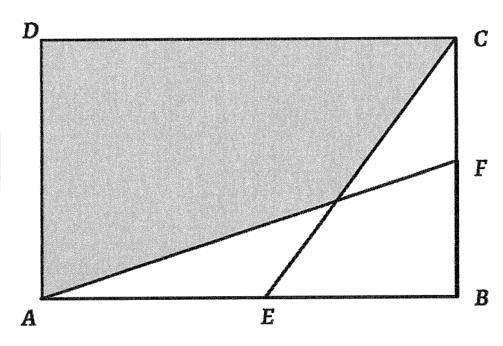
In the diagram below, $ABCD$ is a rectangle. $E$ and $F$ are the midpoints of the sides $AB$ and $BC$ respectively and $AF$ and $CE$ are line segments. If the area of the rectangle is 24 $cm^2$, find the area of the shaded region in $cm^2$.
In a fund-raising campaign of a school, 11 girls and $b$ boys of Class 2A raised the same total amount as that of Class 2B which has 9 boys and $g$ girls, where $b>0$ and $g>0$. The total amount that each class raised is $\$(bg+9b+11g+145)$. Given that the average amount raised by each of the two classes is $\$x$ and $x$ is an integer value more than 30, find the value of $x$.