Let $ABC$ be an acute triangle and $O$ be its circumcircle. Let $O'$ be the circle that is tangent to $O$ at $A$ and tangent to the side $BC$ at $D$. $O'$ intersects the lines $AB$ and $AC$ at $E$ and $F$, respectively. $O'$ intersects the lines $OO'$ and $EO'$ at $A' (\neq A)$ and $G (\neq E)$, respectively. The lines $BO$ and $A'G$ intersect at $H$. Prove that $DF^2 = AF \cdot GH$.
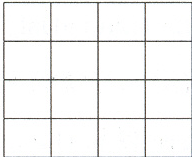
Consider the sixteen tiles fixed on a wall as shown below. How many ways are there to write either $0$ or $1$ on each tile so that the product of the two numbers written on every neighboring pair of tiles (sharing a common side) is always $0$?
For the vertex $A$ of $\triangle ABC$, define $\ell_A$ by the distance between the feet of perpendiculars drawn to the sides $AB$ and $AC$ from the intersection of the angle bisector of $\angle A$ and the side $BC$. Similarly, define $\ell_B$ and $\ell_C$ for the vertices $B$ and $C$, respectively. Prove the inequality
$$
\frac{\ell_A \ell_B \ell_C}{\ell^3} \le \frac{1}{64}
$$
where $\ell$ is the perimeter of $\triangle ABC$.
Let $f: \mathbb{N} \to \mathbb{N}$ be a function satisfying
$$
k f(n) \le f(kn) \le k f(n) + k - 1
$$
for every $k, n \in \mathbb{N}$, where $\mathbb{N}$ is the set of all positive integers.
(1) Show that, for every $a, b \in \mathbb{N}$,
$$
f(a) + f(b) \le f(a + b) \le f(a) + f(b) + 1.
$$
(2) Show that, if $f$ satisfies
$$
f(2007n) \le 2007 f(n) + 2005
$$
for every $n \in \mathbb{N}$, then there exists $c \in \mathbb{N}$ such that $f(2007c) = 2007 f(c)$.
For four non-coplanar points, an equalizing plane is a plane such that the respective distances from each of the points to that plane are all equal. Given a set of four non-coplanar points, how many equalizing planes are there?
Let $a_{n}=1+n^{3}$ be the sequence $\{2,9,28,65, \ldots\}$ and $\delta_{n}=\gcd\left(a_{n+1}, a_{n}\right)$. Find the maximum value that $\delta_{n}$ can take.
A convex polyhedron has as faces 12 squares, 8 regular hexagons and 6 regular octagons. At each vertex of the polyhedron exactly one square, one hexagon and one octagon meet. How many segments joining pairs of vertices of the polyhedron are interior to it, that is, are neither edges nor contained in a face?
Solve, in the set of real numbers, the system of equations
$$
\left.\begin{array}{l}
y^{3}-6 x^{2}+12 x-8=0 \\
z^{3}-6 y^{2}+12 y-8=0 \\
x^{3}-6 z^{2}+12 z-8=0
\end{array}\right\}
$$
Let $ABC$ be a triangle and let $D$, $E$ and $F$ be points on the segments $AC$, $BA$ and $CB$ respectively, such that the segments $AF$, $BD$, $CE$ meet at a point $P$ in the interior of the triangle. We know that $BP = 6$, $PD = 6$, $PC = 9$, $PE = 3$ and $AF = 20$. Find the area of the triangle $ABC$.
Let $P$ be a point in the interior of a triangle $ABC$. Through $P$ the parallels $KP$, $MP$ and $NP$ to the sides $AB$, $AC$ and $BC$ are drawn, which divide the original triangle into three triangles and three parallelograms. Let $S_{1}$, $S_{2}$, $S_{3}$ be the areas of the new triangles and $S$ the area of the triangle $ABC$. Prove that
$$
S \leq 3\left(S_{1}+S_{2}+S_{3}\right)
$$
Prove that, in a triangle, the distance from any vertex to the orthocenter is twice the distance from the circumcenter to the side opposite to that vertex.
Let $ABCD$ be a trapezoid with $AB \parallel CD$ and $AB \gt CD$. The points $K$ and $L$ lie on the sides $AB$ and $CD$ respectively with $\dfrac{AK}{KB} = \dfrac{DL}{LC}$. The points $P$ and $Q$ lie on the segment $KL$ such that
$$
\angle APB = \angle BCD \quad \text{and} \quad \angle CQD = \angle ABC
$$
Show that the points $P$, $Q$, $B$ and $C$ lie on a circle.
We call two people a pair of friends if they know each other, and we call them a non-friend pair if they do not know each other (being friends or not being friends is always mutual). Let $m, n$ be natural numbers. Find the smallest natural number $k$ such that the following holds: in every group of $k$ people there are always $2 m$ people who form $m$ disjoint pairs of friends, or there are $2 n$ people who form $n$ disjoint non-friend pairs.