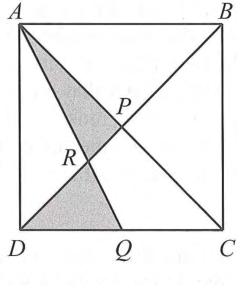
In the diagram, $ABCD$ is a square where $AB=24$ cm. Let point $Q$ be the midpoint of side $CD$, point $P$ be the intersection of diagonals $AC$ and $BD$, point $R$ be the intersection of line segments $AQ$ and $BD$. Find the sum of the area, in cm², of triangle $ARP$ and triangle $DRQ$.
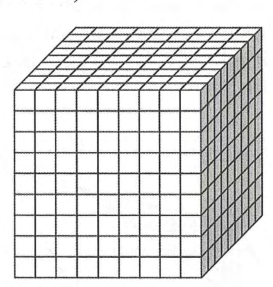
A $9\times9\times9$ cube is formed by using 729 unit cubes, each of size $1\times1\times1$. How many different cubes of different sizes can we find in this $9\times9\times9$ cube? (Note: Two cubes having the same size but are located at different positions must be counted as two different cubes)
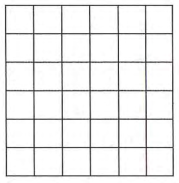
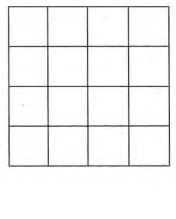
Peter is about to shade some cells in the $6\times6$ grid which is shown on the right. Any two cells that share a side must at most have one shaded cell. While on those un-shaded cells, Peter writes a number which is the total number of cells that shares a side with this cell that are shaded. Given that all the numbers written is at most 3, what is the maximum number of cells that Peter can shade? Fill the grid with one possible solution of shaded cells and filling number.
Find all possible three-digit numbers $\overline{abc}$ such that $\overline{abc}=a!+b!+c!$. (Note: $n!$ (read as $n$ factorial) means $n!=n\times(n-1)\times(n-2)\times\cdots\times3\times2\times1$. For example, $6!=6\times5\times4\times3\times2\times1=720$.)
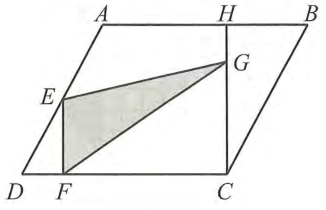
In parallelogram $ABCD$, point $E$ is on $AD$ such that $AE=DE$, point $F$ is on $CD$ and point $H$ is on $AB$ such that $EF\perp DC$ and $CH\perp AB$. Let $AH:HB=3:2$ and point $G$ is on line $CH$. If the area of triangle $EFG$ is 296 cm², find the area, in cm², of parallelogram $ABCD$.
One may express a number in base-8. For example, 37 could be written as $(45)_8$ in base-8 because $(45)_8=4\times8+5=37$. On the other hand, $(49)_8$ does not exist because $4\times8+9=41$ should be expressed as $(51)_8$. Let $\overline{AB}$ be a two-digit prime number in base-10, where $A,B<8$. If the value of $(\overline{AB})_8$ is also a prime number in base-10, how many possible values of $(\overline{AB})_8$ can we obtain?
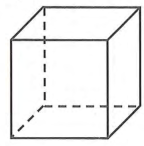
Colour each edge of the cube below by one of the 3 colours: blue, red or yellow so any 2 edges that share the same vertex should have different colours. How many ways can we colour the cube? (Note: Colouring is considered the same if when rotating or reflecting, we see it the same way.)
Using digits 1, 2, 3, 4, 5 and 6 to form a six-digit number $\overline{abcdef}$, where different letters represent different digits. If $2\mid\overline{ab}$, $3\mid\overline{abc}$, $4\mid\overline{abcd}$, $5\mid\overline{abcde}$ and $6\mid\overline{abcdef}$, find all possible six-digit numbers $\overline{abcdef}$.
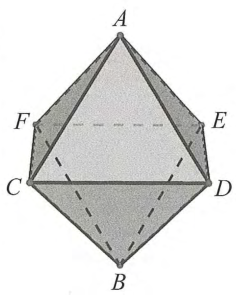
A regular octahedron is shown in the diagram on the right. There are 6 vertices altogether connected by a total of 12 edges. An ant starts from vertex $A$ and moves along any edge but cannot go through any edge more than once. If the ant visits each vertex exactly once before it returns to vertex $A$, how many different routes are there?
Let $A$ be a positive integer consisting of different digits, and $B$ be a positive integer whose digits are a rearrangement of the digits of $A$. Suppose that $A-B=\underbrace{11\ldots1}_{m}$ ($m$ copies of 1’s). Find the maximum value of $m$ that satisfy the given requirements.
Let $n$ be a positive integer such that all of its digits are distinct and that its digit sum is 17. If $n<2018$, how many different possible values of $n$ are there?
Using 16 black pawns and 16 white pawns, how many ways can we place 16 pawns into the $4\times4$ chessboard, where each pawn is occupying 1 cell, such that in each row and in each column the number of white pawns is even?
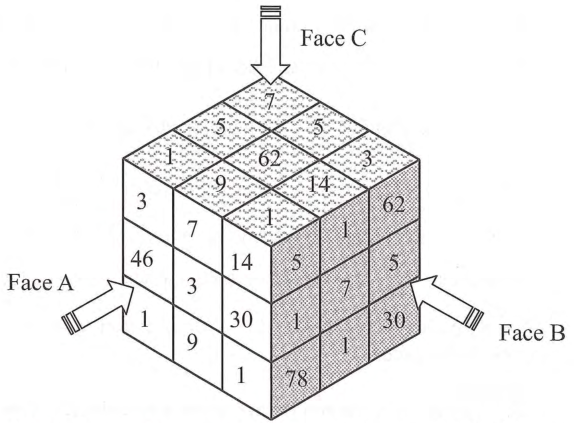
There are 27 unit cubes, each of size $1\times1\times1$, are glued together to form a larger $3\times3\times3$ cube. Each face on each of the $1\times1\times1$ unit cubes contains a positive integer such that:
(i) Two opposite faces of any unit cube must always contain an even number and an odd number. Moreover, the even number must be twice the odd number.
(ii) When any two unit cubes are placed face-to-face, the two touching faces must always contain an even number and an odd number. Moreover, the odd number must be 1 more than the even number.
(a) Place the numbers in the faces of $A'$, $B'$ and $C'$ which are opposite to the faces of $A$, $B$, and $C$, respectively. Find the total sum of the numbers on the faces of $A'$, $B'$ and $C'$. (2 Marks)
(b) Find the total sum of the numbers on the faces of all the unit cubes. (4 Marks)
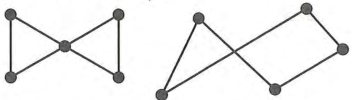
There are 5 points on the plane, such that no three points lie on one line. Every pair of points is connected by a segment. It is known that it is possible to colour five of these segments in red and the rest in blue, so that all segments of each colour form a simple pentagon. Draw one example.
The diagrams below are some examples of a simple pentagon:
The following diagrams below are NOT simple pentagons (because of self intersections):
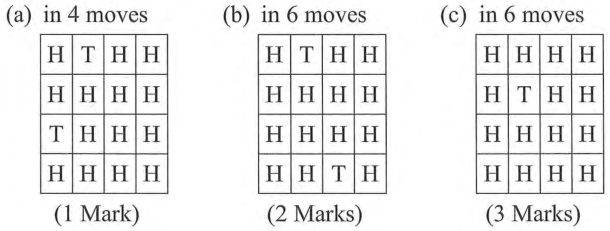
In a $4\times4$ table, we put a coin on each cell. The coins on some cells are tails up (T), while all the other coins are heads up (H). In each move, you are allowed to change all entries in any row, column or diagonal. Diagonals may be of length 1, 2, 3 or 4. Make the entries in the tables below all H using the required number of moves. Show your steps.
(a) in 4 moves (1 Mark)
(b) in 6 moves (2 Marks)
(c) in 6 moves (3 Marks)
(a) In a sequence of positive integers, each term after the first term is the sum of its preceding term and the largest digit of that term. What is the largest possible number of successive odd terms in such a sequence? (3 Marks)
(b) In the following sequence $\{00,01,02,03,\ldots,39\}$, the terms were rearranged so that each term after the first is obtained from the preceding one by increasing or decreasing one of its digits by 1. For example, 29 can be followed by 19, 39 or 28, but not by 30 or 20. What is the largest number of terms that can remain in their original places? (3 Marks)
(a) A chess piece can start anywhere on a $7\times7$ chessboard. It can jump over 4 or 5 vacant squares either vertically or horizontally, but it cannot visit the same square twice. At most how many squares can it visit? (1 Mark)
(b) A chess piece can start anywhere on a $9\times9$ chessboard. It can jump over 5 or 6 vacant squares either vertically or horizontally, but it cannot visit the same square twice. At most how many squares can it visit? (2 Marks)
(c) A chess piece can start anywhere on a $15\times15$ chessboard. It can jump over 8 or 9 vacant squares either vertically or horizontally, but it cannot visit the same square twice. At most how many squares can it visit? (3 Marks)
A job at Hai Liang Education Park can be done by Alex alone in 6 hours and by Bob alone in 10 hours. Alex works on the job for one hour alone, then Bob continues to work on the job for one hour alone. If they repeat the pattern, in how many hours can the job be done? Express your answer as a common fraction.