A chord of a circle is perpendicular to a radius at the midpoint of the radius. The ratio of the area of the larger of the two regions into which the chord divides the circle to the smaller can be expressed in the form $\frac{a\pi + b\sqrt{c}}{d\pi - e\sqrt{f}},$ where $a,$ $b,$ $c,$ $d,$ $e,$ and $f$ are positive integers, $a$ and $e$ are relatively prime, and neither $c$ nor $f$ is divisible by the square of any prime. Find the remainder when the product $a \cdot b \cdot c \cdot d \cdot e \cdot f$ is divided by $1000.$
A jar has $10$ red candies and $10$ blue candies. Terry picks two candies at random, then Mary picks two of the remaining candies at random. Given that the probability that they get the same color combination, irrespective of order, is $\frac{m}{n},$ where $m$ and $n$ are relatively prime positive integers, find $m + n.$
A solid rectangular block is formed by gluing together $N$ congruent $1$-cm cubes face to face. When the block is viewed so that three of its faces are visible, exactly $231$ of the $1$-cm cubes cannot be seen. Find the smallest possible value of $N.$
In order to complete a large job, $1000$ workers were hired, just enough to complete the job on schedule. All the workers stayed on the job while the first quarter of the work was done, so the first quarter of the work was completed on schedule. Then $100$ workers were laid off, so the second quarter of the work was completed behind schedule. Then an additional $100$ workers were laid off, so the third quarter of the work was completed still further behind schedule. Given that all workers work at the same rate, what is the minimum number of additional workers, beyond the $800$ workers still on the job at the end of the third quarter, that must be hired after three-quarters of the work has been completed so that the entire project can be completed on schedule or before?
Three clever monkeys divide a pile of bananas. The first monkey takes some bananas from the pile, keeps three-fourths of them, and divides the rest equally between the other two. The second monkey takes some bananas from the pile, keeps one-fourth of them, and divides the rest equally between the other two. The third monkey takes the remaining bananas from the pile, keeps one-twelfth of them, and divides the rest equally between the other two. Given that each monkey receives a whole number of bananas whenever the bananas are divided, and the numbers of bananas the first, second, and third monkeys have at the end of the process are in the ratio $3 : 2 : 1,$ what is the least possible total for the number of bananas?
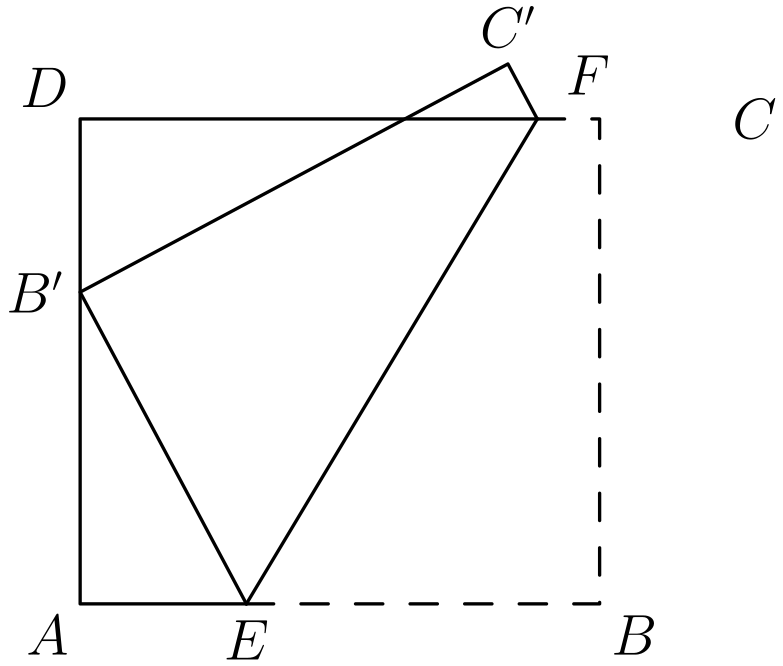
$ABCD$ is a rectangular sheet of paper that has been folded so that corner $B$ is matched with point $B'$ on edge $\overline{AD}.$ The crease is $\overline{EF},$ where $E$ is on $\overline{AB}$ and $F$ is on $\overline{CD}.$ The dimensions $AE = 8,$ $BE = 17,$ and $CF = 3$ are given. The perimeter of rectangle $ABCD$ is $\frac{m}{n},$ where $m$ and $n$ are relatively prime positive integers. Find $m + n.$
A sequence of positive integers with $a_1 = 1$ and $a_9 + a_{10} = 646$ is formed so that the first three terms are in geometric progression, the second, third, and fourth terms are in arithmetic progression, and, in general, for all $n \ge 1,$ the terms $a_{2n-1},$ $a_{2n},$ and $a_{2n+1}$ are in geometric progression, and the terms $a_{2n},$ $a_{2n+1},$ and $a_{2n+2}$ are in arithmetic progression. Let $a_n$ be the greatest term in this sequence that is less than $1000.$ Find $n + a_n.$
Let $\mathcal{S}$ be the set of integers between $1$ and $2^{40}$ whose binary expansions have exactly two $1$’s. If a number is chosen at random from $\mathcal{S},$ the probability that it is divisible by $9$ is $\frac{p}{q},$ where $p$ and $q$ are relatively prime positive integers. Find $p + q.$
A right circular cone has a base with radius $600$ and height $200\sqrt{7}.$ A fly starts at a point on the surface of the cone whose distance from the vertex of the cone is $125,$ and crawls along the surface of the cone to a point on the exact opposite side of the cone whose distance from the vertex is $375\sqrt{2}.$ Find the least distance that the fly could have crawled.
Let $ABCD$ be an isosceles trapezoid, whose dimensions are $AB = 6,$ $BC = 5 = DA,$ and $CD = 4.$ Draw circles of radius $3$ centered at $A$ and $B,$ and circles of radius $2$ centered at $C$ and $D.$ A circle contained within the trapezoid is tangent to all four of these circles. Its radius is $\frac{-k + m\sqrt{n}}{p},$ where $k,$ $m,$ $n,$ and $p$ are positive integers, $n$ is not divisible by the square of any prime, and $k$ and $p$ are relatively prime. Find $k + m + n + p.$
Let $ABCDE$ be a convex pentagon with $\overline{AB} \parallel \overline{CE},$ $\overline{BC} \parallel \overline{AD},$ $\overline{AC} \parallel \overline{DE},$ $\angle ABC = 120^\circ,$ $AB = 3,$ $BC = 5,$ and $DE = 15.$ Given that the ratio between the area of triangle $ABC$ and the area of triangle $EBD$ is $\frac{m}{n},$ where $m$ and $n$ are relatively prime positive integers, find $m + n.$
Consider a string of $n$ $7$’s, $7777\ldots77,$ into which $+$ signs are inserted to produce an arithmetic expression. For example, $7 + 77 + 777 + 7 + 7 = 875$ could be obtained from eight $7$’s in this way. For how many values of $n$ is it possible to insert $+$ signs so that the resulting expression has value $7000?$
A long thin strip of paper is $1024$ units in length, $1$ unit in width, and is divided into $1024$ unit squares. The paper is folded in half repeatedly. For the first fold, the right end of the paper is folded over to coincide with and lie on top of the left end. The result is a $512$ by $1$ strip of double thickness. Next, the right end of this strip is folded over to coincide with and lie on top of the left end, resulting in a $256$ by $1$ strip of quadruple thickness. This process is repeated $8$ more times. After the last fold, the strip has become a stack of $1024$ unit squares. How many of these squares lie below the square that was originally the $942$nd square counting from the left?
The digits of a positive integer $n$ are four consecutive integers in decreasing order when read from left to right. What is the sum of the possible remainders when $n$ is divided by $37?$
Set $\mathcal{A}$ consists of $m$ consecutive integers whose sum is $2m,$ and set $\mathcal{B}$ consists of $2m$ consecutive integers whose sum is $m.$ The absolute value of the difference between the greatest element of $\mathcal{A}$ and the greatest element of $\mathcal{B}$ is $99.$ Find $m.$
A convex polyhedron $P$ has $26$ vertices, $60$ edges, and $36$ faces, $24$ of which are triangular, and $12$ of which are quadrilaterals. A space diagonal is a line segment connecting two non-adjacent vertices that do not belong to the same face. How many space diagonals does $P$ have?
A square has sides of length $2.$ Set $\mathcal{S}$ is the set of all line segments that have length $2$ and whose endpoints are on adjacent sides of the square. The midpoints of the line segments in set $\mathcal{S}$ enclose a region whose area to the nearest hundredth is $k.$ Find $100k.$
Alpha and Beta both took part in a two-day problem-solving competition. At the end of the second day, each had attempted questions worth a total of $500$ points. Alpha scored $160$ points out of $300$ points attempted on the first day, and scored $140$ points out of $200$ points attempted on the second day. Beta, who did not attempt $300$ points on the first day, had a positive integer score on each of the two days, and Beta’s daily success ratio (points scored divided by points attempted) on each day was less than Alpha’s on that day. Alpha’s two-day success ratio was $\frac{300}{500} = \frac{3}{5}.$ The largest possible two-day success ratio that Beta could have achieved is $\frac{m}{n},$ where $m$ and $n$ are relatively prime positive integers. What is $m + n?$