The number $$
\frac{2}{\log_4 2000^6} + \frac{3}{\log_5 2000^6}
$$ can be written as $\frac{m}{n},$ where $m$ and $n$ are relatively prime positive integers. Find $m + n.$
A deck of forty cards consists of four $1$’s, four $2$’s, $\ldots,$ and four $10$’s. A matching pair (two cards with the same number) is removed from the deck. Given that these cards are not returned to the deck, let $\frac{m}{n}$ be the probability that two randomly selected cards also form a pair, where $m$ and $n$ are relatively prime positive integers. Find $m + n.$
Given eight distinguishable rings, let $n$ be the number of possible five-ring arrangements on the four fingers (not the thumb) of one hand. The order of rings on each finger is significant, but it is not required that each finger have a ring. Find the leftmost three nonzero digits of $n.$
One base of a trapezoid is $100$ units longer than the other base. The segment that joins the midpoints of the legs divides the trapezoid into two regions whose areas are in the ratio $2 : 3.$ Let $x$ be the length of the segment joining the legs of the trapezoid that is parallel to the bases and that divides the trapezoid into two regions of equal area. Find the greatest integer that does not exceed $\frac{x^2}{100}.$
In trapezoid $ABCD,$ leg $\overline{BC}$ is perpendicular to bases $\overline{AB}$ and $\overline{CD},$ and diagonals $\overline{AC}$ and $\overline{BD}$ are perpendicular. Given that $AB = \sqrt{11}$ and $AD = \sqrt{1001},$ find $BC^2.$
Given that $z$ is a complex number such that $z + \frac{1}{z} = 2\cos 3^\circ,$ find the least integer that is greater than $z^{2000} + \frac{1}{z^{2000}}.$
A circle is inscribed in quadrilateral $ABCD,$ tangent to $\overline{AB}$ at $P$ and to $\overline{CD}$ at $Q.$ Given that $AP = 19,$ $PB = 26,$ $CQ = 37,$ and $QD = 23,$ find the square of the radius of the circle.
The coordinates of the vertices of isosceles trapezoid $ABCD$ are all integers, with $A = (20, 100)$ and $D = (21, 107).$ The trapezoid has no horizontal or vertical sides, and $\overline{AB}$ and $\overline{CD}$ are the only parallel sides. The sum of the absolute values of all possible slopes for $\overline{AB}$ is $\frac{m}{n},$ where $m$ and $n$ are relatively prime positive integers. Find $m + n.$
The points $A,$ $B,$ and $C$ lie on the surface of a sphere with center $O$ and radius $20.$ It is given that $AB = 13,$ $BC = 14,$ $CA = 15,$ and that the distance from $O$ to triangle $ABC$ is $\frac{m\sqrt{n}}{k},$ where $m,$ $n,$ and $k$ are positive integers, $m$ and $k$ are relatively prime, and $n$ is not divisible by the square of any prime. Find $m + n + k.$
The equation $2000x^6 + 100x^5 + 10x^3$ $+ x - 2 = 0$ has exactly two real roots, one of which is $\frac{m + \sqrt{n}}{r},$ where $m,$ $n,$ and $r$ are integers, $m$ and $r$ are relatively prime, and $r \gt 0.$ Find $m + n + r.$
Find the least positive integer $n$ such that no matter how $10^n$ is expressed as the product of any two positive integers, at least one of these two integers contains the digit $0.$
Let $u$ and $v$ be integers satisfying $0 \lt v \lt u.$ Let $A = (u, v),$ let $B$ be the reflection of $A$ across the line $y = x,$ let $C$ be the reflection of $B$ across the $y$-axis, let $D$ be the reflection of $C$ across the $x$-axis, and let $E$ be the reflection of $D$ across the $y$-axis. The area of pentagon $ABCDE$ is $451.$ Find $u + v.$
In the expansion of $(ax + b)^{2000},$ where $a$ and $b$ are relatively prime positive integers, the coefficients of $x^2$ and $x^3$ are equal. Find $a + b.$
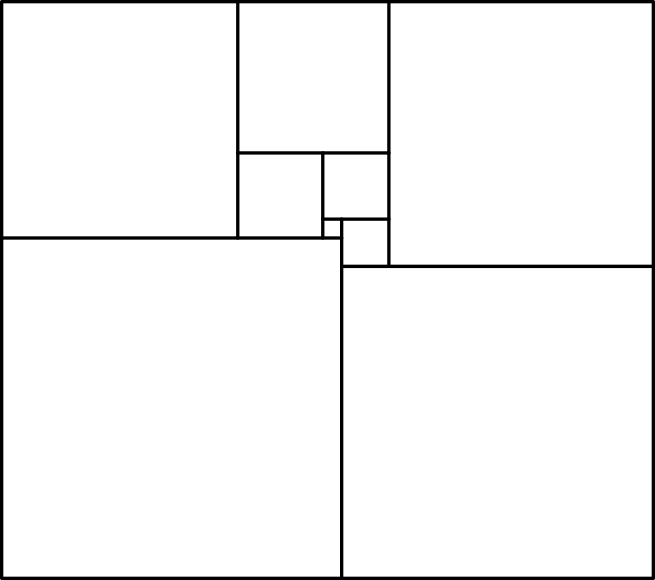
The diagram shows a rectangle that has been dissected into nine non-overlapping squares. Given that the width and the height of the rectangle are relatively prime positive integers, find the perimeter of the rectangle.
Each of two boxes contains both black and white marbles, and the total number of marbles in the two boxes is $25.$ One marble is taken out of each box randomly. The probability that both marbles are black is $\frac{27}{50},$ and the probability that both marbles are white is $\frac{m}{n},$ where $m$ and $n$ are relatively prime positive integers. What is $m + n?$