For two fractions $a/b$ and $c/d$, define their pirate sum by
$$
\frac{a}{b}\diamond\frac{c}{d}=\frac{a+c}{b+d},
$$
where both input fractions are written in lowest terms (that is, simplified as far as possible), and the result is then also reduced to lowest terms. For example, the pirate sum of $2/7$ and $4/5$ is $1/2$.
Let $n\geq3$ be an integer. Initially, the fractions
$$
\frac11,\quad\frac12,\quad\frac13,\quad\ldots,\quad\frac1n
$$
are written on a blackboard. At each move, choose two fractions on the board, erase them, and replace them with their pirate sum. Continue until only one fraction remains.
Determine, as functions of $n$, the largest and the smallest possible values of that final fraction.
Let $a,b,c$ be integers, each between $1$ and $2021$ inclusive, satisfying
$$
\sqrt a+\sqrt b=\sqrt{a+c\sqrt b}.
$$
How many distinct values of $c$ are possible?
Let $ABC$ be an acute triangle, let $M$ be the midpoint of $BC$, and let $H$ be the foot of the altitude from $B$. Let $Q$ be the circumcenter of triangle $ABM$, and let $X$ be the intersection of the altitude $BH$ with the perpendicular bisector of $BC$.
Prove that the following two statements are equivalent:
(i) The circumcircle of triangle $ACM$, the circumcircle of triangle $AXH$, and the line $CQ$ pass through a common point.
While studying the polynomial $p(x)=x^2+2x-6$, Enrica found two distinct real numbers $\alpha$ and $\beta$ such that $p(\alpha)=\beta$ and $p(\beta)=\alpha$. What is $\alpha+\beta$?
A sequence $x_1,x_2,\ldots,x_n,\ldots$ consists of an initial block of $p$ distinct positive integers which then repeats periodically. Thus $x_1,x_2,\ldots,x_p$ are $p$ pairwise distinct positive integers, and $x_{n+p}=x_n$ for every positive integer $n$.
The terms of the sequence are unknown, and the goal is to determine its period $p$. At each step, you may reveal the value of any one term you choose; your choice may depend on the results of previous steps.
(a) Knowing in advance that $1\leq p\leq10$, determine the smallest $n$ for which there is a strategy that determines $p$ with certainty by revealing at most $n$ terms.
(b) Knowing in advance that $p$ is one of the first $k$ primes, determine for which values of $k$ there is a strategy that determines $p$ with certainty by revealing at most five terms.
The participants at a gathering of knaves (who always lie) and knights (who always tell the truth) are numbered from $1$ to $2021$. Each participant declares: "It is possible to form at least $i$ triples of participants that include me and contain exactly two knights," where $i$ is the number assigned to the speaker. How many different values can the number of knaves at the gathering take?
Let $ABC$ be a triangle with a right angle at $B$. Let $H$ be the foot of the altitude from $B$, and let $D$ be the intersection of the bisector of angle $A$ with side $BC$. Suppose that $HD$ is perpendicular to $BC$. What is the value of $\left(\frac{AB}{BC}\right)^2$?
Young Boole has drawn a strip of eight cells, each of which can contain a $0$ or a $1$. Initially every cell contains a $0$. On each move, Boole performs one of the following operations:
Operation a: Replace every $0$ by a $1$ and every $1$ by a $0$.
Operation b: Choose three consecutive cells and, only in those cells, replace every $0$ by a $1$ and vice versa.
How many different combinations of zeros and ones can Boole obtain?
For every nonnegative real number $x$, let $\lfloor x\rfloor$ be its integer part, the greatest integer less than or equal to $x$, and let $\{x\}=x-\lfloor x\rfloor$ be its fractional part.
Let $p$ be a positive, noninteger real solution of $\{z\lfloor z\rfloor\}=2021\{z\}$. What is the second-smallest possible value of $\lfloor p\rfloor$?
Determine the number of ordered triples $(a,b,c)$ of nonnegative integers such that each of $2^a$, $2^b$, and $2^c$ is less than $10000$, and $2^a+2^b+2^c$ is a divisor of $8^a+8^b+8^c$.
Let $ABC$ be an equilateral triangle with side length one, and let $P$ lie on the opposite side of line $AB$ from $C$, with $\angle APB=60^\circ$. Suppose that the bisector of $\angle APB$ meets segments $AB$ and $AC$ at $X$ and $Y$, respectively. What is the minimum possible area of triangle $AXY$?
A grasshopper moves in the plane. From a point $(x,y)$, it may jump either to $(x+y,y)$ or to $(x,x+y)$. It started at $(n,9)$, where $n$ is a positive integer, but does not remember the value of $n$. It knows only that after some number of moves it reached $(2021,2050)$. How many values of $n$ are possible?
Let $ABCD$ be a rectangle, and let $E$ be any point other than $C$ on side $DC$. Let $H$ be the orthogonal projection of $E$ onto diagonal $AC$, and let $K$ be the orthogonal projection of $C$ onto ray $AE$.
Part a: Prove that $K$ lies on the circumcircle of $ABCD$ and that quadrilateral $CKEH$ is cyclic, that is, can be inscribed in a circle.
Part b: Prove that $\angle CKB+\angle CKH=90^\circ$.
Part c: Prove that $K,H,B$ are collinear if and only if $ABCD$ is a square.
Ambra constructs a sequence starting from a positive real number $x_0$ as follows. Given the term $x_n$, she sets
$$
x_{n+1}=\left\{1-\frac1{x_n}\right\},
$$
where $\{\alpha\}$ is the fractional part of $\alpha$, the difference between $\alpha$ and the greatest integer less than or equal to it. As soon as she obtains a term equal to zero, she stops the sequence.
Part a: Prove that if $x_0=p/q$ for positive integers $p,q$, then the sequence eventually stops.
Part b: Prove that if the sequence stops, then its starting value $x_0$ was of the form $p/q$ for positive integers $p,q$.
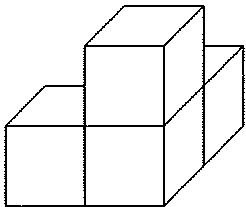
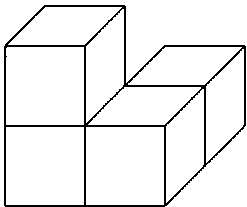
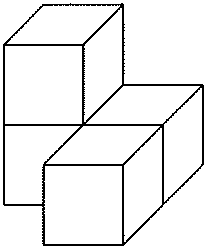
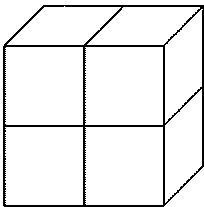
As shown in the following figure, there are four types of blocks formed by four cubes of side one. How many ways are there for putting four blocks of these types in a $2 \times 2 \times 4$ rectangular box so that they do not stick out?
Note that we can use multiple blocks of the same type, and blocks can be rotated. Additionally, we distinguish ways which coincide with each other by rotating the box.
For every positive integer $n$, let $f(n)$ be the smallest positive integer such that $f(n)$ is prime to $n$ and $f(n) + 1$ is prime to $n + 1$. How many different integers will appear in $\{f(1), f(2), \dots, f(10^{10})\}$?
In triangle $ABC$, let $P$ and $Q$ be points on side $BC$ and suppose that the orthocenter of triangle $ACP$ and the orthocenter of triangle $ABQ$ coincide. Given that $AB = 10$, $AC = 11$, $BP = 5$, $CQ = 6$, find the length of $BC$.