Lucas paints the entire outside of a cube blue. He then saws the cube into $27$ equally sized cubes. He neatly stacks these $27$ cubes so that he gets a tower of $27 \times 1 \times 1$ cubes.
At most how many of the $110$ side faces of cubes on the outside of his tower are blue?
In a row there are $2024$ people, numbered $1$ to $2024$, and each of them either always tells the truth or always lies. Moreover, all $2024$ people know from each other whether they are always telling the truth or always lying. At some point, for each number $n$, the person numbered $n$ makes the statement: "At least $n$ of these people always lie."
How many people always tell the truth?
Joah has a number of large pots with marbles in them. At the beginning of the week, all pots contain a different positive number of marbles. On the first day of the week, he adds one marble to each pot. On the second day, he adds a marble to all pots whose number of marbles is divisible by $2$. On the third day, he adds a marble to all pots whose number of marbles is divisible by $3$. He continues like this until the seventh day. Then it turns out that he has several pots with exactly $50$ marbles in them.
What is the maximum number of pots with exactly $50$ marbles that Joah could have?
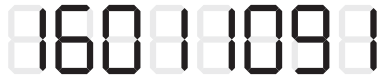
If you write the date 16 January 1091 with 8 digital digits in a row, it looks like this:
When you read this upside down, it reads as the exact same date. What is the first date in the future (22 June 2024 or later) for which it is also true that, written in 8 digital digits consecutively, the date is exactly the same when read upside down?
The uppercase letters $A$, $E$, $F$, $H$, $I$, $K$, $L$, $M$, $N$, $T$, $V$, $W$, $X$, $Y$, $Z$ can be written using only straight line segments. For the $I$, one line segment is enough; for the $E$, four line segments are needed. We call a sequence of at least two of these letters a word; so it does not have to be an existing word or even pronounceable. For example, $FK$ is a word, and you write this word with six line segments.
How many words exist that can be written in uppercase letters with a total of exactly four line segments?
We define a sequence by $a_{1}=850$ and
$$
a_{n+1} = \frac{a_{n}^{2}}{a_{n}-1}
$$
for $n \geq 1$. Determine all values of $n$ for which $\left\lfloor a_{n}\right\rfloor=2024$.
Here the floor $\lfloor a\rfloor$ of a real number $a$ denotes the largest integer less than or equal to $a$.
Find all pairs $(a, b)$ of positive integers such that $f(x)=x$ is the only function $f: \mathbb{R} \rightarrow \mathbb{R}$ that satisfies
$$
f^{a}(x) f^{b}(y)+f^{b}(x) f^{a}(y)=2 x y
$$
for all $x, y \in \mathbb{R}$.
Here $f^{n}(x)$ denotes applying $f$ to $x$ $n$ times, so $f^{1}(x)=f(x)$ and $f^{n+1}(x)=f\left(f^{n}(x)\right)$.
Let $\triangle ABC$ be an acute triangle with $|AB|\lt|AC|$. Points $D$ and $E$ are given on the segments $AB$ and $AC$ respectively. Let $P$ be a point such that $|PB|=|PD|$ and $|PC|=|PE|$. Let $X$ be a point on the arc $AC$ of the circumcircle of $\triangle ABC$ not containing $B$. The line $XA$ intersects the circumcircle of $\triangle ADE$ again at $Y$. Prove that $|PX|=|PY|$.
A teacher wants to spend a morning practising Olympiad problems with her class in teams. To this end, she has set up an arrangement with six large tables. At each table several students can work together on a problem. Each table has a problem; there are three different problems, each on two tables. There are three rounds in which each student sits at one of the tables. The teacher wants to schedule the students in such a way that after three rounds, each student has worked on all the problems once. In addition, she wants each pair of students to sit at the same table at most once.
What is the maximum number of students for which such a schedule is possible?
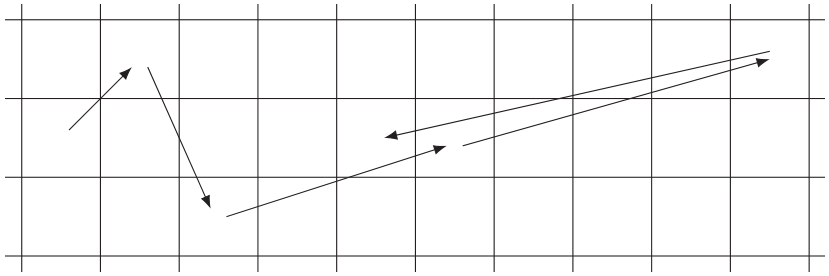
Mila stands on an infinitely large board divided into squares and starts moving. An $n$-jump is a movement in which Mila moves one square left, right, up or down and then $n$ squares in a direction perpendicular to that. Below is an example where Mila starts in the middle box on the left and first does a $1$-jump, followed by a $2$-jump and then a $3$-jump, $4$-jump and $5$-jump.
Suppose Mila first does a $1$-jump, then a $2$-jump, then a $3$-jump, a $4$-jump, and so on. Finally, she does a $m$-jump. For which positive integers $m$ can Mila choose her $m$ jumps such that she can get back to her starting square?
Given are two positive integers $a$ and $b$ with the property that
$$
\frac{b^3}{a^4} \quad \text{and} \quad \frac{a^3}{b^2}
$$
are both integers greater than $1$.
What is the smallest possible value for the sum $a + b$?
Let $ABCD$ be a parallelogram with the property that $|AD| = |BD|$. Now let $P$ and $Q$ be points such that $\triangle ADP$ and $\triangle CDQ$ are equilateral and do not overlap with the parallelogram. Prove that $\angle PQD = 30^\circ$.
An $\ell$-code is an integer $n \ge 0$ of at most $\ell$ digits, if necessary supplemented by leading zeros, so that it consists of $\ell$ digits in total. Thus, you can make a 4-code out of 310 by writing it as 0310. An $\ell$-code is called *self-squared* if the last $\ell$ digits of the square of that code form exactly the original $\ell$-code. Thus, the 1-codes 5 and 6 are self-squared, but the 3-code 006 is not self-squared, because $6^2 = 36 = 036$ does not end in 006. The 2-code 76 is self-squared, because $76^2 = 5776$ ends in 76.
a. Prove that an $\ell$-code $n$ is self-squared if and only if $n(n-1)$ is divisible by $10^\ell$.
b. Prove that any self-squared $\ell$-code $n \ge 2$ ends in the digit 5 or the digit 6.
c. Prove that any self-squared $\ell$-code $n \ge 2$ is extendable to a self-squared $(\ell+1)$-code in exactly one way by placing a digit in front of it.
d. It follows from (b) and (c) that for every $\ell$, there exist exactly two self-squared $\ell$-codes $m, n \ge 2$. What is their sum $m+n$ (in terms of $\ell$)?
We call a positive integer *quadratic* if every two adjacent digits form a square number. For example, the number $364$ is quadratic because both $36$ and $64$ are squares.
How many digits does the largest quadratic number have?
Caitlin took a long walk each day in October. Only on the 16 days when rain was expected, she took an umbrella with her. Of the 31 days of October, the rain forecast was correct on exactly 21 days. Fortunately, on the days when it rained, Caitlin always had her umbrella with her.
On how many days did it *not* rain?
Montasser makes a sequence of numbers. The first two numbers are $6$ and $15$. He always makes the next number in the sequence by dividing the last number by its predecessor and multiplying the result by $2$. Thus, the third number in the sequence is $\frac{15}{6} \cdot 2 = 5$ and the fourth number is $\frac{5}{15} \cdot 2 = \frac{2}{3}$.
What is the one hundredth number in the sequence?
A) $15$
B) $5$
C) $\frac{2}{3}$
D) $\frac{4}{15}$
E) $\frac{4}{5}$
We place the digits $1$ through $9$ one by one in a $3 \times 3$ grid. The digit $1$ may be placed in an arbitrarily chosen box; each subsequent digit comes in a box that is horizontally or vertically adjacent to the box that contains the previous digit. See, for example, the picture below. We call such a grid a *snake grid*. The score of a box in a snake grid is the sum of the digits in all boxes with one side adjacent to the box. The total score of a snake grid is the sum of the scores of all its boxes. For example, the snake grid in the example (row by row, adding up from left to right) has total score $6+13+10+9+20+19+10+15+14 = 116$.
Xander draws five points and a number of infinitely long lines on an infinite sheet of paper. He does this in such a way that on each line there are at least two of those points and that the lines intersect only at points that Xander has drawn.
What is the maximum number of lines Xander could have drawn?