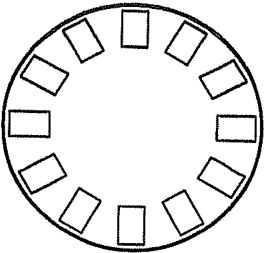
A designer plans to decorate the opening ceremony for this year's IMO contest in Romania with rows of coloured clock faces. Each clock face consists of twelve coloured rectangles glued to a round white base, as illustrated below.
The following design rules apply:
1. Each rectangle is blue, yellow, or red.
2. All three colours must be used somewhere on the clock face.
Two clock faces are considered identical whenever one can be rotated to match the colours of the other.
Find all pairs of functions $f, g : \mathbb{Q} \to \mathbb{Q}$ that satisfy the identity
$$
f(x+y) = f(x)g(1) + g(y), \quad \forall x, y \in \mathbb{Q}
$$
and the equation $f(1) = 3$.
We say that a rectangle with side lengths $a$ and $b$ fits inside a rectangle with side lengths $c$ and $d$ if either $(a \le c)$ and $(b \le d)$ or $(a \le d)$ and $(b \le c)$. For instance, a rectangle with side lengths $1$ and $5$ fits inside another rectangle with side lengths $1$ and $5$, and also fits inside a rectangle with side lengths $6$ and $2$.
Suppose $S$ is a set of $2019$ rectangles, all with integer side lengths between $1$ and $2018$ inclusive. Show that there are three rectangles $A$, $B$, and $C$ in $S$ such that $A$ fits inside $B$, and $B$ fits inside $C$.
A non-degenerate triangle is formed by three points that are not collinear. A triangle is called *nice* if it is non-degenerate and its vertices have integer coordinates $(x, y)$ such that $0 \le x \le 2018$ and $0 \le y \le 2018$. Let $V_n$ denote the number of nice isosceles triangles for which the coordinates of each vertex satisfy $y \le n$. Prove that
$$
V_{n+1} = 2V_n - 2V_{n-2} + V_{n-3} \quad \text{for all } n \gt 2018^2.
$$
Let $M$ be the midpoint of side $BC$ of an equilateral triangle $ABC$. The point $D$ is on $CA$ extended such that $A$ is between $D$ and $C$. The point $E$ is on $AB$ extended such that $B$ is between $A$ and $E$, and $|MD| = |ME|$. The point $F$ is the intersection of $MD$ and $AB$. Prove that $\angle BFM = \angle BME$.
The game of *Greed* starts with an initial configuration of one or more piles of stones. Player 1 and Player 2 take turns to remove stones, beginning with Player 1. At each turn, a player has two choices:
* take one stone from any one of the piles (a simple *move*);
* take one stone from each of the remaining piles (a greedy *move*).
The player who takes the last stone wins.
Consider the following two initial configurations:
(a) There are 2018 piles, with either 20 or 18 stones in each pile.
(b) There are four piles, with 17, 18, 19, and 20 stones, respectively.
In each case, find an appropriate strategy that guarantees victory to one of the players.
The incentre of triangle $ABC$ is $I$, and $H$ is the foot of the perpendicular from $I$ on $AB$. The perpendicular from $H$ on $BC$ meets $BC$ at $E$, and it meets the bisector of $\angle ABC$ at $D$. The perpendicular from $A$ on $BC$ meets $BC$ at $F$. Prove that $\angle BAC = 2\angle EFD$.
There are $2^{2018}$ buckets placed in a circle. Their positions are numbered from $1$ to $2^{2018}$ according to their order in the circle. Initially only buckets at positions $2018$ and $2019$ are full of water, the others are empty.
Before the game starts, John is allowed to fill as many additional buckets as he wishes full of water. At the start of the game, John is given an integer $n$ ($0 \le n \lt 2018$) and two more buckets, one empty and the other full of water. John will then move around the circle, starting at position $2^n$ and moving forward by $2^n$ positions each time. At each position he reaches during his journey he has to replace the bucket he finds by one of those two he carries. He needs to replace an empty bucket by a full one and a full bucket by an empty one. If he cannot do so at any position he reaches, he lost the game.
Is it possible for John to fill the buckets before the start of the game in such a way that he will not lose the game, no matter which value of $n$ he will be given and no matter how long he will move in the circle?
A paper rhombus $ABCD$, with side lengths $4$ and $\angle ABC = 60^\circ$, is folded so that $B$ coincides with the mid-point $H$ of $AD$ and creased. Prove that the length of the crease is $\frac{1}{2}\sqrt{21}$.
From a point on the hypotenuse of a right-angled triangle perpendiculars are drawn to the other two sides. If the hypotenuse has length $4$ and the two perpendiculars have length one, find the area of the triangle.