There are several positive integers smaller than $10^6$ such that the product of each pair of two different numbers is not divisible by $2006$. What is the greatest number of numbers you can have?
On Babba Island they use a two-letter alphabet, $a$ and $b$, and every (finite) sequence of letters is a word. For each set $P$ of six words of 4 letters each, we denote $N_P$ to the set of all words that do not contain any of the words of $P$ as a syllable (subword).
Show that if $N_P$ is finite, then all its words are of length less than or equal to 10, and find a set $P$ such that $N_P$ is finite and contains at least one word of length 10.
Let $a \gt b \gt c \gt d$ be positive integers that satisfy
$$
a + b + c + d = 502 \text{ and } a^2 - b^2 + c^2 - d^2 = 502.
$$
Calculate how many possible values of $a$ are.
Circle $\Gamma$ is tangent to sides $AB$ and $AC$ of triangle $ABC$ at $E$ and $F$, respectively. Let $X$ be the intersection of $BF$ and $EC$, and let $H$ be the intersection of $\Gamma$ with $AX$. Let $Z$ and $T$ be the intersections of $EH$ and $FH$ with $BC$, respectively. The lines $ET$ and $FZ$ intersect at $Q$. Prove that the point $Q$ is on the line $AX$.
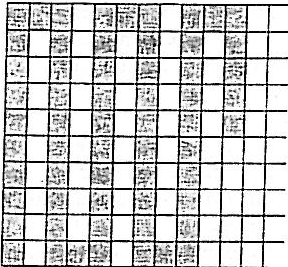
On a gridded board of $10$ rows by $500$ columns, starting with the lower left square and following the model suggested by the figure, Joaquín painted $2006$ squares black.
Then Agustina painted the squares that had two or more neighboring black squares blue. How many squares did Agustina paint?
Note: Two squares are neighbors if they have a common side.
We consider all infinite sequences $(x_n)_{n \ge 1}$ of positive integers that satisfy the recurrence
$$
x_{n+2} = \text{mcd}(x_{n+1}, x_n) + 2006,
$$
for all $n = 1, 2, \dots$. Here $\text{mcd}(u, v)$ denotes the greatest common factor of $u$ and $v$.
Can it happen that a sequence of this type contains exactly $10^{2006}$ different numbers?
The Binarilandia lottery draws a 100-digit number 0 and 1 (it can start with 0). A number will be awarded if it matches at least 51 positions with the drawn number. Determine the smallest number of numbers that need to be played to be sure that at least one of them will be awarded.
In a triangle $ABC$ let $H$ be the intersection point of its heights. It is known that the measure of angle $\angle BAC$ is $60^\circ$. If $J$ belonging to the side $AC$ is taken such that $AJ$ is double $JC$, it holds that $JH = JC$.
Given the location of $A$ and $H$, construct the triangle $ABC$ with a ruler and compass.
An airline company has 9 airplanes, all of different models, and 13 pilots. Training each pilot to fly each plane costs \$1000. Each day 9 of the pilots are drawn to fly the planes and the other 4 have the day off.
Find the minimum amount that should be invested in pilot training to ensure that all planes fly every day, regardless of the pilots drawn. (Each day, each pilot flies only one of the planes.)
In the convex quadrilateral $ABCD$, let $E$ and $F$ be the midpoints of the sides $AD$ and $BC$, respectively. Segments $CE$ and $DF$ are cut at $O$. Prove that if the lines $AO$ and $BO$ divide the side $CD$ into three equal parts then $ABCD$ is a parallelogram.
Carlitos wrote all subsets of $\{1, 2, \ldots, 2006\}$ in which the difference between the number of even numbers and odd numbers is a multiple of $3$.
How many subsets did Carlitos write?
The numbers $1$, $2$, $3$, ..., $n^2$ are placed in the cells of a $n \times n$ grid, in some order, one number per cell. A token is initially found in the space with the number $n^2$. At each step, the piece can advance to any of the squares that share a side with the square it is on. First, the token travels to the square with the number $1$, and to do so it takes one of the shortest paths (with fewer steps) between the square with the number $n^2$ and the square with the number $1$. From the square with the number $1$ it travels to the square with the number $2$, from there to the square with the number $3$, and so on, until it returns to the initial square, taking the shortest path on each of its trips. The complete path takes the $N$ tab steps. Determine the smallest and largest possible value of $N$.
Let $n \gt 1$ be an odd integer. Let $P_0$ and $P_1$ be two consecutive vertices of a regular polygon with sides $n$. For each $k \ge 2$, $P_{k}$ is defined as the vertex of the given polygon that lies on the bisector of $P_{k-1}$ and $P_{k-2}$. Determine for what values of $n$ the sequence $P_0, P_1, P_2, \dots$ runs through all the vertices of the polygon.
Let $ABC$ be a right triangle and isosceles, with $AB = AC$. We consider the points $M$ and $N$ in $AB$ such that $AM = BN$. The perpendicular to $CM$ that cuts $BC$ at $P$ is drawn from $A$. If $\angle APC = 62^\circ$, calculate the measure of angle $BNP$.
Mauro wrote the list of numbers of $12$ digits with each digit equal to $0$ or $1$ such that the sum of digits in even positions is equal to the sum of digits in odd positions. Determine how many numbers are in Mauro's list.
CLARIFICATION: All numbers on the list have the first left digit equal to $1$.
Several segments have been chosen on a line (with possible overlaps). If the left two-thirds of each segment is colored blue, the set of blue points is a segment of length $31$. If the right two-thirds of each segment is colored red, the set of red points is a segment of length $23$. Let $M$ and $m$ be the maximum and minimum length of a segment of the collection, respectively.
What is the minimum value that $M - m$ can have?
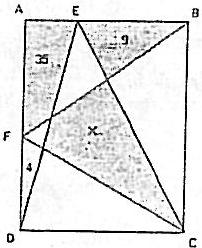
Mr. José has four grandchildren, all of different ages. The age difference between the oldest and youngest grandchildren is $6$ years and the age difference between the other two grandchildren is $1$ years. One of the four grandchildren is $12$ years old. It is known that, by making two parallel cuts on the sides, as shown in the figure, Mr. José can split a rectangular bar of chocolate into four parts whose areas coincide with the ages of the four grandchildren.
How old are Mr. José's grandchildren?