Let $ABC$ be an acute triangle with altitudes $AD$, $BE$ and $CF$ (with $D$ on $BC$, $E$ on $AC$ and $F$ on $AB$). Let $M$ be the midpoint of segment $BC$. The circumcircle of triangle $AEF$ meets line $AM$ at $A$ and at $X$. Line $AM$ meets line $CF$ at $Y$. Let $Z$ be the intersection point of lines $AD$ and $BX$.
Consider a $2007 \times 2007$ board. Some cells of the board are painted. The board is called *charrúa* if no row is completely painted and no column is completely painted.
a) What is the maximum number $k$ of painted cells that a charrúa board can have?
b) For this number $k$, compute the number of distinct charrúa boards that exist.
Let $ABCDE$ be a convex pentagon satisfying the following conditions:
* There is a circle $\Gamma$ tangent to each of its sides.
* The lengths of all its sides are integers.
* At least one side of the pentagon has length $1$.
* Side $AB$ has length $2$.
Let $P$ be the point of tangency of $\Gamma$ with side $AB$.
a) Determine the lengths of segments $AP$ and $BP$.
b) Give an example of a pentagon satisfying the stated conditions.
Prove that for every positive integer $n$ there exists a positive integer $k$ such that the decimal representation of each of the numbers $k, 2k, \ldots, nk$ contains all the digits $0,1,2,3,4,5,6,7,8,9$.
Given a positive integer $m$, the sequence $\{a_n\}$ is defined as follows:
$$
a_1 = \frac{m}{2}, \quad a_{n+1} = a_n [a_n], \text{ if } n \ge 1.
$$
Determine all values of $m$ for which $a_{2007}$ is the first integer appearing in the sequence.
Note: For a real number $x$, $[x]$ denotes the smallest integer greater than or equal to $x$. For example, $[\pi] = 4$, $[2007] = 2007$.
Let $ABC$ be a triangle with incenter $I$ and let $\Gamma$ be a circle with center $I$, with radius greater than that of the incircle and not passing through any of the vertices. Let $X_1$ be the intersection point of $\Gamma$ with line $AB$ closer to $B$; $X_2$, $X_3$ the intersection points of $\Gamma$ with line $BC$, with $X_2$ closer to $B$; and $X_4$ the intersection point of $\Gamma$ with line $CA$ closer to $C$. Let $K$ be the intersection point of lines $X_1X_2$ and $X_3X_4$. Prove that $AK$ meets segment $X_2X_3$ at its midpoint.
Two teams, $A$ and $B$, compete for the territory bounded by a circle.
$A$ has $n$ blue flags and $B$ has $n$ white flags ($n \ge 2$, fixed). They play alternately and $A$ starts the game. Each team, on its turn, places one of its flags at a point of the circle that has not been used in a previous move. Each flag, once placed, cannot be moved.
Once all $2n$ flags have been placed, the territory is divided between the two teams. A point of the territory belongs to team $A$ if the flag closest to it is blue, and to team $B$ if the flag closest to it is white. If the closest blue flag to a point is at the same distance as the closest white flag to that point, then the point is neutral (it belongs neither to $A$ nor to $B$). A team wins the game if its points cover a larger area than the area covered by the points of the other team. There is a draw if both cover equal areas.
Prove that, for every $n$, team $B$ has a winning strategy.
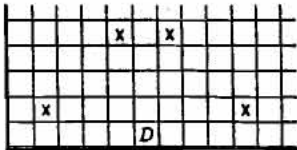
On a $19 \times 19$ square grid board, a piece called a *dragon* jumps as follows: it moves $4$ cells in a direction parallel to one of the sides of the board and $1$ cell in the direction perpendicular to the previous one.
From $D$, the dragon can jump to one of the four positions $X$.
It is known that, with this kind of jump, the dragon can move from any cell to any other.
The dragonian distance between two cells is the smallest number of jumps the dragon must make to move from one cell to the other.
Let $C$ be a cell located in a corner of the board and let $V$ be the cell neighbouring $C$ that touches it at a single point.
Prove that there exists some cell $X$ of the board such that the dragonian distance from $C$ to $X$ is greater than the dragonian distance from $C$ to $V$.
Let $\mathcal{F}$ be the family of all convex hexagons $H$ satisfying the following conditions:
(a) opposite sides of $H$ are parallel;
(b) any three vertices of $H$ can be covered by a strip of width $1$.
Determine the smallest real number $\ell$ such that each hexagon of the family $\mathcal{F}$ can be covered by a strip of width $\ell$.
Let $X = \overline{a1b9}$ and $Y = \overline{51ab}$ be two positive integers, where $a$ and $b$ are digits. It is known that $X$ is a multiple of a two-digit positive number $n$ and $Y$ is the next multiple of that number $n$. Find the number $n$ and the digits $a$ and $b$. Justify why there are no other possibilities.
Jorge chooses 6 distinct positive integers and writes one on each face of a cube. He rolls his cube three times.
The first time his cube showed the number $5$ on top and, moreover, the sum of the numbers on the lateral faces was $20$.
The second time his cube showed the number $7$ on top and, moreover, the sum of the numbers on the lateral faces was $17$.
The third time his cube showed the number $4$ on top and, moreover, all the numbers on the lateral faces turned out to be prime.
Which numbers did Jorge choose and how did he distribute them on the faces of the cube? Analyse all the possibilities.
A $7 \times 7$ board has a lamp in each of its 49 cells, which can be on or off. The allowed operation is to choose 3 consecutive cells of a row or of a column that have two neighbouring lamps on and the other one off, and to change the state of all three. That is:
Give a configuration of exactly 8 lit lamps located in the first 4 rows of the board such that, through a sequence of allowed operations, one arrives at a single lit lamp on the board, located in the last row. Show the sequence of operations used to achieve the goal.
We have a paper pentagon $ABCDE$ such that
$$
AB = BC = 3 \text{ cm},\ CD = DE = 5 \text{ cm},\ EA = 4 \text{ cm};\ \angle ABC = 100^\circ,\ \angle CDE = 80^\circ.
$$
The pentagon must be divided into four triangles by means of three straight cuts, so that with the four triangles a rectangle is assembled, without gaps or overlaps. (The triangles may be rotated and/or turned over.)
Let $n \gt 2$ be an even integer. Tokens must be placed on the cells of an $n \times n$ board so that in each column the number of tokens is even and nonzero, and in each row the number of tokens is odd.
Determine the smallest number of tokens that must be placed on the board to satisfy this rule.
Show a configuration with that number of tokens and explain why the rule cannot be satisfied with fewer tokens.
Eight children, all of different heights, must form a line ordered from shortest to tallest. We say that the line has exactly one error if there is one child who stands immediately behind a taller one, and all the others (except the first in line) stand immediately behind a shorter one. In how many ways can the eight children form a line with exactly one error?
Alex and Bruno together write a natural number with 6 distinct digits. Each one, on his turn, writes a digit to the right of the last digit written by the other. Alex starts with the first digit on the left and Bruno finishes with the last digit on the right. (It is forbidden to write a digit that has already been used.)
Bruno wins if the 6-digit number is prime. Otherwise, Alex wins.
Determine which of the two players has a winning strategy and explain how he must play to win no matter how well the other plays.