Let $m$ be a positive integer. Determine the smallest positive integer $n$ for which there exist real numbers $x_1, x_2, \dots, x_n \in (-1, 1)$ such that $|x_1| + |x_2| + \dots + |x_n| = m + |x_1 + x_2 + \dots + x_n|$.
Let $c_n$ be a sequence which is defined recursively as follows: $c_0 = 1$, $c_{2n+1} = c_n$ for $n \ge 0$, and $c_{2n} = c_n + c_{n-2^e}$ for $n \gt 0$ where $e$ is the maximal nonnegative integer such that $2^e$ divides $n$. Prove that
$$
\sum_{i=0}^{2^n-1} c_i = \frac{1}{n+2} \binom{2n+2}{n+1}.
$$
Let $x_1,\ldots,x_8\ge0$ be real numbers such that $x_i+x_{i+1}+x_{i+2}\le1$ for $i=1,\ldots,8$, where $x_9=x_1$ and $x_{10}=x_2$. Prove
$$\sum_{i=1}^8x_ix_{i+2}\le1$$
and find all equality cases.
Let a,b,c be positive real numbers with abc=1. Prove
$$\begin{aligned}&(a^5+a^4+a^3+a^2+a+1)\\&\quad\cdot(b^5+b^4+b^3+b^2+b+1)\\&\quad\cdot(c^5+c^4+c^3+c^2+c+1)\\&\ge8(a^2+a+1)(b^2+b+1)(c^2+c+1).\end{aligned}$$
Given a positive integer number $n$, determine the maximum number of edges a simple graph on $n$ vertices may have in order that it contain no cycles of even length.
Consider two polynomials $P(x) = a_n x^n + a_{n-1} x^{n-1} + \dots + a_1 x + a_0$ and $Q(x) = b_n x^n + b_{n-1} x^{n-1} + \dots + b_1 x + b_0$ with integer coefficients such that $a_n - b_n$ is a prime, $a_{n-1} = b_{n-1}$ and $a_n b_0 - a_{n-1} b_n \neq 0$. Suppose there exists a rational number $r$ such that $P(r) = Q(r) = 0$. Prove that $r$ is an integer.
Let $A_0A_1A_2$ be a non-equilateral triangle. The incircle of the triangle $A_0A_1A_2$ touches the side $A_iA_{i+1}$ at the point $T_{i+2}$ (indices are reduced modulo 3). Let $X_i$ be the perpendicular foot dropped from the point $T_i$ onto the line $T_{i+1}T_{i+2}$. Show that the lines $A_iX_i$ are concurrent at a point situated on the Euler line of the triangle $T_0T_1T_2$.
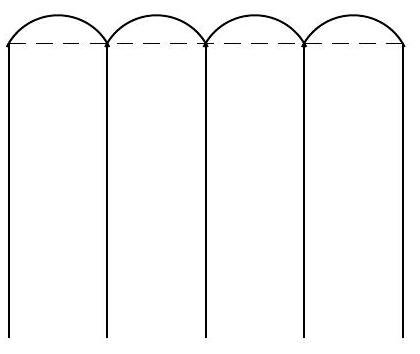
A blacksmith is building a horizontal iron fence made of parallel vertical bars, each $18\,\mathrm{cm}$ from its two neighbors. He joins the top ends of each adjacent pair with a circular arc in the plane of the bars. Its highest point is $3\sqrt3\,\mathrm{cm}$ above the dashed line through all bar tops, perpendicular to the bars. How long is each curved bar used for an arc?
Let $x$ be a 2-digit positive integer and $y$ be a 1-digit positive integer. Suppose that the ten's digit of $x$, the one's digit of $x$ and $y$ are all distinct. Determine the maximum possible value the product $xy$ can take.
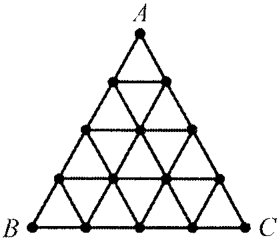
Let $n \gt 3$ be a positive integer. An equilateral triangle $ABC$ is divided into $n^2$ identical equilateral "small" triangles using lines parallel to its sides. The figure below illustrates the case $n = 4$. Let $m$ be the number of rhombi consisting of 2 "small" triangles. Let $d$ be the number of rhombi consisting of 8 "small" triangles. Find the difference $m - d$ in terms of $n$.
Can we divide an equilateral triangle $\triangle ABC$ into 2011 small triangles using 122 straight lines? (There should be 2011 triangles that are not themselves divided into smaller parts and there should be no polygons which are not triangles.)
In a city the phone numbers should consist of exactly eight digits, and $0$ is not allowed as a digit in them (i.e., only $1, 2, 3, \ldots, 9$ may be used). It is required that every two phone numbers either be different in at least two places, or have digits separated by at least two units, in at least one of the eight places. (For example, both $12345678$ and $23345678$ may be selected if there is no more conflict with other numbers, or both $12345678$ and $92345678$ may be selected, again if there is no more conflict with other numbers, but at most one of $12345678$ and $12345679$ may be selected.)
What is the maximum number of phone numbers that can be selected, satisfying the requirements? In how many ways can one select this amount of phone numbers?
Suppose five of the nine vertices of a regular nine-sided polygon are arbitrarily chosen. Show that one can select four among these five such that they are the vertices of a trapezium.
For every positive integer $n$ let $\tau(n)$ denote the number of its positive factors. Determine all $n \in \mathbb{N}$ that satisfy the equality $\tau(n) = \frac{n}{3}$.
Gabriele, a lover of cubes, has bought a magnificent collector's piece: a cube made entirely of chocolate, with edges $10\,\mathrm{cm}$ long. Unfortunately, having lost a bet with two friends, he must give them two thirds of the chocolate's volume. He decides to keep a smaller cube with one vertex coinciding with a vertex of the purchased cube and faces parallel to its faces. He gives the remaining chocolate to his two friends. Let $S$ be the total surface area of the chocolate given away, in $\mathrm{cm}^2$. Then:
(A) $300\le S\le350$;
(B) $350\lt S\le450$;
(C) $450\lt S\le550$;
(D) $550\lt S\le650$;
(E) $650\lt S\le750$.
Consider a rectangle whose lengths of sides are natural numbers. If someone places as many squares as possible, each with area $3$, inside of the given rectangle, such that the sides of the squares are parallel to the rectangle sides, then the maximal number of these squares fill exactly half of the area of the rectangle. Determine the dimensions of all rectangles with this property.
a) Find the largest possible value of the number
$$
x_1x_2 + x_2x_3 + \dots + x_{n-1}x_n,
$$
if $x_1, x_2, \dots, x_n$ ($n \ge 2$) are non-negative integers and their sum is $2011$.
b) Find the numbers $x_1, x_2, \dots, x_n$ for which the maximum value determined at a) is obtained.