For integer $n \ge 2$, let $x_1, x_2, \dots, x_n$ be real numbers satisfying
$$
x_1 + x_2 + \dots + x_n = 0, \quad \text{and} \quad x_1^2 + x_2^2 + \dots + x_n^2 = 1.
$$
For each subset $A \subseteq \{1, 2, \dots, n\}$, define
$$
S_A = \sum_{i \in A} x_i.
$$
(If $A$ is the empty set, then $S_A = 0$.)
Prove that for any positive number $\lambda$, the number of sets $A$ satisfying $S_A \ge \lambda$ is at most $\frac{2^{n-3}}{\lambda^2}$.
For what choices of $x_1, x_2, \dots, x_n, \lambda$ does equality hold?
Let $ABCD$ be a parallelogram. The incircle of triangle $ABC$ touches its sides $AB$, $BC$ and $AC$ at points $M$, $N$ and $K$ respectively. The lines $MK$ and $CD$ intersect at $P$, the lines $NK$ and $AD$ intersect at $Q$. Prove that the points $B$, $E$ and $F$ are collinear, where $E$ and $F$ are the midpoints of $MP$ and $NQ$ respectively.
Sixty-five couples go on an outing. Each boy has a motorcycle and must carry one girl. Suppose they can arrange the rides so that for any two motorcycles exactly one of the following statements holds: (i) their boys know one another; (ii) the boyfriends of their girls know one another. Prove that one couple can be removed so that the remaining 64 couples still admit such an arrangement.
Find all integers $n \ge 3$ such that among any $n$ positive real numbers $a_1, a_2, \ldots, a_n$ with
$$ \max(a_1, a_2, \ldots, a_n) \le n \cdot \min(a_1, a_2, \ldots, a_n), $$
there exist three that are the side lengths of an acute triangle.
Illustration only; the configuration/coloring may vary.
Let $O$ be the circumcenter of acute triangle $ABC$, and let the line $AO$ meet $BC$ at $D$. Choose points $E$ on $AB$ and $F$ on $AC$ such that $ED=BD$ and $DF=CD$. Prove that $EF\parallel BC$.
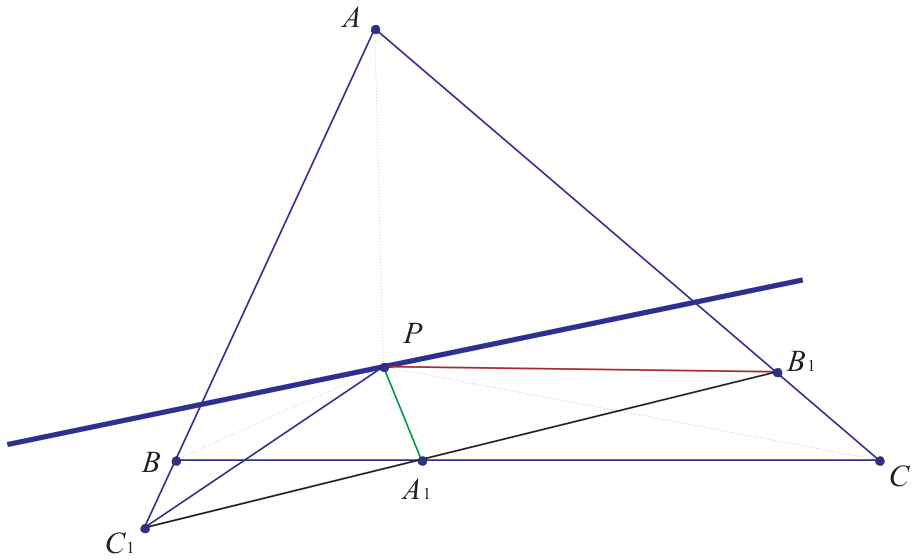
Let $P$ be a point in the plane of $ABC$, and $\gamma$ a line passing through $P$. Let $A'$, $B'$, $C'$ be the points where the reflections of lines $PA$, $PB$, $PC$ with respect to $\gamma$ intersect lines $BC$, $AC$, $AB$, respectively. Prove that $A'$, $B'$, $C'$ are collinear.
Let $ABCD$ be a convex quadrilateral with $AD$ not parallel to $BC$. The circles with diameters $AB$ and $CD$ meet at two points $E,F$ inside $ABCD$. Let $Q,R,S$ be the perpendicular feet from $E$ to the lines $AB,BC,CD$, and let $\omega_E$ be their circumcircle. Similarly, let $\omega_F$ be the circle through the perpendicular feet from $F$ to $CD,DA,AB$. Prove that the midpoint of $EF$ lies on the line joining the two intersection points of $\omega_E$ and $\omega_F$.
Each of $1005$ citizens of the Emerald city wears glasses (with two lenses). The lenses in the glasses are colored rose, blue and green evenly: in total there are $670$ lenses of each color. All citizens composed a circle so that no two neighbors in this circle have lenses of a common color. What is the maximum possible number of citizens wearing glasses with lenses of different color?
In an isosceles triangle $ABC$ with $AB = AC$, let $D$ be the foot of the perpendicular of $A$ and $P$ be an interior point of the triangle $ADC$ such that $\angle APB \gt 90^\circ$ and $\angle PBD + \angle PAD = \angle PCB$. Let $Q$ be the intersection of the lines $CP$ and $AD$, and $R$ be the intersection of the lines $BP$ and $AD$. Let $T$ be a point on $[AB]$ and $S$ be a point on the ray $[AP]$ not belonging to $[AP]$ such that $\angle TRB = \angle DQC$ and $\angle PSR = 2\angle PAR$. Show that $RS = RT$.
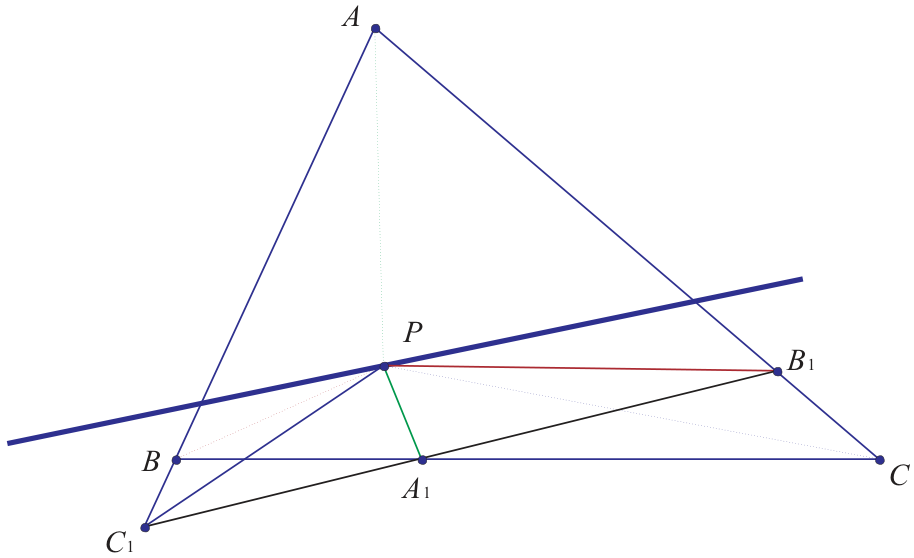
Let $P$ be a point in the plane of $ABC$, and $\gamma$ a line passing through $P$. Let $A'$, $B'$, $C'$ be the points where the reflections of lines $PA$, $PB$, $PC$ with respect to $\gamma$ intersect lines $BC$, $AC$, $AB$, respectively. Prove that $A'$, $B'$, $C'$ are collinear.
On the sides of an acute triangle $ABC$ three triangles $A'BC$, $AB'C$, $ABC'$ are constructed outside with $\angle ABC' = \angle A'BC = \angle B'AC = 30^\circ$ and $\angle BAC' = \angle AB'C = \angle A'CB = 90^\circ$. Prove that $A'C' \perp B'M$, where $M$ is the midpoint of $BC$.
Prove that there exist a point $A$ on the graph of $f(x) = x^4$ and a point $B$ on the graph of $g(x) = x^4 + x^2 + x + 1$ such that the distance between $A$ and $B$ is less than $\frac{1}{100}$.
Is it possible to paint each cell of an $8 \times 8$ table with one of 16 colors so that for each two colors there are two cells painted with these colors and having a common side?