A digital lock opens as soon as its unique correct four-digit combination is entered; repeated digits are allowed. For example, typing 000125 opens it if the code is 0001, 0012 or 0125. Little Pierre does not know the code. What is the minimum number of digits he must type to guarantee that the lock opens?
Triangle $ABC$ has $AB = 5$, $BC = 3\sqrt{2}$, and $AC = 1$. If the altitude from $B$ to $AC$ and the angle bisector of angle $A$ intersect at $D$, what is $BD$?
a) Prove that for every real number $x$ the arithmetic mean of $\sqrt{1 + \sin x}$ and $\sqrt{1 - \sin x}$ is equal to one of the following: $\sin \frac{x}{2}$, $\cos \frac{x}{2}$, $-\sin \frac{x}{2}$, $-\cos \frac{x}{2}$.
b) Can one leave out one of the four numbers listed in part a) in such a way that the claim still holds?
Let $ABC$ be a triangle where $|AB| = |AC|$. Points $P$ and $Q$ are different from the vertices of the triangle and lie on the sides $AB$ and $AC$, respectively. Prove that the circumcircle of the triangle $APQ$ passes through the circumcenter of $ABC$ if and only if $|AP| = |CQ|$.
Let $x,y,z$ be strictly positive real numbers such that
$$x+y+z\ge\frac1x+\frac1y+\frac1z.$$
Show that
$$\frac xy+\frac yz+\frac zx\ge\frac1{xy}+\frac1{yz}+\frac1{zx}.$$
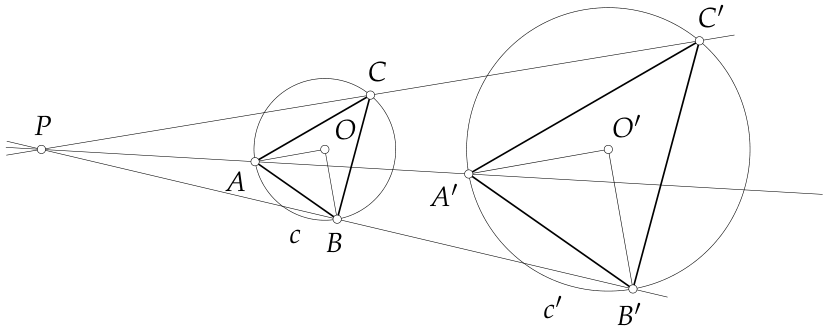
Two circles $c$ and $c'$ with centers $O$ and $O'$ lie completely outside each other. Points $A$, $B$, and $C$ lie on the circle $c$ and points $A'$, $B'$, and $C'$ lie on the circle $c'$ so that segment $AB \parallel A'B'$, $BC \parallel B'C'$, and $\angle ABC = \angle A'B'C'$. The lines $AA'$, $BB'$, and $CC'$ are all different and intersect in one point $P$, which does not coincide with any of the vertices of the triangles $ABC$ or $A'B'C'$. Prove that $\angle AOB = \angle A'O'B'$.
For what positive integers $n$ do there exist functions $f, g:\{1,2, \ldots, n\} \rightarrow \{1,2, \ldots, n\}$ such that for each $1 \leq i \leq n$, either $f(g(i))=i$ or $g(f(i))=i$, but not both?
Let $x_1,x_2,\ldots,x_5$ be real numbers such that
$$\begin{aligned}|x_2-x_1|&=2|x_3-x_2|=3|x_4-x_3|\\&=4|x_5-x_4|=5|x_1-x_5|.\end{aligned}$$
Prove that these five real numbers are equal.
Let $x$, $y$, $z$ be positive real numbers whose sum is $2012$. Find the maximum value of
$$
\frac{(x^2 + y^2 + z^2)(x^3 + y^3 + z^3)}{(x^4 + y^4 + z^4)}
$$
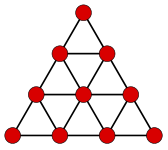
An equilateral triangle with side length $3$ is divided into $9$ equilateral triangles with side length $1$. An integer from $1$ to $10$ is written into every point that is a vertex of a small triangle (colored vertices on the figure), such that all numbers are written exactly once. For every small triangle, the sum of the numbers in the three vertices is written inside it. Prove that there exist three small triangles such that the sum of the numbers inside them is at least $48$.
Find the smallest positive integer $n$ such that $\underbrace{2^{2^{2 \cdots}}}_{n} \gt 3^{3^{3^{3}}}$. (The notation $\underbrace{2^{2^{2 \cdots}}}_{n}$ is used to denote a power tower with $n$ $2$'s. For example, $\underbrace{2^{2^{2^{2}}}}_{n=4}$ would equal $2^{2^{2^{2}}}$.)
Determine all nonconstant monic polynomials with integer coefficients
$$X^n+a_1X^{n-1}+\cdots+a_{n-1}X+a_n$$
whose roots are exactly $a_1,\ldots,a_{n-1},a_n$, counted with multiplicity.
Let $f$ be the function such that
$$
f(x)= \begin{cases}2x & \text{ if } x \leq \frac{1}{2} \\ 2-2x & \text{ if } x \gt \frac{1}{2}\end{cases}
$$
What is the total length of the graph of $\underbrace{f(f(\ldots f}_{2012\ f\text{'s}}(x) \ldots))$ from $x=0$ to $x=1$?
Prove that for every positive integer $n$ and every group of real numbers $a_1, a_2, \dots, a_n \gt 0$,
$$
\sum_{k=1}^{n} \frac{k}{a_{1}^{-1} + a_{2}^{-1} + \dots + a_{k}^{-1}} \le 2 \sum_{k=1}^{n} a_{k}.
$$
Can “2” immediately to the right of the inequality be replaced by a smaller positive number?