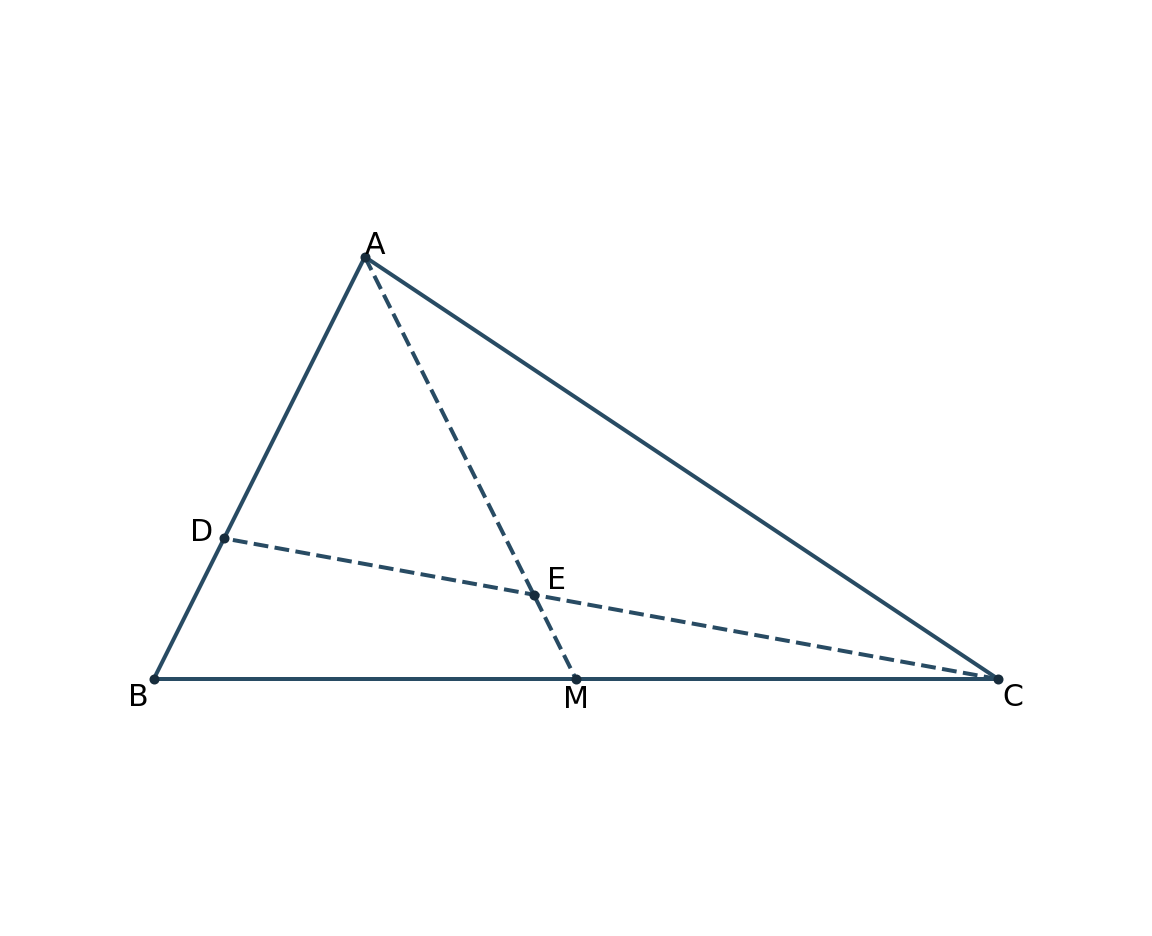
Points $A$, $M$, $N$ and $B$ are collinear, in that order, and $AM = 4$, $MN = 2$, $NB = 3$. If point $C$ is not collinear with these four points, and $AC = 6$, prove that $CN$ bisects $\angle BCM$.
Jeck and Lisa are playing a game on an $m \times n$ board, with $m, n \gt 2$. Lisa starts by putting a knight onto the board. Then in turn Jeck and Lisa put a new piece onto the board according to the following rules:
1. Jeck puts a queen on an empty square that is two squares horizontally and one square vertically, or alternatively one square horizontally and two squares vertically, away from Lisa's last knight.
2. Lisa puts a knight on an empty square that is on the same row, column or diagonal as Jeck's last queen.
The one who is unable to put a piece on the board loses the game. For which pairs $(m,n)$ does Lisa have a winning strategy?
Find the largest possible value of
$$
\left(\sin \theta_{1}\right)\left(\cos \theta_{2}\right)+\left(\sin \theta_{2}\right)\left(\cos \theta_{3}\right)+\cdots+\left(\sin \theta_{2013}\right)\left(\cos \theta_{2014}\right)+\left(\sin \theta_{2014}\right)\left(\cos \theta_{1}\right)
$$
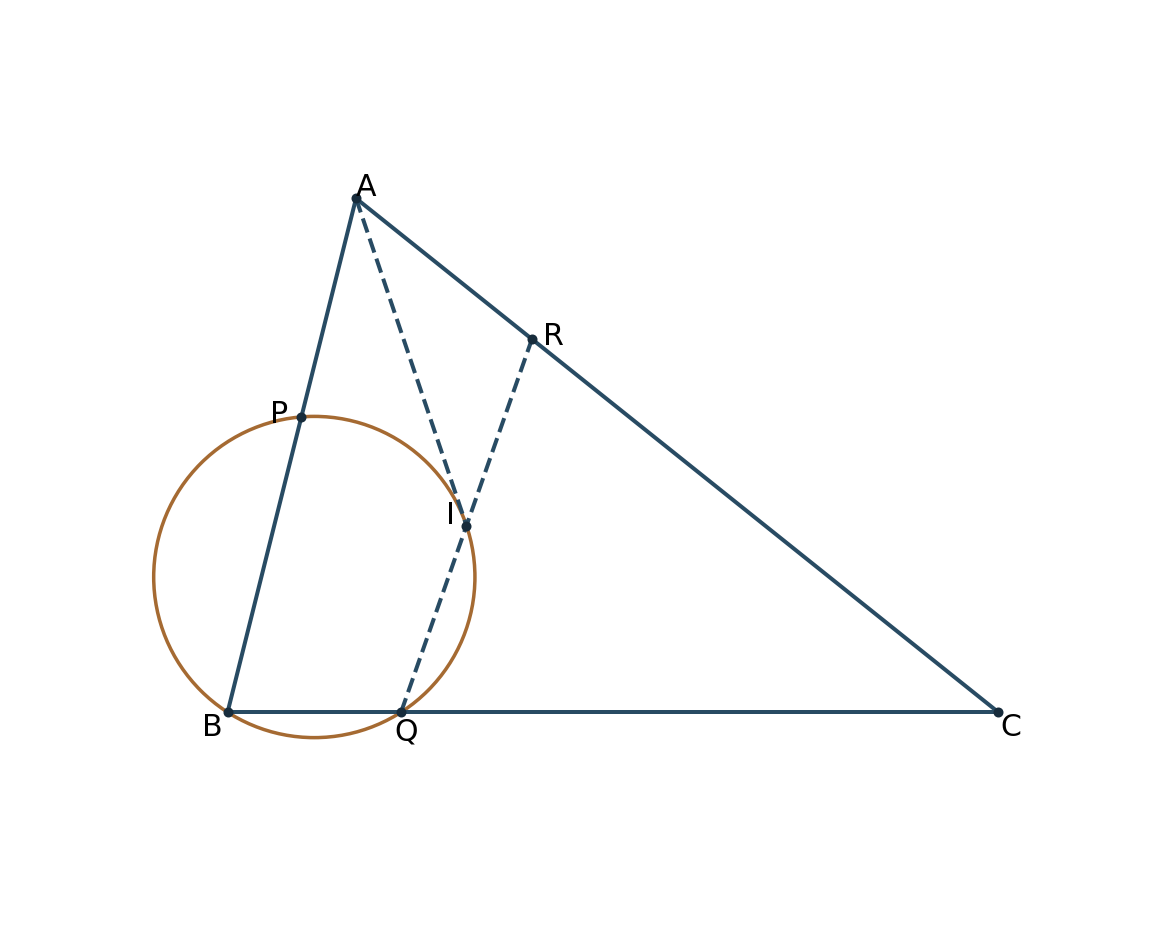
In triangle $ABC$, $I$ is the incentre. A circle is tangent to $AI$ at $I$ and passes through $B$. It meets $AB$ again at $P$ and $BC$ again at $Q$. Line $QI$ meets $AC$ at $R$. Prove that $|AR|\cdot|BQ|=|PI|^2$.
Let $a$, $b$, $c$ be real numbers for which $a + b + c = 4$ and $a, b, c \gt 1$. Prove that
$$
\frac{1}{a-1} + \frac{1}{b-1} + \frac{1}{c-1} \ge 8 \left( \frac{1}{a+b} + \frac{1}{b+c} + \frac{1}{c+a} \right).
$$
Macedonian source version, translated in full:
Let $a$, $b$, $c$ be real numbers for which $a + b + c = 4$ and $a, b, c \gt 1$. Prove that
$$
\frac{1}{a-1} + \frac{1}{b-1} + \frac{1}{c-1} \ge 8 \left( \frac{1}{a+b} + \frac{1}{b+c} + \frac{1}{c+a} \right).
$$
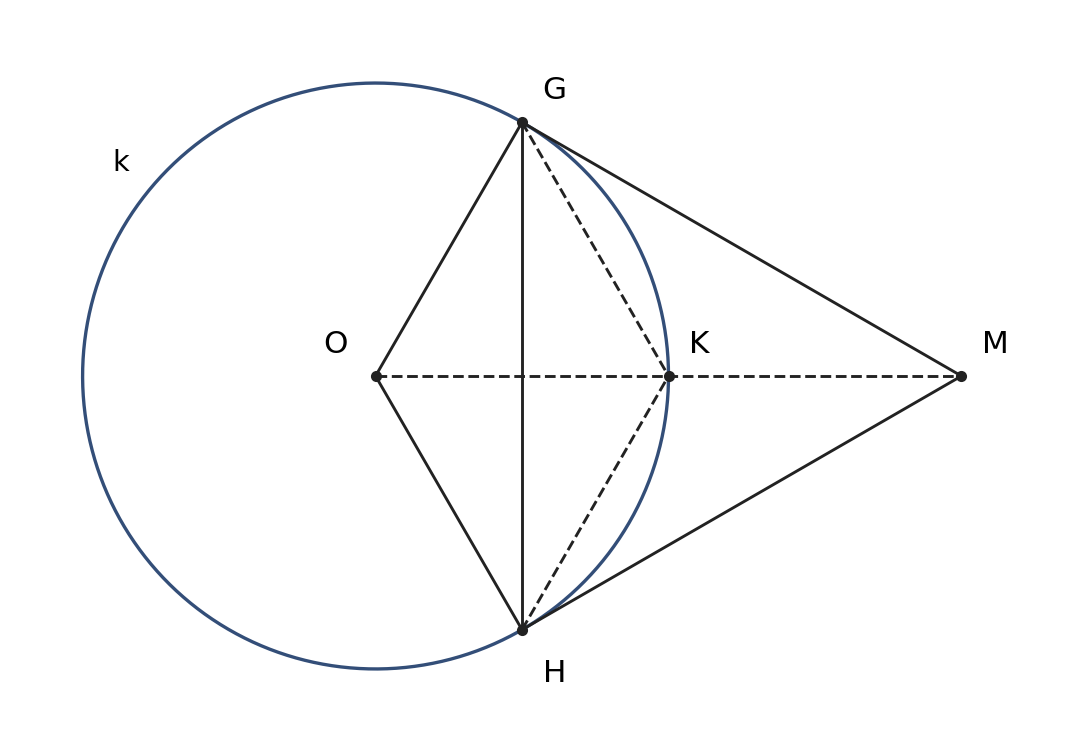
Two tangents are drawn from a point $M$ to circle $k$, that touch it at points $G$ and $H$. If $O$ is the center of $k$ and $K$ is the orthocenter of the triangle $MGH$, prove that $\angle GMH = \angle OGK$.
Macedonian source version, translated in full:
Two tangents are drawn from a point $M$ to circle $k$, that touch it at points $G$ and $H$. If $O$ is the center of $k$ and $K$ is the orthocenter of the triangle $MGH$, prove that $\angle GMH = \angle OGK$.
In a Word Finding game, a player tries to find a word in a $12 \times 12$ array of letters by looking at blocks of adjacent letters that are arranged horizontally, arranged vertically, or arranged diagonally. How many such 3-letter blocks are there in a given $12 \times 12$ array of letters?
Prove that there are infinitely many positive integers which can't be expressed as $a^{d(a)} + b^{d(b)}$ where $a$ and $b$ are positive integers.
For positive integer $a$ expression $d(a)$ denotes the number of positive divisors of $a$.
Find the maximum value of
$$
(1-x)(2-y)(3-z)\left(x+\frac{y}{2}+\frac{z}{3}\right)
$$
where $x\lt 1$, $y\lt 2$, $z\lt 3$, and $x+\frac{y}{2}+\frac{z}{3}\gt 0$.
Two numbers $p$ and $q$ are both chosen randomly (and independently of each other) from the interval $[-2,2]$. Find the probability that $4x^{2}+4px+1-q^{2}=0$ has imaginary roots.
A game is played on an $n \times n$ chessboard. At the beginning there are 99 stones on each square. Two players $A$ and $B$ take turns, where in each turn the player chooses either a row or a column and removes one stone from each square in the chosen row or column. They are only allowed to choose a row or a column, if it has at least one stone on each square. The first player who cannot move, loses the game. Player $A$ takes the first turn. Determine all $n$ for which player $A$ has a winning strategy.
Find all $n \in \mathbb{N}$ divisible by $11$, such that all numbers that can be obtained from $n$ by an arbitrary rearrangement of its digits are again divisible by $11$.
Macedonian source version, translated in full:
Find all $n \in \mathbb{N}$ divisible by $11$, such that all numbers that can be obtained from $n$ by an arbitrary rearrangement of its digits are again divisible by $11$.