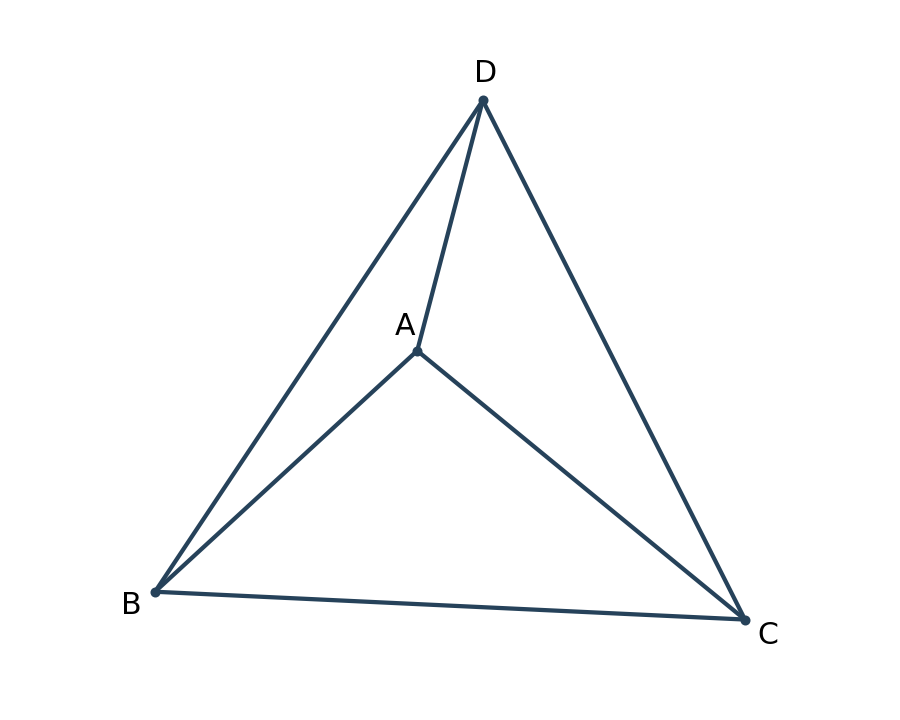
The faces of two identical regular tetrahedra are colored red, white, green and blue. The colors are chosen randomly, but the four faces of each tetrahedron must have different colors. What is the probability that after coloring the two tetrahedra are indistinguishable?
(A) $\frac1{4!}$
(B) $\frac2{4!}$
(C) $\frac14$
(D) $\frac12$
(E) 1
Let $n$ be a natural number. Permutation $a_1, a_2, \dots, a_n$ of numbers $1, 2, \dots, n$ is called square (cubic), if for each natural number $1 \le i \le n - 1$, $a_i a_{i+1} + 1$ is a perfect square (cube).
a) Prove that for infinitely many natural numbers $n$ there exists at least one square permutation of numbers $1, 2, \dots, n$.
b) Prove that for no natural number $n$ there exists a cubic permutation of numbers $1, 2, \dots, n$.
Several (at least two) segments are drawn on a board. Select two of them, and let $a$ and $b$ be their lengths. Delete the selected segments and draw a segment of length $\frac{a b}{a+b}$. Continue this procedure until only one segment remains on the board. Prove:
a) the length of the last remaining segment does not depend on the order of the deletions.
b) for every positive integer $n$, the initial segments on the board can be chosen with distinct integer lengths, such that the last remaining segment has length $n$.
Function $f$ is said to **generate** function $g$ (and denote it by $f \to g$), if $g$ can be written as the composition of function $f$ with itself for several times; i.e., natural number $k$ exists for which $f \circ f \circ \dots \circ f = g$ ($k$ times).
We want to explore some properties of this relation. For example, it can easily be shown that if $f \to g$ and $g \to h$, then $f \to h$. (transitivity)
a) Show that two functions $f \neq g: \mathbb{R} \to \mathbb{R}$ exist for which $f \to g$ and $g \to f$.
b) Prove that for each function $f: \mathbb{R} \to \mathbb{R}$ there are a finite number of functions $g: \mathbb{R} \to \mathbb{R}$ for which $f \to g$ and $g \to f$.
c) Does a function $g: \mathbb{R} \to \mathbb{R}$ exist such that the only function that generates it is itself?
d) Does there exist a function that generates functions $x^3$ and $x^5$?
e) Prove that if there exists a function that generates two linear polynomials $P$ and $Q$, then there exists a linear polynomial that generates both $P$ and $Q$.
Let $a$, $b$, $c$, $d$, $e$ be not necessarily distinct divisors of $210$. Find all $5$-permutations $(a, b, c, d, e)$ which satisfy the condition $abcde \gt 44100$.
Diagonals of the convex quadrilateral $ABCD$ inscribed in a circle intersect at point $E$. The line passing $E$ perpendicular to the side $AD$ intersects the side $BC$ at point $N$. The line passing $E$ perpendicular to the side $BC$ intersects the side $AD$ at point $M$. Prove that $2MN = AB + CD$ implies that $ABCD$ is a trapezoid.
A knight is placed on a corner square of a $3\times3$ chessboard. A move takes it to a square reached by two horizontal steps followed by one vertical step, or by two vertical steps followed by one horizontal step. In how many ways can it reach the opposite corner square in exactly 12 moves?
Let $O$ be the point of intersection of two diagonals of a square $ABCD$. Points $P, Q, R, S$ lie on the line segments $OA, OB, OC, OD$, respectively, and satisfy $OP = 3$, $OQ = 5$, $OR = 4$. Here we denote for a line segment $XY$ its length also by $XY$. If the point of intersection of lines $AB$ and $PQ$, the point of intersection of lines $BC$ and $QR$, and the point of intersection of lines $CD$ and $RS$ are collinear, what is the value of $OS$?
Let $m$ be a positive integer of $1000$ digits, with the property that all of its digits are non-zero. For a positive integer $n$, consider $\left\lfloor \frac{m}{n} \right\rfloor$, where we define for any real number $r$, $\lfloor r \rfloor$ to be the largest integer less than or equal to $r$. Determine the largest possible number of digits which are $0$ for $\left\lfloor \frac{m}{n} \right\rfloor$, where $1 \le n \le m$.
Find all functions $f : \mathbb{R}^+ \to \mathbb{R}^+$ such that for all positive real numbers $x$ and $y$,
$$
f\left(\frac{y}{f(x+1)}\right) + f\left(\frac{x+1}{x f(y)}\right) = f(y).
$$
A square $(2n+1)\times(2n+1)$ chessboard, with $n\gt 0$, is colored so that each square is white or black. A square is called special if at least $n$ other squares in its row and at least $n$ other squares in its column have the same color as it.
a. Prove that there are at least $2n+1$ special squares.
b. Give an example with at most $4n$ special squares.
c. Determine, as a function of $n$, the minimum possible number of special squares.
Let $D$ be a variable point on side $BC$ of triangle $ABC$. The incenters of triangles $ABC$, $ABD$ and $ACD$ are $I$, $I_1$ and $I_2$, respectively. Points $M$ and $N$ are the second intersection points of circumcircles of triangles $IAI_1$ and $IAI_2$ with the circumcircle of triangle $ABC$, respectively. Prove that as $D$ varies on side $BC$, line $MN$ passes through a fixed point in the plane.
Let $ABC$ be a triangle with circumcircle $\omega$ and circumcenter $O$. Denote by $M$ the midpoint of that arc $BC$ of $\omega$ which does not contain vertex $A$. Lines passing through $O$ parallel to $MB$ and $MC$ intersect sides $AB$ and $AC$ at points $K$ and $L$, respectively. If the perpendicular from vertex $A$ to side $BC$ intersects $\omega$ at point $N$, show that $NK = NL$.
In each unit cell of a $n \times m$ table an integer number is written. An **diagonal** is formed by those cells of the table for which the difference between their column number and their row number is a constant number. We want to make all the numbers in the table $0$ during a finite number of steps. In each step, we can select a row, a column or a diagonal and add $1$ or $-1$ to the number in every cell of it. Prove that if we can make all the numbers in each $3 \times 3$ subtable $0$ without altering the rest of the table, then we can make all the numbers in the table $0$.
For example, in the $5 \times 9$ table below, cells of a diagonal and also cells of a $3 \times 3$ subtable are shown. Note that the rightmost upper cell (row $1$, column $9$) is also considered a diagonal.
Find all polynomials with integer coefficients $P$ such that the set $P(\mathbb{Z}) = \{P(a) : a \in \mathbb{Z}\}$ contains an infinite geometric progression.
a, b, c are integers and $a \lt b \lt c$. An integer $n$ is said to be *quadratical* if $a^2 + b^2 - c^2 = n$. Find number of quadratical numbers no less than 1 and no greater than 2014.
Given $n$ different points in a plane, prove that among these points it is always possible to find 3 points forming an angle not exceeding $\frac{\pi}{n}$.