Do there exist functions $f$ and $g$, $f: \mathbb{R} \to \mathbb{R}$, $g: \mathbb{R} \to \mathbb{R}$, such that $f(x + f(y)) = y^2 + g(x)$ for all real $x$ and $y$?
An $n \times n$ ($n \ge 4$) square is divided into $n^2$ unit cells. Find all possible values of $n$ such that this square can be covered with some layers of 4-cell figures of the following shape [ ] (i.e. each cell of the square must be covered with the same number of these figures).
(The sides of each figure must coincide with the sides of the cells; the figures may be rotated but none of them can go beyond the bounds of the square.)
(Jury)
Editorial source clarification: The original Belarus 2014 booklet, problem 8.8, shows a straight $1\times4$ rectangle (I-tetromino) at the bracket placeholder, not an L-tetromino. This independently recovered definition supplements the unchanged extraction above.
The segment $\overline{AB}$ is a diameter of a circle with the centre $O$. On the circle the point $C$ is given such that $OC$ is perpendicular to $AB$. Let $P$ be a point on the shorter arc $\widehat{BC}$. The lines $CP$ and $AB$ intersect at the point $Q$, and the point $R$ is the intersection of the line $AP$ and the line through $Q$ perpendicular to the line $AB$.
Prove that $|BQ| = |QR|$. (Macedonia 2013)
Prove that there exist infinitely many positive integers $n$ such that the largest prime divisor of $n^4 + n^2 + 1$ is equal to the largest prime divisor of $(n+1)^4 + (n+1)^2 + 1$. (IMO Shortlist 2013)
On the playground there are $2014$ athletes with the numbers from $1$ to $2014$ on their shirts (each number is on exactly one shirt). At the beginning they are all standing. In certain time intervals the coach shouts out all positive integers from $1$ to $2014$ in the increasing order. All athletes having a multiple of the shouted number on their shirts change their position from the standing position to crouch and vice versa.
How many athletes are crouching after the coach shouts out the number $2014$?
Let $ABCD$ be a convex quadrilateral such that $\angle BAD = 90^\circ$, $\angle BAC = 2\angle BDC$ and $\angle DBA + \angle DCB = 180^\circ$. Find $\angle DBA$.
Let $H$ be an intersection point of the altitudes $AA_1$, $BB_1$, $CC_1$ of an acute-angled triangle $ABC$. Let $M$ and $N$ be the midpoints of the segments $BC$ and $AH$, respectively.
Prove that $MN$ is the perpendicular bisector of the segment $B_1C_1$.
Andrija and Boris have 2014 cards labelled with numbers from 1 to 2014. Andrija has all the cards with even, and Boris all the cards with odd numbers. Andrija arranged his cards in a circle clockwise, from 2 to 2014 respectively, and put them upside down, so that the numbers on the cards can not be seen. Boris knows that the cards are arranged in that order and that direction, but does not know the position of the card with number 2. After that, Boris puts one of his cards on top of each Andrija's card thus forming 1007 pairs of cards.
For each pair they compare the numbers on the cards and give one point to the player whose card has the larger number.
Find the largest possible $N$ such that Boris can be certain he will gain at least $N$ points. (Ukraine 2010)
Let $a$ be a positive integer, and let $b$ and $c$ be integers such that the equation $a x^2 + b x + c = 0$ has two different solutions in the interval $\langle 0, \frac{1}{2} \rangle$. Prove that $a \ge 6$.
$n$ points are marked on a plane. Each pair of these points is connected with a segment. Each segment is painted one of four different colors.
Find the largest possible value of $n$ such that one can paint the segments so that for any four points there are four segments (connecting these four points) of four different colors.
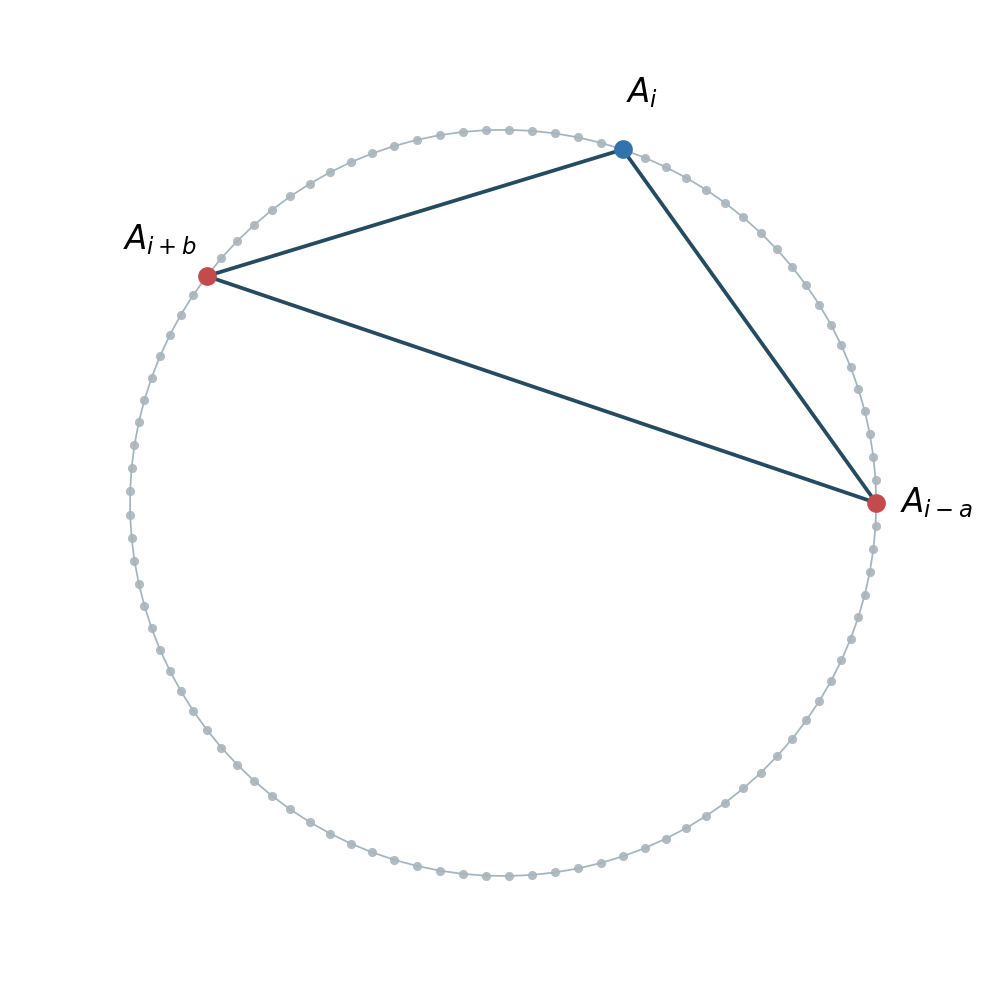
Let $A_1A_2\cdots A_{101}$ be a regular 101-gon, and color every vertex red or blue. Let $N$ be the number of obtuse triangles satisfying the following: The three vertices of the triangle must be vertices of the 101-gon, both the vertices with acute angles have the same color, and the vertex with obtuse angle have different color.
(1) Find the largest possible value of $N$.
(2) Find the number of ways to color the vertices such that maximum $N$ is achieved. (Two colorings are different if for some $A_i$ the colors are different on the two coloring schemes)
Supplemental illustration (AI-generated; gray vertices, if present, have unspecified colors):
Find all prime numbers $p$ for which there exists a positive integer $n$ such that both $n^2 + 3$ and $(n + 1)^2 + 3$ are divisible by $p$. (Stipe Vidak)
Find the least positive integer $a$ such that the expression
$$
\frac{n^8 + n^6 + n^4 + n^2 + a}{n^2 - 1}
$$
for $n = 2014$ is an integer divisible by $3$. (Mea Bombardelli)
$N$ cells are marked on an $n \times n$ table so that at least one marked cell is among any four cells of the table which form the figure $\Box\Box$ (the figure may be rotated). Find the smallest possible value of $N$.
A sequence $(a_n)$, $n \in \mathbb{N}$ is defined as
$$
a_1 = 1,\ a_2 = 2,\ a_3 = 3 \text{ and } a_n = \frac{a_{n-1} a_{n-2} + 7}{a_{n-3}}, \text{ for } n \ge 4.
$$
Prove that all terms of this sequence are integers.
Let $n \ge 2$ be an integer and let $a_0, a_1, \ldots, a_n$ be consecutive terms of an arithmetic progression. Prove that
$$
a_0 - \binom{n}{1}a_1 + \dots + (-1)^k \binom{n}{k}a_k + \dots + (-1)^n \binom{n}{n}a_n = 0.
$$