For positive $a$, $b$, $c$, that satisfy the condition $ab + bc + ca = 3$, prove an inequality:
$$
\frac{1}{2a^3+1} + \frac{1}{2b^3+1} + \frac{1}{2c^3+1} \ge 1.
$$
Grasshopper is sitting at point $O$ of coordinate line. He makes $2016$ jumps in positive direction. Firstly his jump has length $1$, every next jump is $k \in \mathbb{N}$ times longer than the previous one. There are holes in every point with coordinate $2016l$, $l \in \mathbb{N}$. Determine $k$ for which the grasshopper will make all the jumps and will not jump into hole.
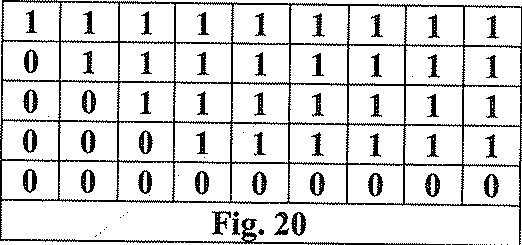
In every cell of the table $5 \times 9$ either $0$ or $1$ is written. Then the sums of the numbers for every row and column are calculated. What is the maximum amount of different values that can be among these $14$ numbers?
a) Does there exist a set $A$ that has $2016$ pairwise different positive integers and such a property: for every non-empty subset $B \subset A$ that is not equal to $A$ and every non-empty subset $C \subset (A \setminus B)$ the sum of the elements of subset $B$ is not divisible by the sum of the elements of subset $C$?
b) Does there exist a set $A$ that has $2016$ pairwise different positive integers and such a property: for every non-empty subset $B \subset A$ that is not equal to $A$ and contains at least $2$ elements and every non-empty subset $C \subset (A \setminus B)$ the product of the elements of subset $B$ is divisible by the sum of the elements of subset $C$?
Vertices of a regular $(6n+3)$-gon, which are renumbered clockwise by numbers $1; 2; \ldots; 6n+3$, are the game field. Vertices with numbers $2n+1; 4n+2; 6n+3$ are called holes. At the start of the game there are $3$ chips on the field. $2$ players in turn choose any one of the $3$ chips and move it clockwise to a neighbouring vertex, if this one isn't occupied by another chip. The first player wins, if at least $2$ chips get in holes after anyone's turn. Can the first player always win, if at the start of the game they are placed in the form of a regular triangle?
(Bogdan Rublyov)
An acute-angled triangle $ABC$ is given, where $AB \lt BC$. Its incircle with the centre in point $I$ is touching the side $BC$ in point $K$. The line $AK$ intersects a second time the circumscribed circle of triangle $ABC$ in point $T$. Let $M$ be the midpoint of $BC$, and $N$ be the midpoint of arc $BAC$ of the circumscribed circle of triangle $ABC$. Line segment $NT$ intersects the circumscribed circle of triangle $BIC$ in point $P$. Prove that $PM \parallel AK$.
For six integers $a, b, c$ and $A, B, C$ the following correlations are true:
$$
b + c = A^2, \quad c + a = B^2, \quad a + b = C^2, \quad C \gt B \gt A \geq 0.
$$
Find numbers $a, b, c$, for which the sum $A^2 + B^2 + C^2$ takes the smallest possible value.
In a triangle $ABC$ with sides $BC \gt AC \gt AB$, consider the angles between the height and median, being built from one top. Find out, on which top this angle is the largest of the three.
How many three-digit numbers are there with non-zero digits which have the following property: after any permutation of its digits one obtains three-digit number which is divisible by $4$?
There are 22 cards, where the numbers $1, 2, \ldots, 22$ are written. Using these cards one formed 11 fractions. What is the greatest possible number of integer numbers among the fractions?
30 children – boys and girls – formed a circle. It occurred that there is no child such that both its neighbors are boys. What is the least possible number of girls there?
The vertices of a cube are enumerated by the numbers $1$, $2$, $\ldots$, $8$. Someone chose three sides of the cube and told the numbers which are written on them to Pete: $\{1, 4, 6, 8\}$, $\{1, 2, 6, 7\}$, $\{1, 2, 5, 8\}$. Is it possible to determine which number has the vertex which is opposite to the one numbered $5$?
Find a positive integer $N$ and $a_{1}, a_{2}, \ldots, a_{N}$, where $a_{k}=1$ or $a_{k}=-1$ for each $k=1,2, \ldots, N$, such that
$$
a_{1} \cdot 1^{3}+a_{2} \cdot 2^{3}+a_{3} \cdot 3^{3}+\cdots+a_{N} \cdot N^{3}=20162016,
$$
or show that this is impossible.
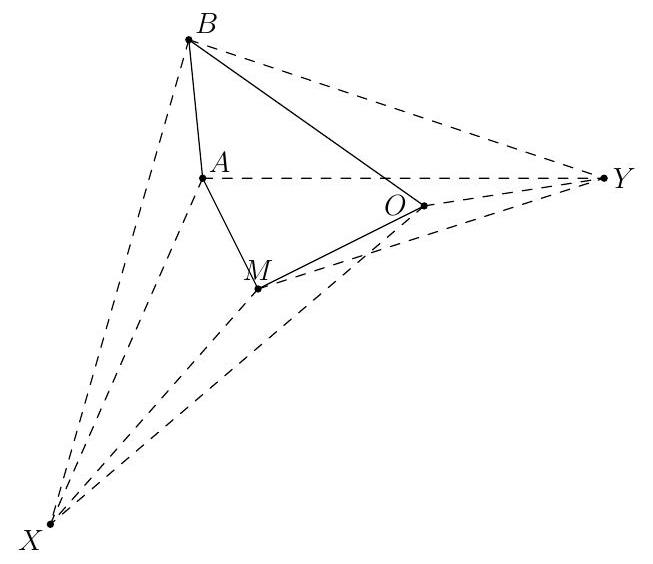
The corners of a fixed convex (but not necessarily regular) $n$-gon are labeled with distinct letters. If an observer stands at a point in the plane of the polygon, but outside the polygon, they see the letters in some order from left to right, and they spell a "word" (that is, a string of letters; it doesn't need to be a word in any language). For example, in the diagram below (where $n=4$), an observer at point $X$ would read "BAMO," while an observer at point $Y$ would read "MOAB."
Determine, as a formula in terms of $n$, the maximum number of distinct $n$-letter words which may be read in this manner from a single $n$-gon. Do not count words in which some letter is missing because it is directly behind another letter from the viewer's position.
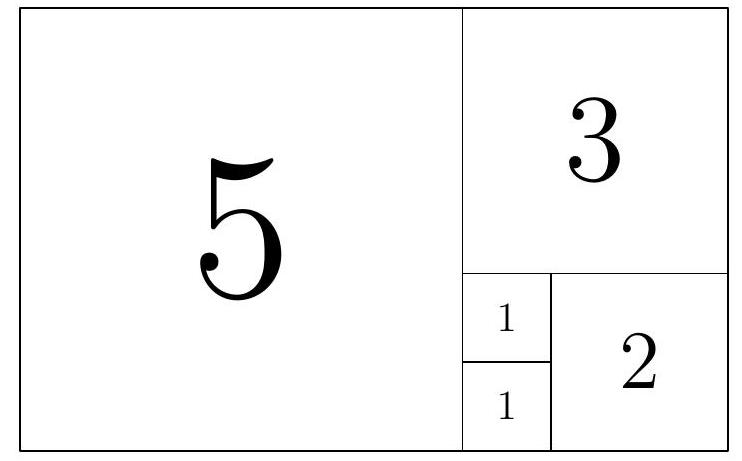
The diagram below is an example of a rectangle tiled by squares:
Each square has been labeled with its side length. The squares fill the rectangle without overlapping.
In a similar way, a rectangle can be tiled by nine squares whose side lengths are $2$, $5$, $7$, $9$, $16$, $25$, $28$, $33$, and $36$. Sketch a possible arrangement of those squares. They must fill the rectangle without overlapping. Label each square in your sketch by its side length, as in the picture above.