Quadratic polynomials $P(x)$ and $Q(x)$ have leading coefficients of $2$ and $-2,$ respectively. The graphs of both polynomials pass through the two points $(16, 54)$ and $(20, 53).$ Find $P(0) + Q(0).$
Find the three-digit positive integer $\underline{a}\,\underline{b}\,\underline{c}$ whose representation in base nine is $\underline{b}\,\underline{c}\,\underline{a},$ where $a,$ $b,$ and $c$ are (not necessarily distinct) digits.
In isosceles trapezoid $ABCD,$ parallel bases $\overline{AB}$ and $\overline{CD}$ have lengths $500$ and $650,$ respectively, and $AD = BC = 333.$ The angle bisectors of $\angle A$ and $\angle D$ meet at $P,$ and the angle bisectors of $\angle B$ and $\angle C$ meet at $Q.$ Find $PQ.$
Let $w = \frac{\sqrt{3} + \mathrm{i}}{2}$ and $z = \frac{-1 + \mathrm{i}\sqrt{3}}{2},$ where $\mathrm{i} = \sqrt{-1}.$ Find the number of ordered pairs $(r, s)$ of positive integers not exceeding $100$ that satisfy the equation $\mathrm{i} \cdot w^r = z^s.$
A straight river that is $264$ meters wide flows from west to east at a rate of $14$ meters per minute. Melanie and Sherry sit on the south bank of the river with Melanie a distance of $D$ meters downstream from Sherry. Relative to the water, Melanie swims at $80$ meters per minute, and Sherry swims at $60$ meters per minute. At the same time, Melanie and Sherry begin swimming in straight lines to a point on the north bank of the river that is equidistant from their starting positions. The two women arrive at this point simultaneously. Find $D.$
Find the number of ordered pairs of integers $(a, b)$ such that the sequence $$
3, 4, 5, a, b, 30, 40, 50
$$ is strictly increasing and no set of four (not necessarily consecutive) terms forms an arithmetic progression.
Let $a,$ $b,$ $c,$ $d,$ $e,$ $f,$ $g,$ $h,$ $i$ be distinct integers from $1$ to $9.$ The minimum possible positive value of $$
\frac{a \cdot b \cdot c - d \cdot e \cdot f}{g \cdot h \cdot i}
$$ can be written as $\frac{m}{n},$ where $m$ and $n$ are relatively prime positive integers. Find $m + n.$
Equilateral triangle $\triangle ABC$ is inscribed in circle $\omega$ with radius $18.$ Circle $\omega_A$ is tangent to sides $\overline{AB}$ and $\overline{AC}$ and is internally tangent to $\omega.$ Circles $\omega_B$ and $\omega_C$ are defined analogously. Circles $\omega_A,$ $\omega_B,$ and $\omega_C$ meet in six points — two points for each pair of circles. The three intersection points closest to the vertices of $\triangle ABC$ are the vertices of a large equilateral triangle in the interior of $\triangle ABC,$ and the other three intersection points are the vertices of a smaller equilateral triangle in the interior of $\triangle ABC.$ The side length of the smaller equilateral triangle can be written as $\sqrt{a} - \sqrt{b},$ where $a$ and $b$ are positive integers. Find $a + b.$
Ellina has twelve blocks, two each of red ($\textbf{R}$), blue ($\textbf{B}$), yellow ($\textbf{Y}$), green ($\textbf{G}$), orange ($\textbf{O}$), and purple ($\textbf{P}$). Call an arrangement of blocks *even* if there is an even number of blocks between each pair of blocks of the same color. For example, the arrangement $$
\textbf{R B B Y G G Y R O P P O}
$$ is even. Ellina arranges her blocks in a row in random order. The probability that her arrangement is even is $\frac{m}{n},$ where $m$ and $n$ are relatively prime positive integers. Find $m + n.$
Three spheres with radii $11,$ $13,$ and $19$ are mutually externally tangent. A plane intersects the spheres in three congruent circles centered at $A,$ $B,$ and $C,$ respectively, and the centers of the spheres all lie on the same side of this plane. Suppose that $AB^2 = 560.$ Find $AC^2.$
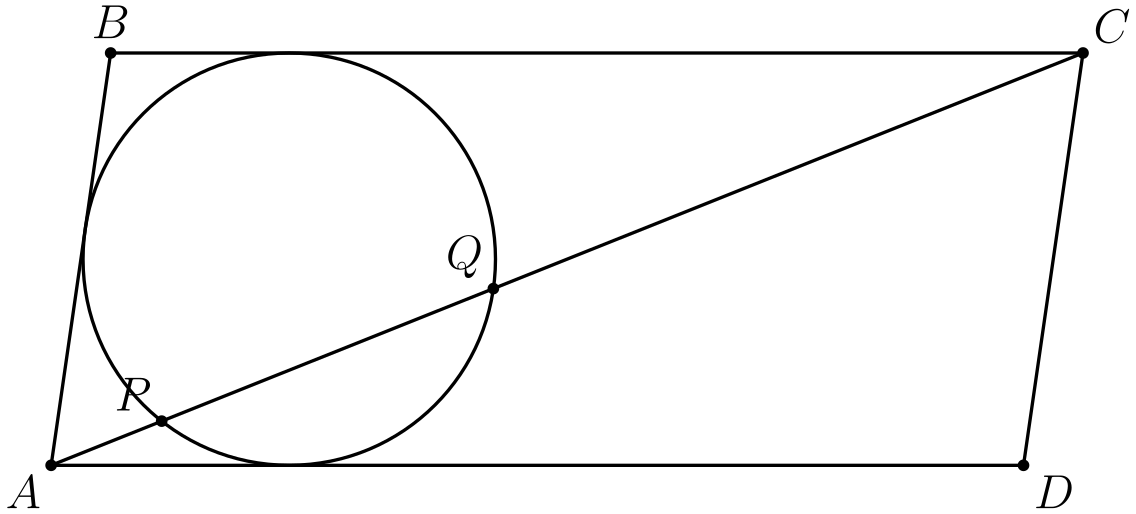
Let $ABCD$ be a parallelogram with $\angle BAD \lt 90^\circ.$ A circle tangent to sides $\overline{DA},$ $\overline{AB},$ and $\overline{BC}$ intersects diagonal $\overline{AC}$ at points $P$ and $Q$ with $AP \lt AQ,$ as shown. Suppose that $AP = 3,$ $PQ = 9,$ and $QC = 16.$ Then the area of $ABCD$ can be expressed in the form $m\sqrt{n},$ where $m$ and $n$ are positive integers, and $n$ is not divisible by the square of any prime. Find $m + n.$
For any finite set $X,$ let $|X|$ denote the number of elements in $X.$ Define $$
S_n = \sum |A \cap B|,
$$ where the sum is taken over all ordered pairs $(A, B)$ such that $A$ and $B$ are subsets of $\{1, 2, 3, \ldots, n\}$ with $|A| = |B|.$ For example, $S_2 = 4$ because the sum is taken over the pairs of subsets $$
\begin{aligned} &(A, B) \in {}\\ &\quad \small\left\{\begin{gathered} (\emptyset, \emptyset), (\{1\}, \{1\}), \\ (\{1\}, \{2\}), (\{2\}, \{1\}), \\ (\{2\}, \{2\}), (\{1, 2\}, \{1, 2\}) \end{gathered}\right\}, \end{aligned}
$$ giving $S_2 = 0 + 1 + 0 + 0 + 1 + 2 = 4.$ Let $\frac{S_{2022}}{S_{2021}} = \frac{p}{q},$ where $p$ and $q$ are relatively prime positive integers. Find the remainder when $p + q$ is divided by $1000.$
Let $S$ be the set of all rational numbers that can be expressed as a repeating decimal in the form $0.\overline{abcd},$ where at least one of the digits $a,$ $b,$ $c,$ or $d$ is nonzero. Let $N$ be the number of distinct numerators obtained when numbers in $S$ are written as fractions in lowest terms. For example, both $4$ and $410$ are counted among the distinct numerators for numbers in $S$ because $0.\overline{3636} = \frac{4}{11}$ and $0.\overline{1230} = \frac{410}{3333}.$ Find the remainder when $N$ is divided by $1000.$
Given $\triangle ABC$ and a point $P$ on one of its sides, call line $\ell$ the *splitting line* of $\triangle ABC$ through $P$ if $\ell$ passes through $P$ and divides $\triangle ABC$ into two polygons of equal perimeter. Let $\triangle ABC$ be a triangle where $BC = 219$ and $AB$ and $AC$ are positive integers. Let $M$ and $N$ be the midpoints of $\overline{AB}$ and $\overline{AC},$ respectively, and suppose that the splitting lines of $\triangle ABC$ through $M$ and $N$ intersect at $30^\circ.$ Find the perimeter of $\triangle ABC.$
Let $x,$ $y,$ and $z$ be positive real numbers satisfying the system of equations $$
\sqrt{2x - xy} + \sqrt{2y - xy} = 1
$$ $$
\sqrt{2y - yz} + \sqrt{2z - yz} = \sqrt{2}
$$ $$
\sqrt{2z - zx} + \sqrt{2x - zx} = \sqrt{3}.
$$ Then $\left[(1 - x)(1 - y)(1 - z)\right]^2$ can be written as $\frac{m}{n},$ where $m$ and $n$ are relatively prime positive integers. Find $m + n.$