Many states use a sequence of three letters followed by a sequence of three digits as their standard license-plate pattern. Given that each three-letter three-digit arrangement is equally likely, the probability that such a license plate will contain at least one palindrome (a three-letter arrangement or a three-digit arrangement that reads the same left-to-right as it does right-to-left) is $\frac{m}{n},$ where $m$ and $n$ are relatively prime positive integers. Find $m + n.$
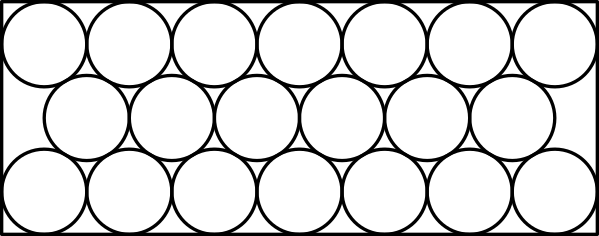
The diagram shows twenty congruent circles arranged in three rows and enclosed in a rectangle. The circles are tangent to one another and to the sides of the rectangle as shown in the diagram. The ratio of the longer dimension of the rectangle to the shorter dimension can be written as $\frac{1}{2}\left(\sqrt{p} - q\right),$ where $p$ and $q$ are positive integers. Find $p + q.$
Jane is $25$ years old. Dick is older than Jane. In $n$ years, where $n$ is a positive integer, Dick’s age and Jane’s age will both be two-digit numbers and will have the property that Jane’s age is obtained by interchanging the digits of Dick’s age. Let $d$ be Dick’s present age. How many ordered pairs of positive integers $(d, n)$ are possible?
Consider the sequence defined by $a_k = \frac{1}{k^2 + k}$ for $k \ge 1.$ Given that $a_m + a_{m+1} + \cdots + a_{n-1} = \frac{1}{29},$ for positive integers $m$ and $n$ with $m \lt n,$ find $m + n.$
Let $A_1,$ $A_2,$ $A_3,$ $\ldots,$ $A_{12}$ be the vertices of a regular dodecagon. How many distinct squares in the plane of the dodecagon have at least two vertices in the set $\{A_1, A_2, A_3, \ldots, A_{12}\}?$
The solutions to the system of equations $$
\log_{225} x + \log_{64} y = 4
$$ $$
\log_x 225 - \log_y 64 = 1
$$ are $(x_1, y_1)$ and $(x_2, y_2).$ Find $\log_{30}\left(x_1 y_1 x_2 y_2\right).$
The Binomial Expansion is valid for exponents that are not integers. That is, for all real numbers $x,$ $y,$ and $r$ with $|x| \gt |y|,$ $$
\begin{aligned} &(x + y)^r \\ &= x^r + r x^{r-1} y \\ &{}+ \frac{r(r - 1)}{2!}\,x^{r-2} y^2 \\ &{}+ \frac{r(r - 1)(r - 2)}{3!}\,x^{r-3} y^3 \\ &{}+ \cdots \end{aligned}
$$ What are the first three digits to the right of the decimal point in the decimal representation of $\left(10^{2002} + 1\right)^{\frac{10}{7}}?$
Harold, Tanya, and Ulysses paint a very long picket fence.
• Harold starts with the first picket and paints every $h$th picket;
• Tanya starts with the second picket and paints every $t$th picket; and
• Ulysses starts with the third picket and paints every $u$th picket.
Call the positive integer $100h + 10t + u$ *paintable* when the triple $(h, t, u)$ of positive integers results in every picket being painted exactly once. Find the sum of all the paintable integers.
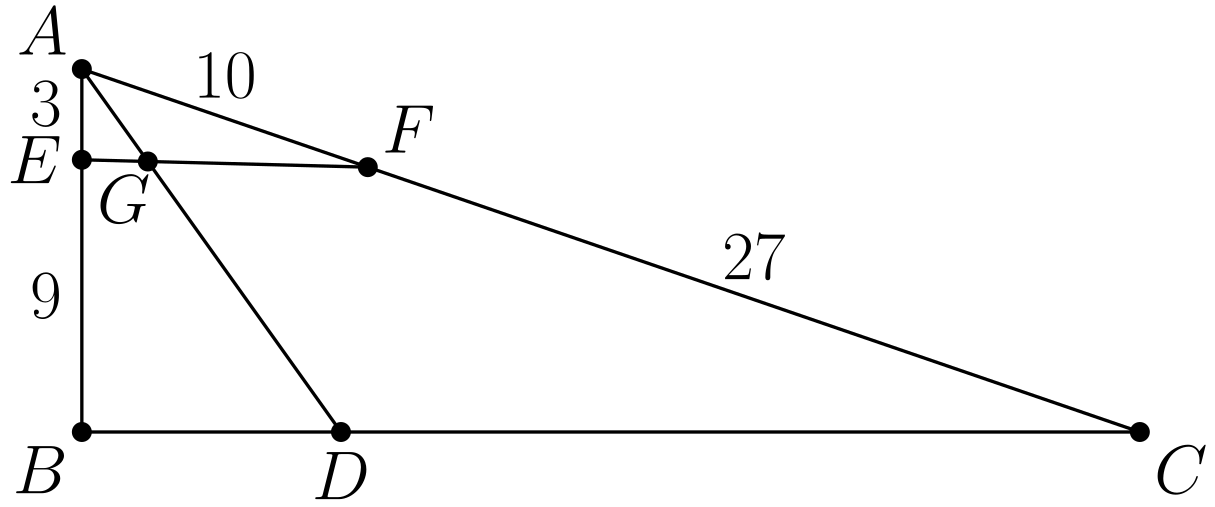
In the diagram below, angle $ABC$ is a right angle. Point $D$ is on $\overline{BC},$ and $\overline{AD}$ bisects angle $CAB.$ Points $E$ and $F$ are on $\overline{AB}$ and $\overline{AC},$ respectively, so that $AE = 3$ and $AF = 10.$ Given that $EB = 9$ and $FC = 27,$ find the integer closest to the area of quadrilateral $DCFG.$
Let $ABCD$ and $BCFG$ be two faces of a cube with $AB = 12.$ A beam of light emanates from vertex $A$ and reflects off face $BCFG$ at point $P,$ which is $7$ units from $\overline{BG}$ and $5$ units from $\overline{BC}.$ The beam continues to be reflected off the faces of the cube. The length of the light path from the time it leaves point $A$ until it next reaches a vertex of the cube is given by $m\sqrt{n},$ where $m$ and $n$ are integers and $n$ is not divisible by the square of any prime. Find $m + n.$
Let $F(z) = \frac{z + i}{z - i}$ for all complex numbers $z \ne i,$ and let $z_n = F(z_{n-1})$ for all positive integers $n.$ Given that $z_0 = \frac{1}{137} + i$ and $z_{2002} = a + bi,$ where $a$ and $b$ are real numbers, find $a + b.$
In triangle $ABC,$ the medians $\overline{AD}$ and $\overline{CE}$ have lengths $18$ and $27,$ respectively, and $AB = 24.$ Extend $\overline{CE}$ to intersect the circumcircle of $ABC$ at $F.$ The area of triangle $AFB$ is $m\sqrt{n},$ where $m$ and $n$ are positive integers and $n$ is not divisible by the square of any prime. Find $m + n.$
A set $\mathcal{S}$ of distinct positive integers has the following property: for every integer $x$ in $\mathcal{S},$ the arithmetic mean of the set of values obtained by deleting $x$ from $\mathcal{S}$ is an integer. Given that $1$ belongs to $\mathcal{S}$ and that $2002$ is the largest element of $\mathcal{S},$ what is the greatest number of elements that $\mathcal{S}$ can have?
Polyhedron $ABCDEFG$ has six faces. Face $ABCD$ is a square with $AB = 12;$ face $ABFG$ is a trapezoid with $\overline{AB}$ parallel to $\overline{GF},$ $BF = AG = 8,$ and $GF = 6;$ and face $CDE$ has $CE = DE = 14.$ The other three faces are $ADEG,$ $BCEF,$ and $EFG.$ The distance from $E$ to face $ABCD$ is $12.$ Given that $EG^2 = p - q\sqrt{r},$ where $p,$ $q,$ and $r$ are positive integers and $r$ is not divisible by the square of any prime, find $p + q + r.$