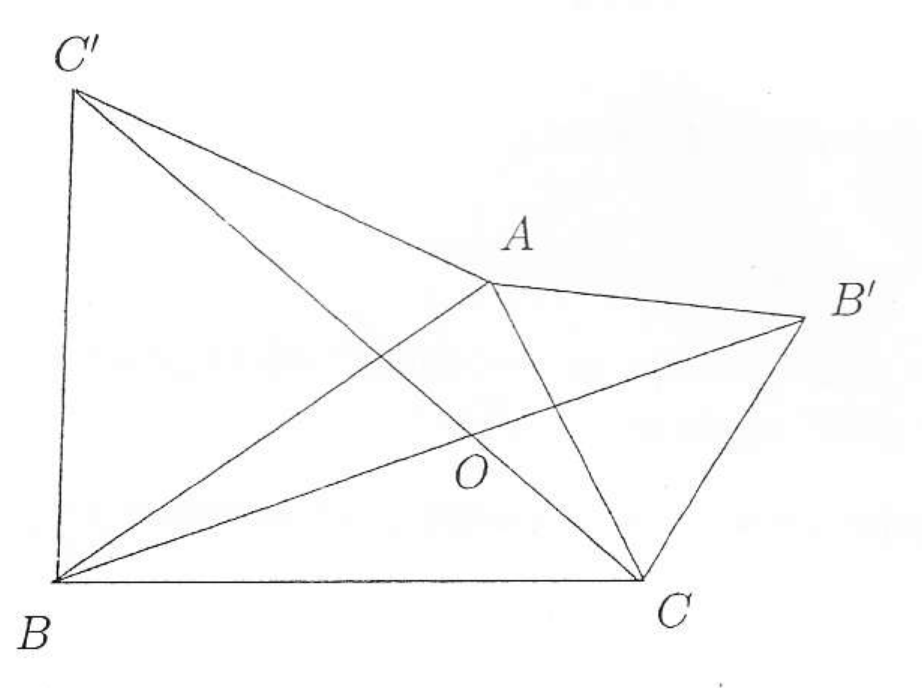
In the following figure, $ABC$ is a triangle and both $ABC^{\prime}$ and $AB^{\prime} C$ are equilateral triangles. Let $O$ be the meeting point of lines $CC^{\prime}$ and $BB^{\prime}$. Find $\angle BOC$ in degrees.
Consider the function $g(x)=Ax^2+Bx$, where $A$ and $B$ are constants. Assume that $u,v$ are two numbers such that $$g(u-3)=g(v+3),\qquad u-v\ne6.$$ Find the largest possible value of $A(g(u+v))^2+Bg(u+v)$.
Let $a_1,a_2,\ldots$ and $b_1,b_2,\ldots$ be two arithmetic progressions such that $a_1=10$ and $b_1=24$, and that $a_{100}+b_{100}=2014$. Find the sum of the first twenty terms of the sequence $$a_1+b_1,a_2+b_2,a_3+b_3,\ldots.$$
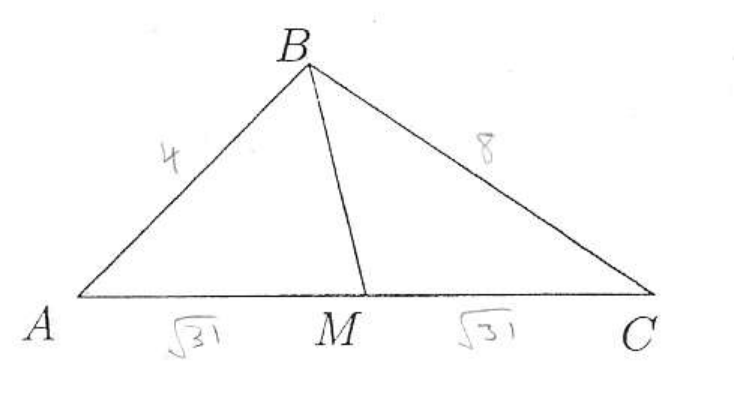
The figure below (not drawn to scale) shows a triangle $ABC$ with $BC=8$ cm, $BA=4$ cm and $AC=2\sqrt{31}$ cm. The point $M$ is the midpoint of $AC$. Find the length of $BM$ in centimetres.
The set $A$ is a non-empty subset of the set $\{1,2,3,4,5,6,7,8,9\}$ with the property that whenever $a\in A$, then $10-a\in A$. How many possible subsets $A$ are there?
In the sequence $$\frac14,\frac24,\frac34,\frac19,\frac29,\frac39,\ldots,\frac89,\frac1{16},\frac2{16},\ldots,\frac{15}{16},\frac1{25},\frac2{25},\ldots,\frac{24}{25},\ldots,$$ the $N$th term is $\frac{2014}{2025}$. Find $N$.
Find the number of triples $(a,b,c)$ such that $a,b,c$ are numbers in the set $\{1,2,3,\ldots,15\}$ satisfying the conditions $a\lt b-1$ and $b\lt c-2$.
The first term of an arithmetic progression is an integer and the common difference is 2. If the sum of the first $n$ terms $(n\gt 1)$ of the arithmetic progression is 2014, find the sum of all the possible values of $n$.
Find the largest even four-digit perfect square whose units digit exceeds the tens digit by 1 and whose thousands digit exceeds the hundreds digit by 1.
Find the number of integers $k$ in the set $S=\{1,2,3,\ldots,12014\}$ such that $k$ is of exactly one of the following forms $$n^2,n^3,n^5,$$ where $n$ is an integer.
(Note: For example, 100, 1000 are such numbers but $64=8^2=4^3$ is not.)
Let $a,b,c$ be positive real numbers such that $abc=1$. Find the least possible value of $$\frac{2014}{a^3(b+c)}+\frac{2014}{b^3(a+c)}+\frac{2014}{c^3(a+b)}.$$
A sequence $a_0,a_1,a_2,a_3,\ldots$, with $a_1=1$, is defined such that for any positive integers $m,n$, where $m\ge n$, the terms of the sequence satisfy the relation $$a_{m+n}+a_{m-n}+m-n=\frac12(a_{2m}+a_{2n})+1.$$ Find the value of $\left\lfloor\frac{a_{2014}}{2014}\right\rfloor$.
Let $n$ be a positive integer such that, for each of the digits $0,1,\ldots,9$, there exists a factor of $n$ ending in that digit. What is the smallest possible value of $n$?