A circular coin $A$ is rolled, without sliding, along the circumference of another stationary circular coin $B$ whose radius is twice that of $A$. Let $x$ be the number of degrees through which $A$ turns about its centre until it first returns to its initial position. Find $x$.
Towns $X,Y,Z$ have plane coordinates $(0,0),(200,0),(0,300)$, respectively, and contain $100,200,300$ students, respectively. A school is to be built at an integer grid point $(x,y)$ so that the overall distance travelled by all students is minimized. Find $x+y$.
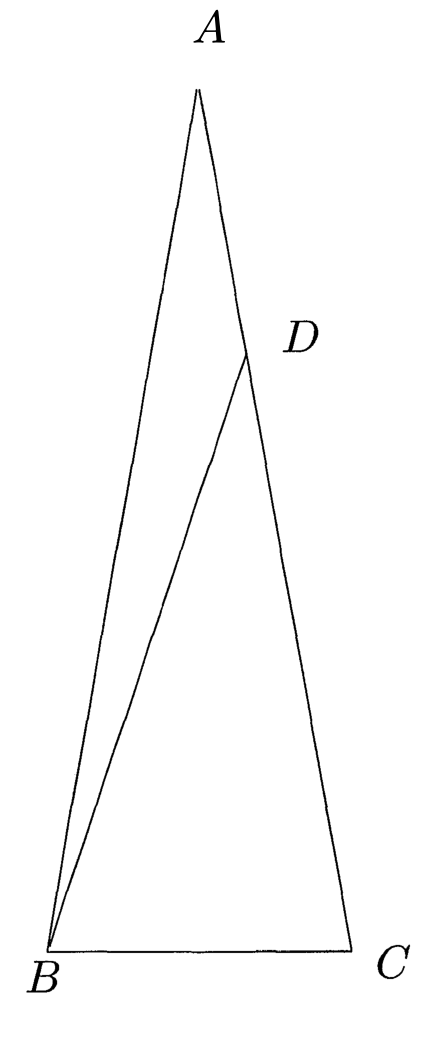
The diagram shows isosceles triangle $ABC$ with $AB=AC$ and $\angle A=20^\circ$. Point $D$ lies on $AC$ with $AD=BC$, and segment $BD$ is drawn. Determine $\angle ABD$ in degrees.
Given $\dfrac{\cos^4\alpha}{\cos^2\beta}+\dfrac{\sin^4\alpha}{\sin^2\beta}=1$, evaluate $\dfrac{\cos^4\beta}{\cos^2\alpha}+\dfrac{\sin^4\beta}{\sin^2\alpha}$.
Let $x_i\in\{\sqrt2-1,\sqrt2+1\}$ for $i=1,2,\ldots,2012$. Define $S=x_1x_2+x_3x_4+\cdots+x_{2011}x_{2012}$. How many distinct positive integer values can $S$ attain?
Let $A=\{x\in\mathbb R:x^2+x-110\lt 0\}$ and $B=\{x\in\mathbb R:x^2+10x-96\lt 0\}$. The integer solutions of $x^2+ax+b\lt 0$ are exactly the integers in $A\cap B$. Find the maximum possible value of $\lfloor|a-b|\rfloor$.
Let $x[n]$ denote the right-associated power tower $x^{x^{\cdot^{\cdot^x}}}$ with $n$ copies of $x$. What is the minimum $n$ such that $9[9]\lt 3[n]$? For example, $3[2]=3^3=27$ and $2[3]=2^{2^2}=16$.
A collection of $2011$ circles divides the plane into $N$ regions. Every pair of circles intersects at two points and no point lies on three circles. Find the last four digits of $N$.
A positive integer $N$ is called “visible” if $N=\lfloor x\rfloor+\lfloor2x\rfloor+\lfloor3x\rfloor$ for some real $x$; otherwise it is “invisible”. For example, $8=\lfloor1.5\rfloor+\lfloor2(1.5)\rfloor+\lfloor3(1.5)\rfloor$ is visible, while $10$ is invisible. Find the $2011$th invisible positive integer in increasing order.