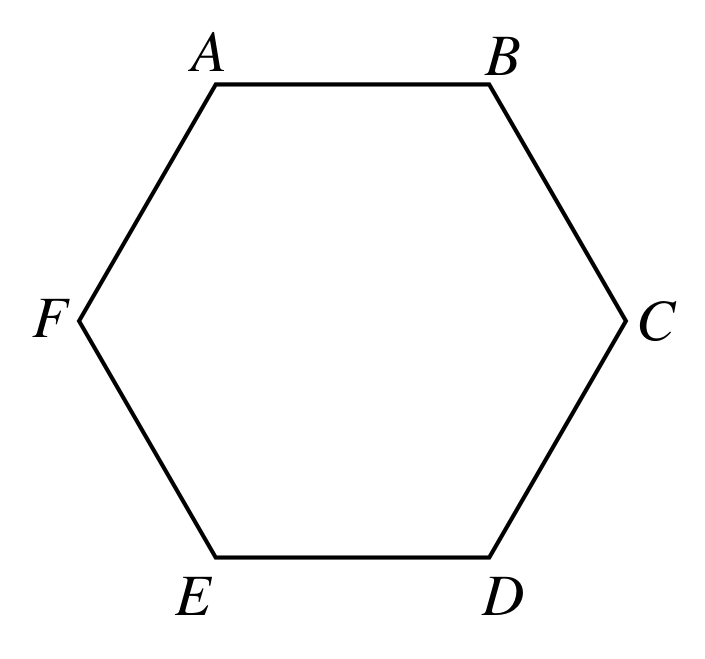
Given a regular hexagon, we construct all possible triangles from its vertices. We find that:
- There are $L$ possible acute triangles.
- There are $M$ possible right triangles.
- There are $N$ possible obtuse triangles.
Triangles are considered distinct if they have at least one different vertex, even if the triangles are congruent. What is the value of $L\times M\times N$?
Alex, having only one 20-dollar bill, went to buy lunch. While giving him back change, the cashier got distracted and mixed up the dollars and cents—paying dollars instead of cents and cents instead of dollars. Alex put the change in his wallet without looking at it. After a while he decided to buy a slice of bread as an addition to his lunch. He paid 15 cents for it and then noticed that the amount he had with him now was double of what he should have had after paying for the lunch and the slice of bread (if the cashier had not made a mistake). How many dollars and how many cents is the correct change that Alex should have received after buying lunch? (Note: 1 dollar = 100 cents)
Two couriers, Alice and Bob, travel at different constant speeds. Alice departs from village $A$ towards village $B$ and Bob departs from village $B$ towards village $A$ at the same time. When they meet at point $C$, both turn around and return to their starting points. After some time, Alice realizes that she has forgotten to give Bob a package, so she turns around again and catches up with Bob halfway between $C$ and $B$. After delivering the package, Alice turns around to go back to $A$ and Bob continues to $B$. If the distance between $A$ and $B$ is 24 km, when Bob arrives at $B$, what is the distance, in km, of Alice from $A$?
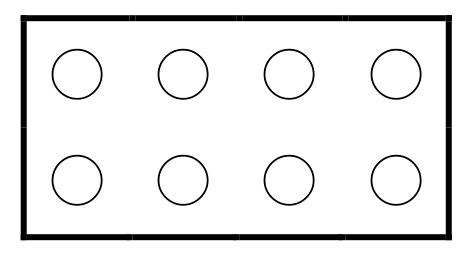
There are 8 circles on a rectangular board as shown in the diagram below. The distances between any pair of adjacent circles, horizontally or vertically, are all equal. Boris wants to colour some circles in red. How many ways can Boris colour some of the circles so that the resulting board has no line of symmetry?
The number 3 has the following properties: it is one less than a square number, and five times of it is also one less than a square number.
$$3=4-1=2^2-1$$
$$5\times3=16-1=4^2-1$$
24 is another number with the same properties:
$$24=25-1=5^2-1$$
$$5\times24=121-1=11^2-1$$
What is the smallest number with the same properties that is greater than 25?
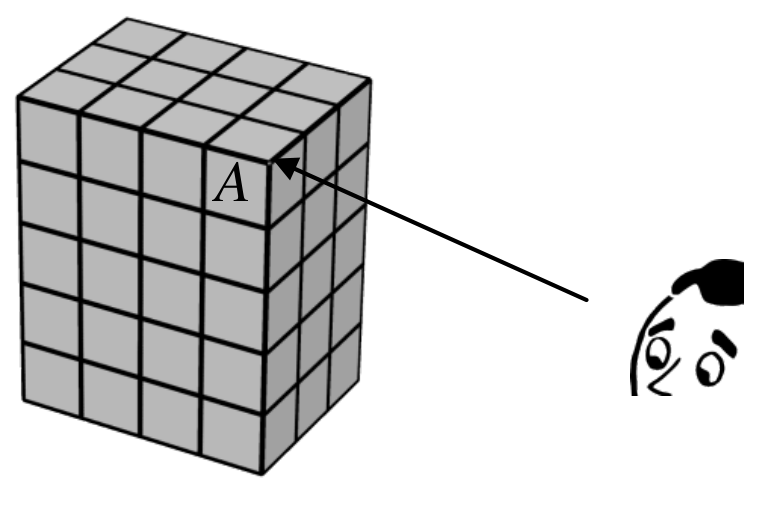
An $a\times b\times c$ rectangular block with $a\le b\le c\le20$ is made from unit cubes. When it is viewed from one vertex, such that the three faces intersecting at this vertex can be entirely seen, exactly 487 cubes are visible. What is the number of the unit cubes not visible? List down all possible answers.
For example, the diagram on the right is a $3\times4\times5$ rectangular block. When it is viewed from vertex $A$, 36 cubes are visible.
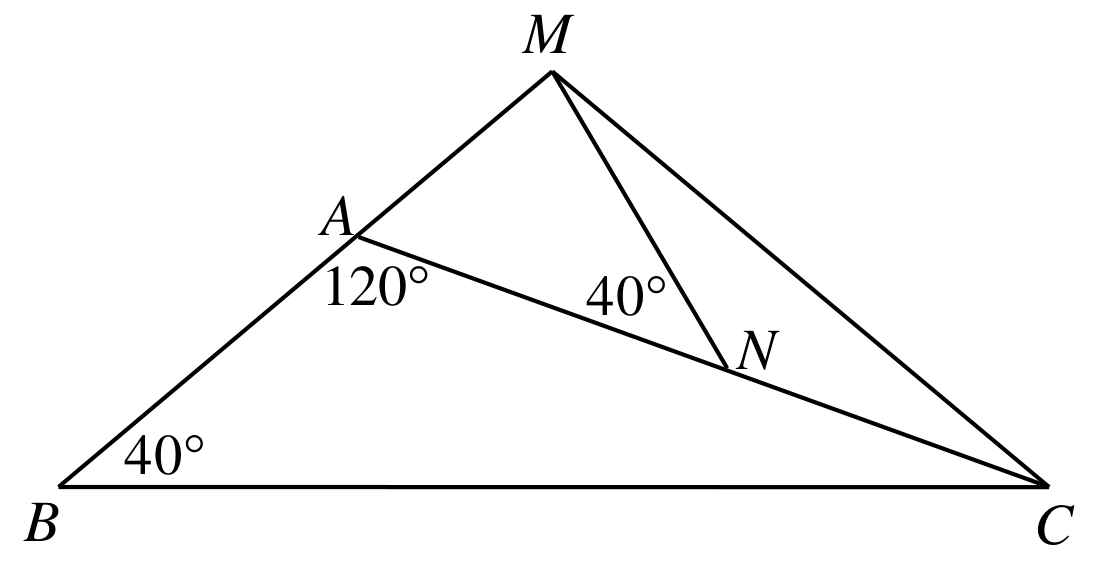
In triangle $ABC$, $\angle BAC=120^\circ$ and $\angle ABC=40^\circ$. Let $N$ be a point on $AC$ such that $AN=AB$. Let $M$ be a point on the line $BA$ such that $\angle ANM=40^\circ$, as shown in the diagram below. What is the measure, in degrees, of $\angle BMC$?
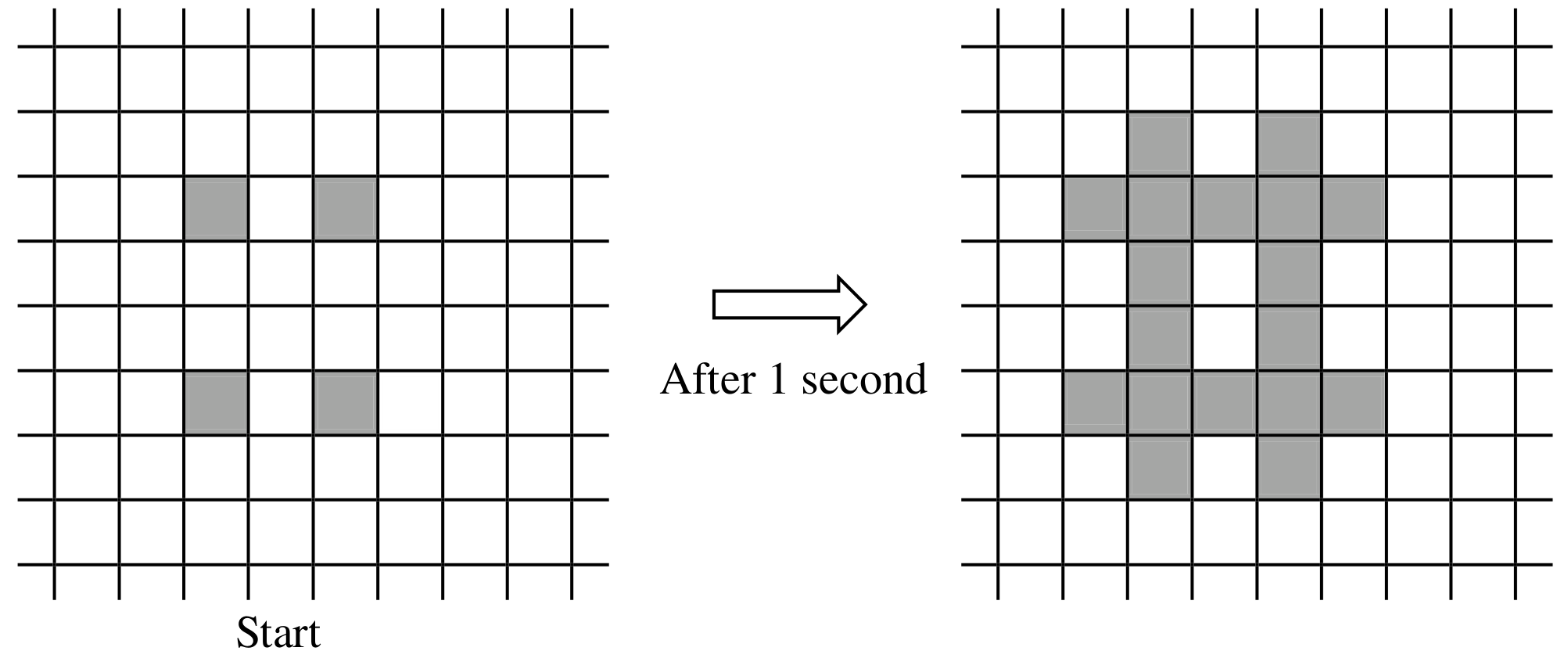
A wizard paints in grey four squares of an infinite grid table, as shown in the diagram below on the left. Then he casts a spell so that, at every second, each square that has at least one common side with those grey squares becomes also grey. For example, after 1 second, there will be 18 grey squares as shown in the diagram below on the right. What is the number of grey squares after 60 seconds?
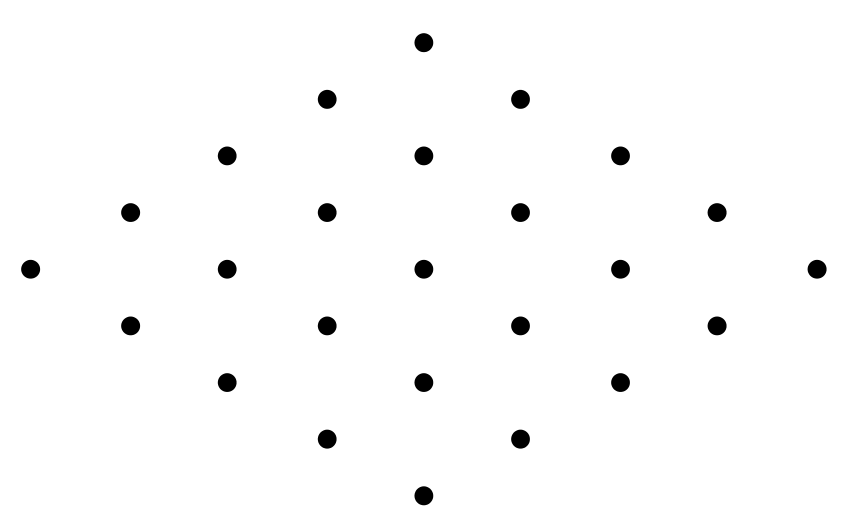
The rhombus shape below is formed by using 25 dots arranged in a triangular grid. The distances between any two adjacent dots are equal. What is the number of equilateral triangles that can be drawn with 3 dots from these 25 dots as vertices?
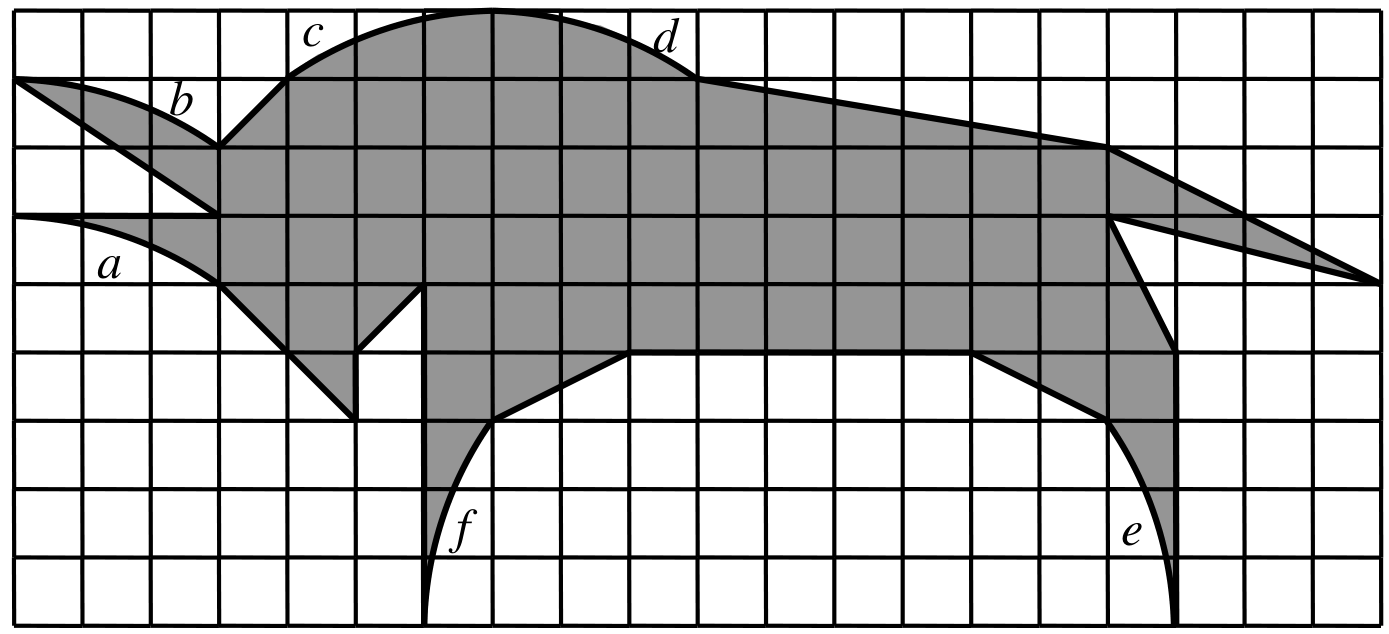
What is the area, in cm$^2$, of the shaded diagram (Bull shape) formed by six identical arcs (namely $a,b,c,d,e,f$) and fifteen segments, given that the side length of each unit square is $1$ cm and all six arcs are in $1\times3$ or $3\times1$ rectangles?
Thirty students from five classes in one school decided to join the “Donate a book” initiative and brought a total of $40$ books for the library. Students from the same class brought the same number of books, and students from different classes brought different numbers of books. If every student donated at least one book, how many students donated exactly one book?
The product of five consecutive positive integers is $120$ times greater than $\overline{ABABAB}$, where $A$ and $B$ are non-zero digits. What is the largest of those five numbers?
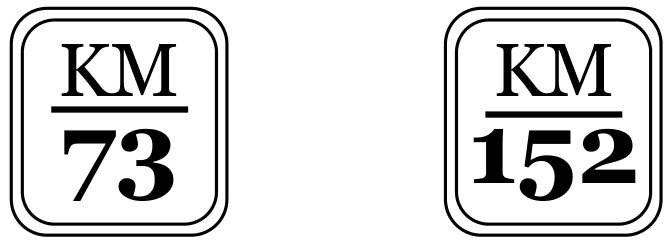
Mr. Sun was traveling in an old bus that was moving at a constant speed on a road with kilometre markers, which indicate the distance in kilometres from the road’s start. Two examples of such kilometre markers are given below. A moment before falling asleep, he saw that the bus was passing a kilometre marker labelled with a two-digit number. After exactly one hour, Mr. Sun opened his eyes and saw the bus passing a kilometre marker labelled with a three-digit number, and he remembered that: its first digit was equal to the second digit of the number he saw before falling asleep, the second digit of the three-digit number was $0$, and the third digit of the three-digit number was equal to the first digit of the number he saw before falling asleep. Mr. Sun then slept for exactly two more hours before waking up, when he saw the bus passing a kilometre marker with a number that was almost the same as the second number, except that the second digit had been replaced by another digit. What was the speed, in km/h, of the bus?
Alex has a large piece of paper of width $6$ cm and length $94$ cm. He wants to cut as many rectangles as possible from this paper such that each rectangle has integer side lengths in cm and perimeter $20$ cm. What is the largest possible number of rectangles he can get?
**User-approved clarification (added condition, not official source wording):**
Every side of each cut rectangle must be parallel to an edge of the original sheet.
Allen, Bob and Cindy are walking around a circular lake trail. They start walking from the same location at the same time. Bob is walking clockwise, while Cindy and Allen are walking counterclockwise. They all walk at constant speeds. After a while, Bob meets Cindy for the first time. Then $3$ minutes later, Bob meets Allen. Finally, another $14$ minutes later, Bob meets Cindy for the second time. It is known that Cindy’s speed is $\frac34$ of Bob’s speed and the lake trail is $2023$ metres long. How many minutes after Bob meets Cindy for the first time will Bob meet Allen for the second time?
**User-approved clarification (added condition, not official source wording):**
The Bob–Allen encounter described as occurring 3 minutes after Bob first meets Cindy is Bob and Allen's first meeting after they start.
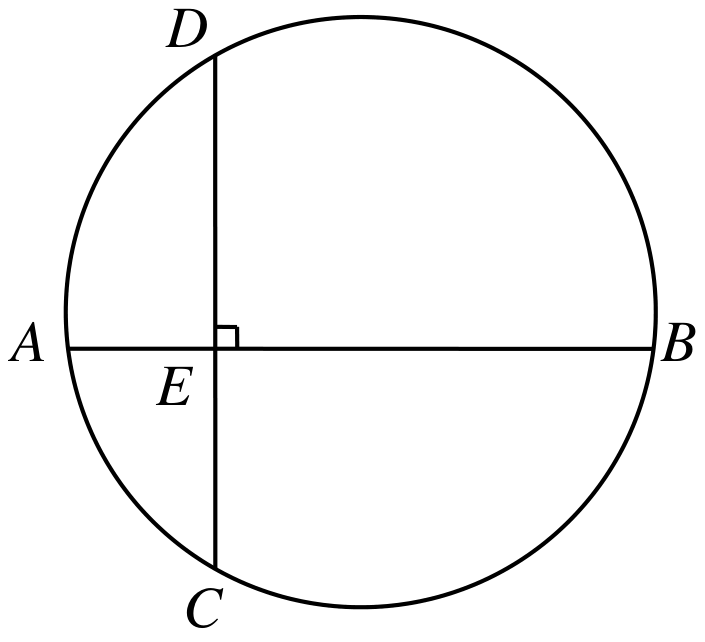
Two perpendicular chords of a circle, $AB$ and $CD$, intersect each other at point $E$, as shown in the diagram below. If $AE=28$ cm, $EB=84$ cm and $CE=42$ cm, what is the area, in cm$^2$, of the circle? (Take $\pi=\frac{22}{7}$.)