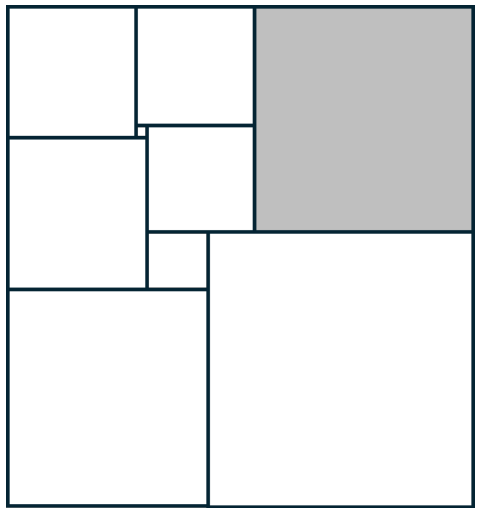
In the diagram below, a rectangle is composed of nine squares. Given that the area of the shaded square is $100\text{ cm}^2$. What is the area, in $\text{cm}^2$, of the rectangle?
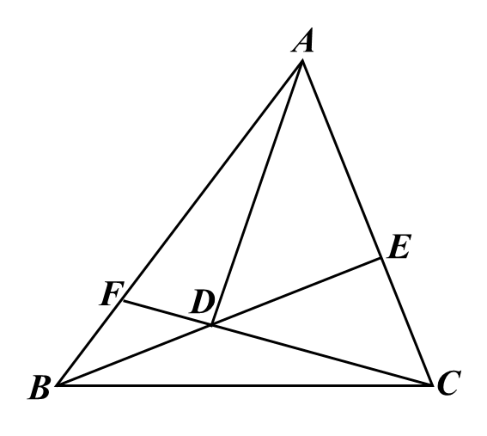
In the diagram below, $ABC$ is a triangle, where $E$ is a point on $AC$ and $F$ is a point on $AB$. The lines $BE$ and $CF$ intersect at $D$. If the ratio of the areas of the triangles $BDF$ and $CDE$ is $5:16$, the ratio of the areas of the triangles $AFD$ and $AED$ is $5:8$ and the area of the triangle $BCD$ is $18\text{ cm}^2$, what is the area, in $\text{cm}^2$, of the triangle $ABC$?
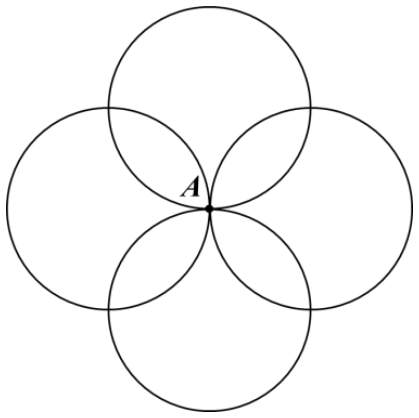
Four cyclists start riding at exactly 12:00 noon. Each cyclist rides on a different circular track, where each track is exactly 1 mile long. The four cyclists ride at four different constant speeds, which are 6, 9, 12 and 15 miles per hour, respectively. All four tracks meet at the center (Point $A$). They all start together at the center and keep riding around their own track. They agree to stop when they have come back to the center together for the sixth time (counting the start at 12:00 noon as the first time). At what time do they stop?
Let $I,M,S$ and $O$ be digits that are not necessarily different that satisfies
$$\overline{IMSO}=\frac74\times\overline{OSMI}.$$
How many possible four-digit numbers $\overline{IMSO}$ are there?
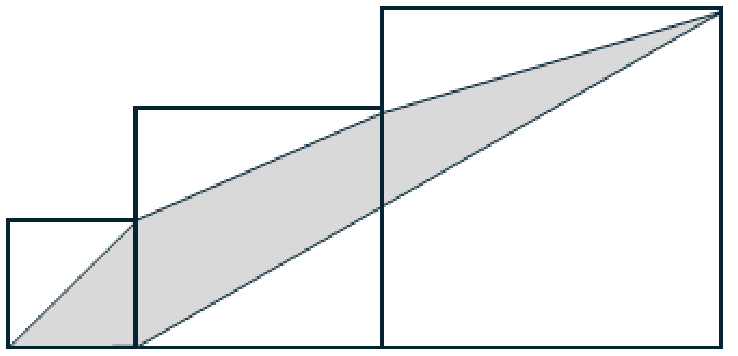
In the diagram below, three squares with side lengths in the ratio of $2:3:5$ are placed next to each other. If the area of the shaded region is $152\text{ cm}^2$, then what is the perimeter, in cm, of the diagram?
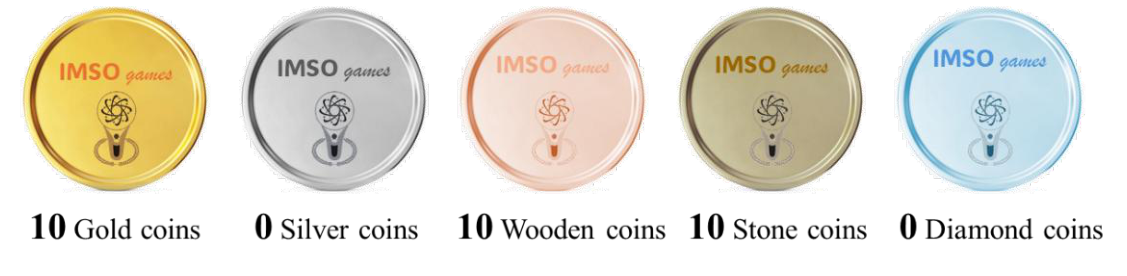
In a video game, you start the game with 10 gold coins, 10 wooden coins, 10 stone coins, 0 silver coins and 0 diamond coins.
There are four trading options that are available:
a.) Trading gold coin(s) to a silver coin:
The cost increases by 1 gold coin each time you do a trade.
- First trade: exchange 1 gold coin → receive 1 silver coin.
- Second trade: exchange 2 gold coins → receive 1 silver coin.
- Third trade: exchange 3 gold coins → receive 1 silver coin, and so on.
b.) Trading wooden coin(s) to silver coins:
The cost increases by 1 wooden coin each time you do a trade.
- First trade: exchange 3 wooden coins → receive 2 silver coins.
- Second trade: exchange 4 wooden coins → receive 2 silver coins.
- Third trade: exchange 5 wooden coins → receive 2 silver coins, and so on.
c.) Trading stone coins(s) to a diamond coin:
The cost increases by 1 stone each time you do a trade.
- First trade: exchange 2 stone coins → receive 1 diamond coin.
- Second trade: exchange 3 stone coins → receive 1 diamond coin.
- Third trade: exchange 4 stone coins → receive 1 diamond coin, and so on.
- You may perform trades in any order and any number of times, provided you have enough coins at the moment of the trade.
- If you do not have enough coins to perform the required condition for a trade, then you cannot perform that trade. (You cannot partially perform a trade).
- The counters for each of the different trade types are independent with each other.
What is the maximum number of diamond coins you can obtain? Give a full and detailed explanation and describe the general strategy that achieves the maximum.
Please write down your full solution at the reverse side of this sheet.
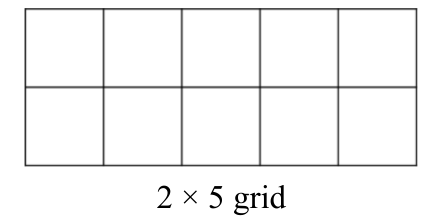
The diagram below shows a grid with 2 rows and 5 columns.
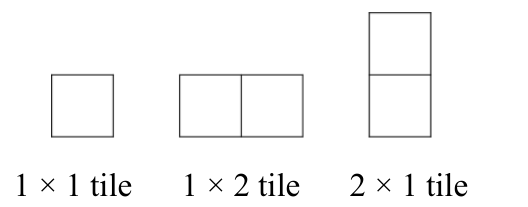
The grid must be completely covered using the following types of tiles namely:
- a 1-unit tile, which occupies one space $(1\times1)$ or
- a 2-unit tile, which occupies two spaces and may be placed either horizontally $(1\times2)$ or vertically $(2\times1)$.
How many different ways are there to completely cover the entire $2\times5$ grid without overlapping?
For each positive integer $n$, let $S(n)$ be the sum of its digits and $P(n)$ be the product of its digits.
For example, if $n=2025$,
$$S(2025)=2+0+2+5=9\quad\text{and}\quad P(2025)=2\times0\times2\times5=0.$$
List down all the possible three-digit numbers $n$ that satisfy $n=S(n)\times P(n)$.
Twenty students participated in a chess tournament, where each student played every other student exactly twice. A student earns 3 points for a win, 1 point for a draw and 0 points for a loss. What is the maximum number of students that can have at least 90 points at the end of the tournament?
Let $a,b$, and $c$ be distinct positive integers satisfying $a^b\times b^a=(a\times b)^c$. What is the smallest possible value of $a+b+c$ across all valid triples $(a,b,c)$?
There is a coin machine. Each time somebody use it, the machine doubles the number of inserted coins and then automatically deducts 3 coins as a fee before returning them. Siti uses the machine three times in a row, always inserting in all the coins she has. After the third use, she ends up with 35 coins. How many coins does Siti have at first?
When a positive integer a is divided by a positive integer b, the remainder is 32. However, when 2a is divided by b, the remainder is 11. What is the value of b?
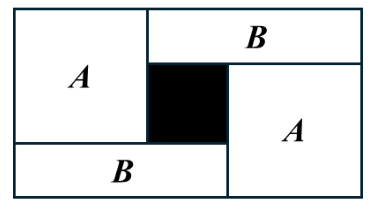
In the diagram below, a rectangular garden with length of 26 m and width of 14 m is shown. It is divided into five sections (two identical squares A, two identical rectangles B and one shaded square). What is the area, in $\mathrm{m}^2$, of the shaded square?
A bag contains balls of four colours: orange, blue, red and yellow. Each student draws two balls from the bag at the same time. What is the least number of students required to guarantee that at least two students draw exactly the same pair of coloured balls?
Let A, B, C, D, E, F, G and H be a re-arrangement of prime numbers 2, 3, 5, 7, 11, 13, 17 and 19. What is the smallest possible value of $A\times B+C\times D+E\times F+G\times H$?