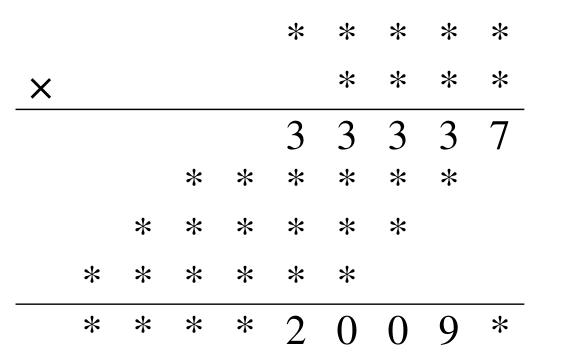
**Printed examination instructions.** Answer the following 5 questions. Write down your answer in the space provided after each question. Each question is worth 8 points. Time limit: 60 minutes.
At a recent athletics meeting, five old acquaintances, Fred, Greta, Hans, Iolo and Jan, met for the first time since leaving college, so they had much news to exchange. They lived in different towns: Acton, Buswick, Coalford, Derby and Eccles. Their different jobs were, in no particular order, engineer, lawyer, teacher, doctor and shopkeeper. Each won exactly one different event: 100 m, 400 m, 1500 m, High Jump and Javelin.
The following facts were also known:
1. Hans, the shopkeeper from Derby, won the High Jump.
2. The lawyer was from Eccles and said he was not a runner.
3. Greta was a P.E. teacher from Buswick and won the 1500 m.
4. The doctor, from Acton, did not win the 100 m.
5. The person from Derby was not an engineer.
6. Iolo was an engineer from Coalford and did not win the 400 m.
7. Jan was not a lawyer, but did win the 400 m.
8. Fred did not come from Acton and was not a runner.
(a) Which event did the person from Coalford win? (1 point)
In 2008, a school had 450 new pupils, making a total of 1600 pupils. In 2009 there were 504 new pupils, and 8% of the previous year's pupils left the school.
(a) Find the percentage increase in the number of new pupils from 2008 to 2009. (2 points)
(b) How many pupils left the school? (3 points)
(c) What was the total number of pupils in the school in 2009? (3 points)
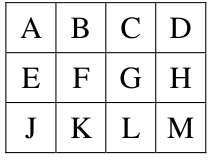
The diagram represents a small sheet of 12 postage stamps, all perforated at their edges and all of the same value. The letters only identify the stamps.
You need 4 stamps to post a letter and want all 4 properly joined together at their edges, not merely at corners. For example, ABCD, EFGH, JKLM and FGHL work, but EFLM does not. In how many different ways can you obtain such a group of 4? Write down this number.
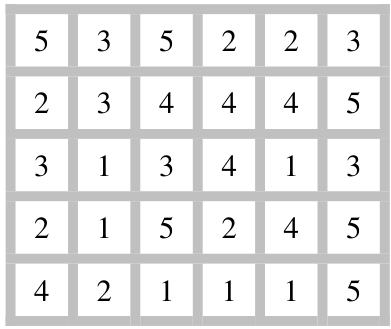
A domino consists of two unit squares joined edge to edge, each with a number on it. Fifteen dominoes numbered 11, 12, 13, 14, 15, 22, 23, 24, 25, 33, 34, 35, 44, 45 and 55 have been assembled into the 6 by 5 rectangle below. The individual domino boundaries have been erased. Reconstruct the dominoes by drawing the boundary lines.
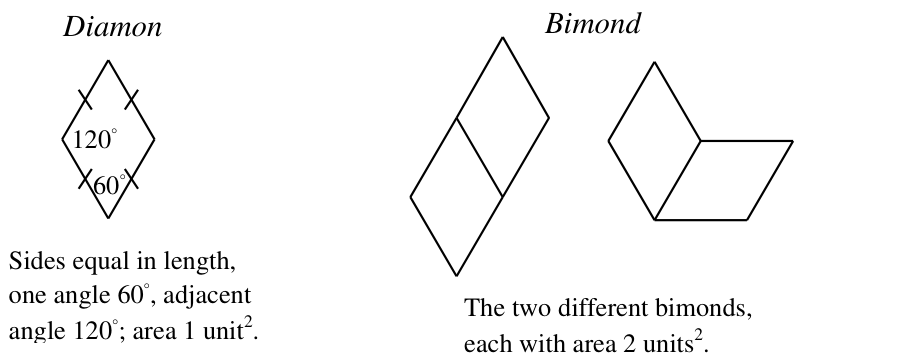
Shapes can be made by joining diamonds edge to edge. Each diamond has equal sides, an angle of 60 degrees and an adjacent angle of 120 degrees, and area 1 square unit. Exactly two different shapes can be made from two diamonds; these are called bimonds, each of area 2 square units.
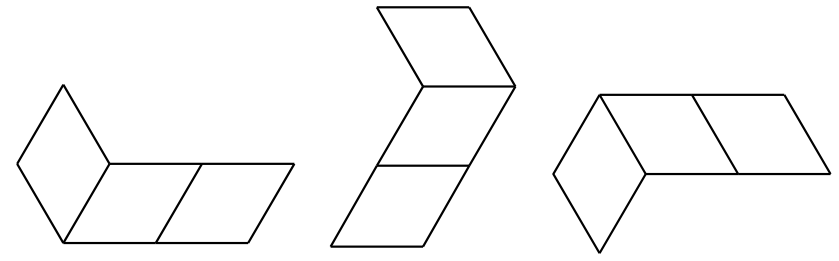
Each shape below is a trimond made from three edge-joined diamonds, of area 3 square units. The three pictures show the same trimond: rotations or reflections produce one from another.
(1) From a set of one diamond, two different bimonds and your collection of different trimonds, fit some pieces together into a parallelogram of area 12 square units. Draw it, showing the pieces used. (2 points)
(2) From the same set of pieces, make another parallelogram of area 12 square units but with a different perimeter. Draw it. (2 points)
(3) How many different shapes can be made from four diamonds joined edge to edge, each of area 4 square units? (4 points)
In a small group of people all of the following relationships were present: father, mother, son, daughter, brother, sister, cousin, nephew, niece, uncle and aunt. What is the smallest group of people for which this is possible?
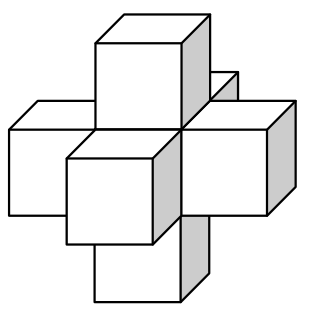
Seven cubes are glued together face to face as shown in the diagram. The volume of the solid formed in this way is $189\text{ cm}^3$. Find its surface area.
Jack said to Jim: “If I give you 6 pigs for one horse, then you will own twice as many animals as I own.” Dan said to Jack: “If I give you 14 sheep for one horse, then you will own three times as many animals as I own.” Jim said to Dan: “If I give you 4 cows for one horse, then you will own six times as many animals as I own.” How many animals in total do Jack, Jim and Dan own?
By adding brackets in various ways to the expression $1\div3\div5\div7\div11\div13$, what is the maximum number of different values the expression can have?
Tom has a contract to dig out some foundations, and it must be done in 30 days. His own machine, which he wishes to use as much as possible, would take 48 days to do all the work. He can hire a bigger machine which would do the complete job in 21 days, but it costs 300 dollars a day. There is only enough room for one machine at a time. What is the least number of days for which he will have to hire the larger machine?
Four different right-angled triangles all have sides of integral length and their perimeters are the same length. Find the smallest perimeter for which this is possible.
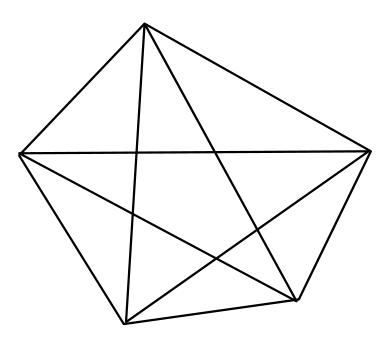
The diagram shows an irregular pentagon with all five diagonals drawn. How many distinct triangles (not necessarily different in shape or size) can be found using only the lines, or parts of lines, shown?
I have a rectangular picture whose edges are each an exact number of centimetres in length. At a quick glance it could be mistaken for a square, but it is not a square. It is placed inside a black border which is 3 cm wide all the way around. The area of the border is exactly equal to the area of the picture. What is the area, in $\text{cm}^2$, of the picture alone?
A combination lock on a safe needs a six-letter sequence to open it, made from A, B, C, D, E, F with none used twice. Here are three guesses:
| Guess | 1 | 2 | 3 | 4 | 5 | 6 |
| --- | --- | --- | --- | --- | --- | --- |
| FIRST | C | B | A | D | F | E |
| SECOND | A | E | D | C | B | F |
| THIRD | E | D | F | A | C | B |
In the FIRST guess only ONE letter is in its correct place. In the SECOND guess only TWO letters are correctly placed, and those two positions are not next to each other. In the THIRD guess only THREE letters are correctly placed. Each of the six letters is in its correct place once across the guesses. What is the correct combination?
Printed instructions: Answer the following 10 questions and show your detailed solution in the space provided after each question. Each question is worth 4 points. Time limit:60 minutes.
There are two clocks. One gains 6 seconds every hour, while the other loses 9 seconds every hour. If both are set to show the same time and then set going, how long will it be before their displayed times are exactly 1 hour apart?
Replace the asterisks in 86**** with the digits 1, 2, 3 and 4, using each once, so that the resulting six-digit number is the largest possible number divisible by 132.
Two isosceles triangles have equal areas. In both triangles all side lengths are whole numbers of centimetres, and the two equal sides are 13 cm. In one triangle the third side is 10 cm. What is the third side of the other triangle?