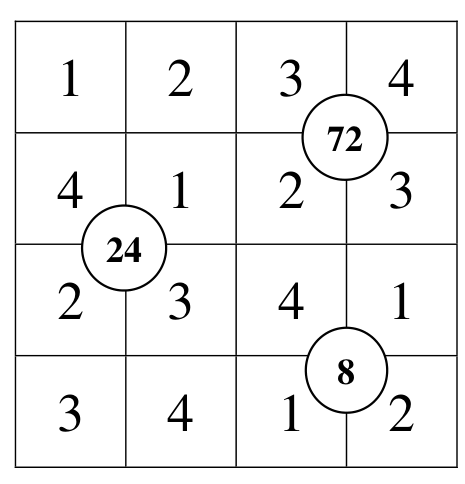
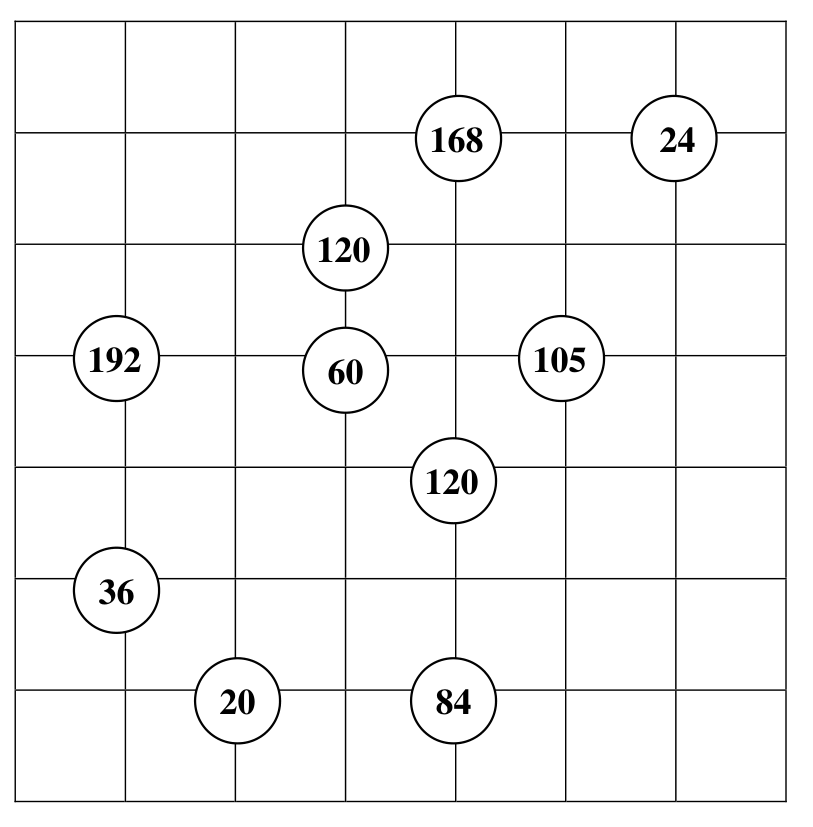
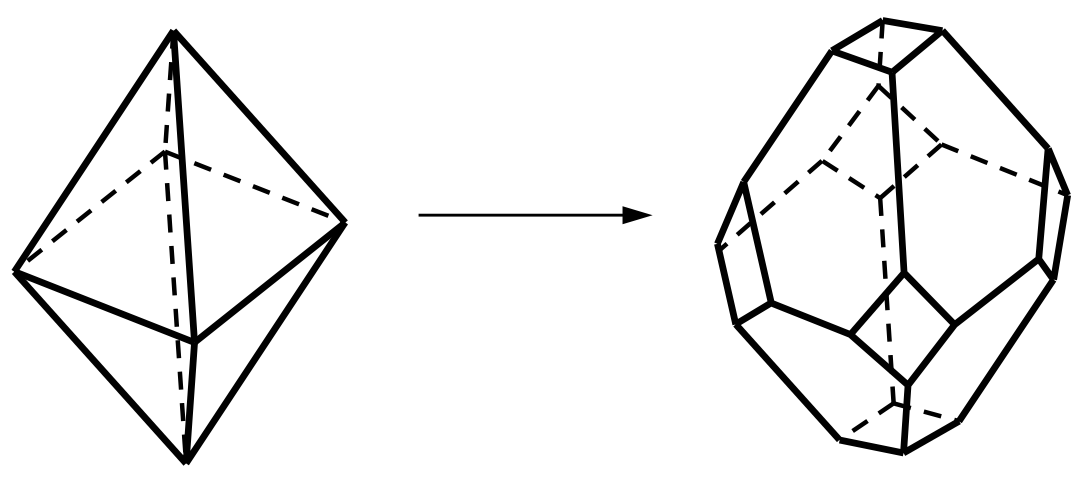
Place the digits 1 to 7 in the grid so that each digit appears once in every row and once in every column. Each circled number is the product of the four digits surrounding that circle.
The source includes a completed 4-by-4 example explaining the rule and the blank 7-by-7 puzzle:
The Fibonacci numbers are
$$F_1=1,\quad F_2=1,\quad F_3=2,\quad F_4=3,\quad F_5=5,\quad F_6=8,\quad F_7=13,\ldots$$
The first two are both 1, and each later number is the sum of the two preceding it. What is the last digit of the sum of the first 2005 Fibonacci numbers?
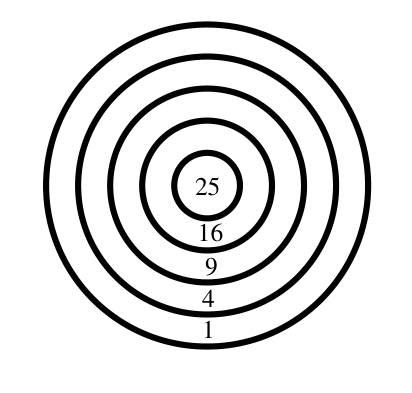
Four darts are thrown at the dartboard shown. The four scores are added, and a miss counts as zero. What is the smallest positive total score that is impossible to obtain?
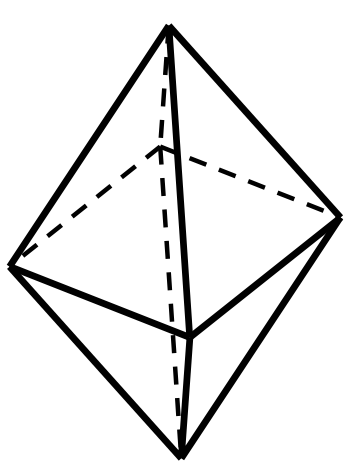
An ant sits at a vertex of an octahedron with edge length 1 m. The ant moves along the edges of the octahedron and comes back to the original vertex without visiting any other point twice. What is the length of the longest such journey?
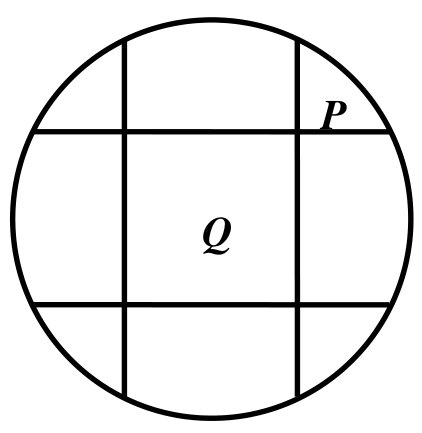
Each of the four chords in the diagram cuts the area of the circle in the ratio $1:3$. The points of intersection of these chords are the vertices of a square. What is the ratio of the area of region $P$ to the area of region $Q$?
There are 64 football teams in a tournament. They are first divided into 8 groups, each of eight teams. In each group they play a knockout tournament (when a team loses a game it is eliminated). The best of each group then plays each other once to decide the overall winner. How many matches must be played?
If a car runs at 60 km/h, it completes a certain distance in 18 minutes. At what average speed, in kilometers per hour, would this car need to cover the same distance in 15 minutes?
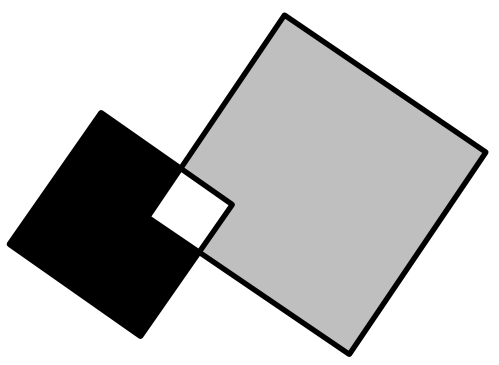
The diagram is made from two overlapping squares. The lighter shaded area comprises $\frac{73}{75}$ of the larger square and the darker area $\frac{14}{15}$ of the smaller square. What is the ratio of the area of the smaller square to the area of the larger square?
From four numbers, three are chosen, averaged and the fourth one added. This can be done four ways, leaving out a different number each time. The four results are 64, 70, 78 and 84. What is the largest of the original numbers?
Source instructions: 20 questions; each correct answer is worth 2 points. Write answers on the answer sheet. Time limit: 60 minutes.
A foundation has allocated a certain amount of money for 1st, 2nd and 3rd prizes in a competition. The money is divided in the ratio of 3:2 where the larger amount is for the 1st prize and the smaller amount is divided again in the ratio of 3:2 for the 2nd and 3rd prizes respectively. It becomes known that the 3rd prize is 3300 dollars less than the first prize. How much is the 2nd prize?
Three men and three children arrive at the river where there is a small boat that will hold one adult or two children. What is the minimum number of trips across the river in either direction to get the family across?
Mr. Sun has a broken calculator. When just turned on, it displays 0. If the + key is pressed, it adds 35. If the − key is pressed, it subtracts 35. If the × key is pressed, it adds 91. If the ÷ key is pressed, it subtracts 91. The other keys do not function. Mr. Sun turns the calculator on. What is the number closest to 2005 that he can get using this calculator?