Six points $A,$ $B,$ $C,$ $D,$ $E,$ and $F$ lie in a straight line in that order. Suppose that $G$ is a point not on the line and that $AC = 26,$ $BD = 22,$ $CE = 31,$ $DF = 33,$ $AF = 73,$ $CG = 40,$ and $DG = 30.$ Find the area of $\triangle BGE.$
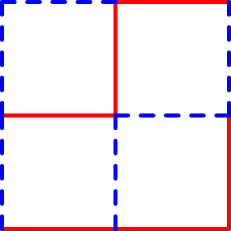
Four unit squares form a $2 \times 2$ grid. Each of the $12$ unit line segments forming the sides of the squares is colored either red or blue in such a way that each unit square has $2$ red sides and $2$ blue sides. One example is shown below (red is solid, blue is dashed). Find the number of such colorings.
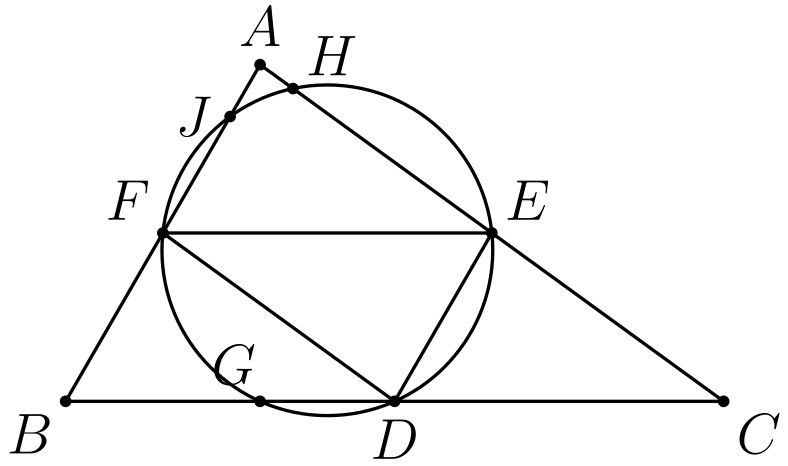
Suppose $\triangle ABC$ has angles $\angle BAC = 84^\circ,$ $\angle ABC = 60^\circ,$ and $\angle ACB = 36^\circ.$ Let $D,$ $E,$ and $F$ be the midpoints of sides $\overline{BC},$ $\overline{AC},$ and $\overline{AB},$ respectively. The circumcircle of $\triangle DEF$ intersects $\overline{BD},$ $\overline{AE},$ and $\overline{AF}$ at points $G,$ $H,$ and $J,$ respectively. The points $G,$ $D,$ $E,$ $H,$ $J,$ and $F$ divide the circumcircle of $\triangle DEF$ into six minor arcs, as shown. Find $\overset{\frown}{DE} + 2 \cdot \overset{\frown}{HJ} + 3 \cdot \overset{\frown}{FG},$ where the arcs are measured in degrees.
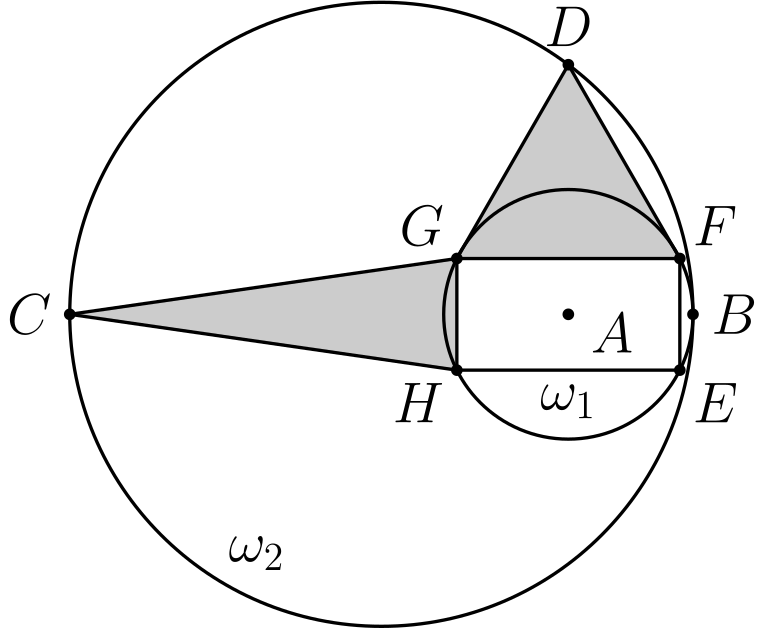
Circle $\omega_1$ with radius $6$ centered at point $A$ is internally tangent at point $B$ to circle $\omega_2$ with radius $15.$ Points $C$ and $D$ lie on $\omega_2$ such that $\overline{BC}$ is a diameter of $\omega_2$ and $\overline{BC} \perp \overline{AD}.$ The rectangle $EFGH$ is inscribed in $\omega_1$ such that $\overline{EF} \perp \overline{BC},$ $C$ is closer to $\overline{GH}$ than to $\overline{EF},$ and $D$ is closer to $\overline{FG}$ than to $\overline{EH},$ as shown. Triangles $\triangle DGF$ and $\triangle CHG$ have equal areas. The area of rectangle $EFGH$ is $\frac{m}{n},$ where $m$ and $n$ are relatively prime positive integers. Find $m + n.$
Let $A$ be the set of positive integer divisors of $2025.$ Let $B$ be a randomly selected subset of $A.$ The probability that $B$ is a nonempty set with the property that the least common multiple of its elements is $2025$ is $\frac{m}{n},$ where $m$ and $n$ are relatively prime positive integers. Find $m + n.$
From an unlimited supply of $1$-cent coins, $10$-cent coins, and $25$-cent coins, Silas wants to find a collection of coins that has a total value of $N$ cents, where $N$ is a positive integer. He uses the so-called *greedy algorithm*, successively choosing the coin of greatest value that does not cause the value of his collection to exceed $N.$ For example, to get $42$ cents, Silas will choose a $25$-cent coin, then a $10$-cent coin, then $7$ $1$-cent coins. However, this collection of $9$ coins uses more coins than necessary to get a total of $42$ cents; indeed, choosing $4$ $10$-cent coins and $2$ $1$-cent coins achieves the same total value with only $6$ coins.
In general, the greedy algorithm succeeds for a given $N$ if no other collection of $1$-cent, $10$-cent, and $25$-cent coins gives a total value of $N$ cents using strictly fewer coins than the collection given by the greedy algorithm. Find the number of values of $N$ between $1$ and $1000$ inclusive for which the greedy algorithm succeeds.
There are $n$ values of $x$ in the interval $0 \lt x \lt 2\pi$ where $f(x) = \sin(7\pi \cdot \sin(5x)) = 0.$ For $t$ of these $n$ values of $x,$ the graph of $y = f(x)$ is tangent to the $x$-axis. Find $n + t.$
Sixteen chairs are arranged in a row. Eight people each select a chair in which to sit so that no person sits next to two other people. Let $N$ be the number of subsets of $16$ chairs that could be selected. Find the remainder when $N$ is divided by $1000.$
Let $S$ be the set of vertices of a regular $24$-gon. Find the number of ways to draw $12$ segments of equal lengths so that each vertex in $S$ is an endpoint of exactly one of the $12$ segments.
Let $A_1A_2 \ldots A_{11}$ be an $11$-sided non-convex simple polygon with the following properties:
• For every integer $2 \le i \le 10,$ the area of $\triangle A_iA_1A_{i+1}$ is $1.$
• For every integer $2 \le i \le 10,$ $\cos(\angle A_iA_1A_{i+1}) = \frac{12}{13}.$
• The perimeter of the $11$-gon $A_1A_2 \ldots A_{11}$ is equal to $20.$
Then $A_1A_2 + A_1A_{11}$ can be expressed as $\frac{m\sqrt{n} - p}{q}$ where $m,$ $n,$ $p,$ and $q$ are positive integers, $n$ is not divisible by the square of any prime, and no prime divides all of $m,$ $p,$ and $q.$ Find $m + n + p + q.$
Let the sequence of rationals $x_1,$ $x_2,$ $\ldots$ be defined such that $x_1 = \frac{25}{11}$ and $$
x_{k+1} = \frac{1}{3}\left(x_k + \frac{1}{x_k} - 1\right)
$$ for all $k \ge 1.$ Then $x_{2025}$ can be expressed as $\frac{m}{n}$ for relatively prime positive integers $m$ and $n.$ Find the remainder when $m + n$ is divided by $1000.$
Let $\triangle ABC$ be a right triangle with $\angle A = 90^\circ$ and $BC = 38.$ There exist points $K$ and $L$ inside the triangle such that $$
\begin{gathered} AK = AL = BK \\ = CL = KL = 14. \end{gathered}
$$ The area of the quadrilateral $BKLC$ can be expressed as $n\sqrt{3}$ for some positive integer $n.$ Find $n.$
There are exactly three positive real numbers $k$ such that the function $$
\begin{aligned} f(x) &= \frac{(x - 18)(x - 72)}{x} \\ &\quad {}\cdot (x - 98)(x - k) \end{aligned}
$$ defined over the positive real numbers achieves its minimum value at exactly two positive real numbers $x.$ Find the sum of these three values of $k.$
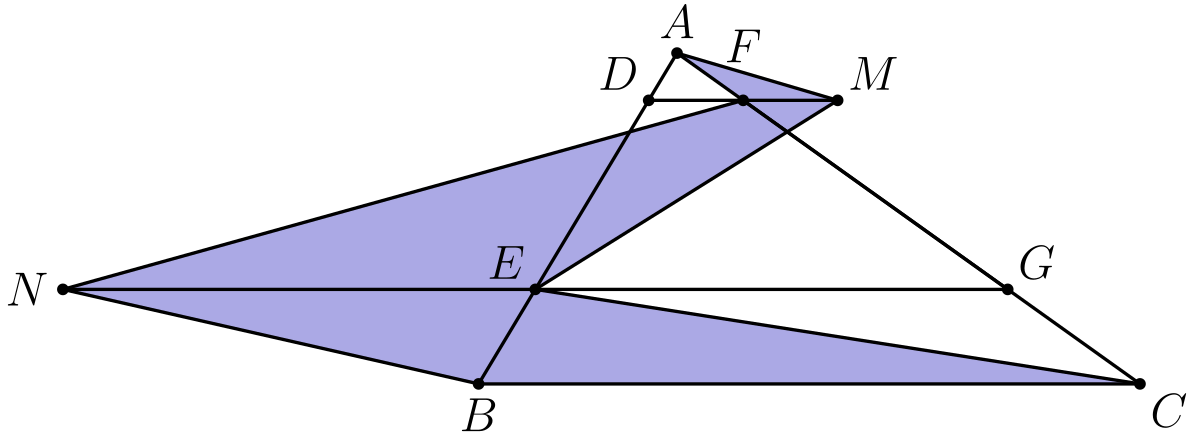
On $\triangle ABC$ points $A,$ $D,$ $E,$ and $B$ lie in that order on side $\overline{AB}$ with $AD = 4,$ $DE = 16,$ and $EB = 8.$ Points $A,$ $F,$ $G,$ and $C$ lie in that order on side $\overline{AC}$ with $AF = 13,$ $FG = 52,$ and $GC = 26.$ Let $M$ be the reflection of $D$ through $F,$ and let $N$ be the reflection of $G$ through $E.$ Quadrilateral $DEGF$ has area $288.$ Find the area of heptagon $AFNBCEM.$
The $9$ members of a baseball team went to an ice-cream parlor after their game. Each player had a single scoop cone of chocolate, vanilla, or strawberry ice cream. At least one player chose each flavor, and the number of players who chose chocolate was greater than the number of players who chose vanilla, which was greater than the number of players who chose strawberry. Let $N$ be the number of different assignments of flavors to players that meet these conditions. Find the remainder when $N$ is divided by $1000.$
There are $8! = 40320$ eight-digit positive integers that use each of the digits $1,$ $2,$ $3,$ $4,$ $5,$ $6,$ $7,$ $8$ exactly once. Let $N$ be the number of these integers that are divisible by $22.$ Find the difference between $N$ and $2025.$