Let $\alpha$ be the radian measure of the smallest angle in a $3$-$4$-$5$ right triangle. Let $\beta$ be the radian measure of the smallest angle in a $7$-$24$-$25$ right triangle. In terms of $\alpha$, what is $\beta$?
(A) $\frac{\alpha}{3}$ (B) $\alpha - \frac{\pi}{8}$ (C) $\frac{\pi}{2} - 2\alpha$ (D) $\frac{\alpha}{2}$ (E) $\pi - 4\alpha$
There are exactly $K$ positive integers $b$ with $5 \le b \le 2024$ such that the base-$b$ integer $2024_b$ is divisible by 16 (where 16 is in base ten). What is the sum of the digits of $K$?
(A) 16 (B) 17 (C) 18 (D) 20 (E) 21
Let $x_n = \sin^2(n°)$. What is the mean of $x_1, x_2, x_3, \dots, x_{90}$?
(A) $\frac{11}{45}$ (B) $\frac{22}{45}$ (C) $\frac{89}{180}$ (D) $\frac{1}{2}$ (E) $\frac{91}{180}$
Suppose $z$ is a complex number with positive imaginary part, with real part greater than $1$, and with $|z| = 2$. In the complex plane, the four values $0$, $z$, $z^2$, and $z^3$ are the vertices of a quadrilateral with area $15$. What is the imaginary part of $z$?
(A) $\frac{3}{4}$ (B) $1$ (C) $\frac{4}{3}$ (D) $\frac{3}{2}$ (E) $\frac{5}{3}$
The graph of $y = e^{x+1} + e^{-x} - 2$ has an axis of symmetry. What is the reflection of the point $(-1, \frac{1}{2})$ over this axis?
(A) $(-1, -\frac{3}{2})$ (B) $(-1, 0)$ (C) $(-1, \frac{1}{2})$ (D) $(0, \frac{1}{2})$ (E) $(3, \frac{1}{2})$
There are real numbers $x$, $y$, $h$, and $k$ that satisfy the system of equations
$$
\begin{aligned}
x^2 + y^2 - 6x - 8y &= h \\
x^2 + y^2 - 10x + 4y &= k.
\end{aligned}
$$
What is the minimum possible value of $h + k$?
(A) -54 (B) -46 (C) -34 (D) -16 (E) 16
A triangle in the coordinate plane has vertices $A(\log_2 1, \log_2 2)$, $B(\log_2 3, \log_2 4)$, and $C(\log_2 7, \log_2 8)$. What is the area of $\triangle ABC$?
(A) $\log_2 \frac{\sqrt{3}}{7}$ (B) $\log_2 \frac{3}{\sqrt{7}}$ (C) $\log_2 \frac{7}{\sqrt{3}}$ (D) $\log_2 \frac{11}{\sqrt{7}}$ (E) $\log_2 \frac{11}{\sqrt{3}}$
A set of 12 tokens—3 red, 2 white, 1 blue, and 6 black—is to be distributed at random to 3 game players, 4 tokens per player. The probability that some player gets all the red tokens, another player gets all the white tokens, and the remaining player gets the blue token can be written as $\frac{m}{n}$, where $m$ and $n$ are relatively prime positive integers. What is $m + n$?
(A) 387 (B) 388 (C) 389 (D) 390 (E) 391
Integers $a$ and $b$ are randomly chosen without replacement from the set of integers with absolute value not exceeding $10$. What is the probability that the polynomial $x^3 + a x^2 + b x + 6$ has $3$ distinct integer roots?
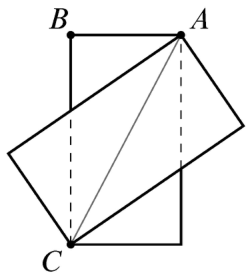
On top of a rectangular card with sides of length $1$ and $2 + \sqrt{3}$, an identical card is placed so that two of their diagonals line up, as shown ($AC$, in this case).
Continue the process, adding a third card to the second, and so on, lining up successive diagonals after rotating clockwise. In total, how many cards must be used until a vertex of a new card lands exactly on the vertex labeled $B$ in the figure?
(A) 6 (B) 8 (C) 10 (D) 12 (E) No new vertex will land on $B$.
Cyclic quadrilateral $ABCD$ has lengths $BC = CD = 3$ and $DA = 5$ with $\angle CDA = 120^\circ$. What is the length of the shorter diagonal of $ABCD$?
(A) $\frac{31}{7}$ (B) $\frac{33}{7}$ (C) 5 (D) $\frac{39}{7}$ (E) $\frac{41}{7}$
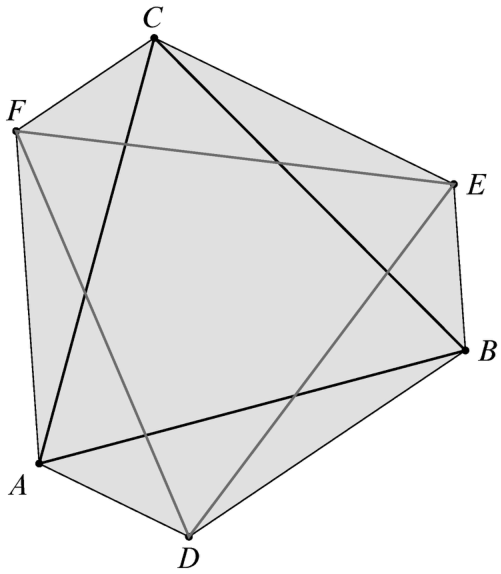
Equilateral $\triangle ABC$ with side length $14$ is rotated about its center by angle $\theta$, where $0 \lt \theta \le 60^\circ$, to form $\triangle DEF$. See the figure. The area of hexagon $ADBECF$ is $91\sqrt{3}$. What is $\tan \theta$?
(A) $\frac{3}{5}$
(B) $\frac{5\sqrt{3}}{11}$
(C) $\frac{4}{5}$
(D) $\frac{11}{13}$
(E) $\frac{7\sqrt{3}}{13}$
Points $P$ and $Q$ are chosen uniformly and independently at random on sides $\overline{AB}$ and $\overline{AC}$, respectively, of equilateral triangle $\triangle ABC$. Which of the following intervals contains the probability that the area of $\triangle APQ$ is less than half the area of $\triangle ABC$?
Suppose $A$, $B$, and $C$ are points in the plane with $AB = 40$ and $AC = 42$, and let $x$ be the length of the line segment from $A$ to the midpoint of $BC$. Define a function $f$ by letting $f(x)$ be the area of $\triangle ABC$. Then the domain of $f$ is an open interval $(p, q)$, and the maximum value $r$ of $f(x)$ occurs at $x = s$. What is $p + q + r + s$?
Suppose that $a_1 = 2$ and the sequence $(a_n)$ satisfies the recurrence relation
$$
\frac{a_n - 1}{n - 1} = \frac{a_{n-1} + 1}{(n-1) + 1}
$$
for all $n \ge 2$. What is the greatest integer less than or equal to
$$
\sum_{n=1}^{100} a_n^2?
$$
The measures of the smallest angles of three different right triangles sum to $90^\circ$. All three triangles have side lengths that are primitive Pythagorean triples. Two of them are $3$-$4$-$5$ and $5$-$12$-$13$. What is the perimeter of the third triangle?
(A) $40$
(B) $126$
(C) $154$
(D) $176$
(E) $208$