In a two-dimensional cave with a parallel floor and ceiling, two stalactites of lengths $16$ and $36$ hang perpendicularly from the ceiling, while two stalagmites of heights $25$ and $49$ grow perpendicularly from the ground. If the tips of these four structures form the vertices of a square in some order, compute the height of the cave.
A polyomino is a connected figure constructed by joining one or more unit squares edge-to-edge. Determine, with proof, the number of non-congruent polyominoes with no holes, perimeter $180$, and area $2024$.
Given that $x$, $y$, and $z$ are positive real numbers such that
$$x^{\log_{2}(yz)} = 2^{8} \cdot 3^{4}, \quad y^{\log_{2}(zx)} = 2^{9} \cdot 3^{6}, \quad \text{and} \quad z^{\log_{2}(xy)} = 2^{5} \cdot 3^{10},$$
compute the smallest possible value of $xyz$.
Point $P$ lies inside square $ABCD$ such that the areas of $\triangle PAB$, $\triangle PBC$, $\triangle PCD$, and $\triangle PDA$ are $1$, $2$, $3$, and $4$, in some order. Compute $PA \cdot PB \cdot PC \cdot PD$.
Let $\lfloor z\rfloor$ denote the greatest integer less than or equal to $z$. Compute
$$
\sum_{j = -1000}^{1000} \left\lfloor \frac{2025}{j + 0.5} \right\rfloor.
$$
Sophie is at $(0,0)$ on a coordinate grid and would like to get to $(3,3)$. If Sophie is at $(x,y)$, in a single step she can move to one of $(x + 1, y)$, $(x, y + 1)$, $(x - 1, y + 1)$, or $(x + 1, y - 1)$. She cannot revisit any points along her path, and neither her $x$-coordinate nor her $y$-coordinate can ever be less than $0$ or greater than $3$. Compute the number of ways for Sophie to reach $(3,3)$.
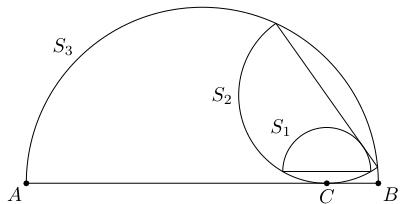
A semicircle is inscribed in another semicircle if the smaller semicircle's diameter is a chord of the larger semicircle, and the smaller semicircle's arc is tangent to the diameter of the larger semicircle.
Semicircle $S_{1}$ is inscribed in a semicircle $S_{2}$, which is inscribed in another semicircle $S_{3}$. The radii of $S_{1}$ and $S_{3}$ are $1$ and $10$, respectively, and the diameters of $S_{1}$ and $S_{3}$ are parallel. The endpoints of the diameter of $S_{3}$ are $A$ and $B$, and $S_{2}$'s arc is tangent to $AB$ at $C$. Compute $AC \cdot CB$.
Jerry places at most one rook in each cell of a $2025 \times 2025$ grid of cells. A rook attacks another rook if the two rooks are in the same row or column and there are no other rooks between them.
Determine, with proof, the maximum number of rooks Jerry can place on the grid such that no rook attacks 4 other rooks.
Let $\triangle ABC$ be an equilateral triangle with side length $6$. Let $P$ be a point inside triangle $\triangle ABC$ such that $\angle BPC = 120^\circ$. The circle with diameter $\overline{AP}$ meets the circumcircle of $\triangle ABC$ again at $X \neq A$. Given that $AX = 5$, compute $XP$.
Let $\mathcal{S}$ be the set of all nonconstant monic polynomials $P$ with integer coefficients satisfying $P\left(\sqrt{3} + \sqrt{2}\right) = P\left(\sqrt{3} - \sqrt{2}\right)$. If $Q$ is an element of $\mathcal{S}$ with minimal degree, compute the only possible value of $Q(10) - Q(0)$.
In an $11 \times 11$ grid of cells, each pair of edge-adjacent cells is connected by a door. Karthik wants to walk a path in this grid. He can start in any cell, but he must end in the same cell he started in, and he cannot go through any door more than once (not even in opposite directions). Compute the maximum number of doors he can go through in such a path.
Find all functions $f: \mathbb{Z}^+ \to \mathbb{Z}^+$, where $\mathbb{Z}^+$ is the set of all positive integers, such that for any positive integers $m, n$, $f^{f(m)}(n) + n = f^m(n) + f(n)$. Here powers of the function denote iteration.
For any 4-digit positive integer $n$, define $f(n) = (a+b)^2$, where $a, b$ are the numbers formed by the first two and last two digits of $n$, respectively (leading zeroes are allowed). Find all 4-digit positive integers $n$ such that $f(n) = n$.
Let *A*, *B*, *C*, *D* be the 4 squares in the centre of a $4 \times 4$ grid of squares. These 4 squares form the centre of the grid. A frog can jump from one of the 4 squares in the centre to any square in the grid which shares a side. If the frog jumps out of the centre from a particular square for the first time, that square is called an exit square. Find the number of ways in which the frog can start from *A* with *A* being the exit square in $n$ jumps. Give your answer in terms of $n$.
Let $a_1, a_2, \dots, a_n$ be positive numbers and $A$ their arithmetic mean. Prove that
$$
A^{n-1} \geq \frac{1}{n} \sum_{i=1}^{n} a_1 \cdots \hat{a}_i \cdots a_n, \quad \text{where } \hat{a}_i \text{ denotes the term } a_i \text{ is omitted.}
$$
Find the smallest positive integer $n$, or show no such $n$ exists, such that one can find infinitely many distinct $n$-tuplets of positive rationals $(a_1, a_2, \dots, a_n)$ satisfying:
$$
\sum_{i=1}^{n} a_i \in \mathbb{Z}, \quad \sum_{i=1}^{n} \frac{1}{a_i} \in \mathbb{Z}.
$$